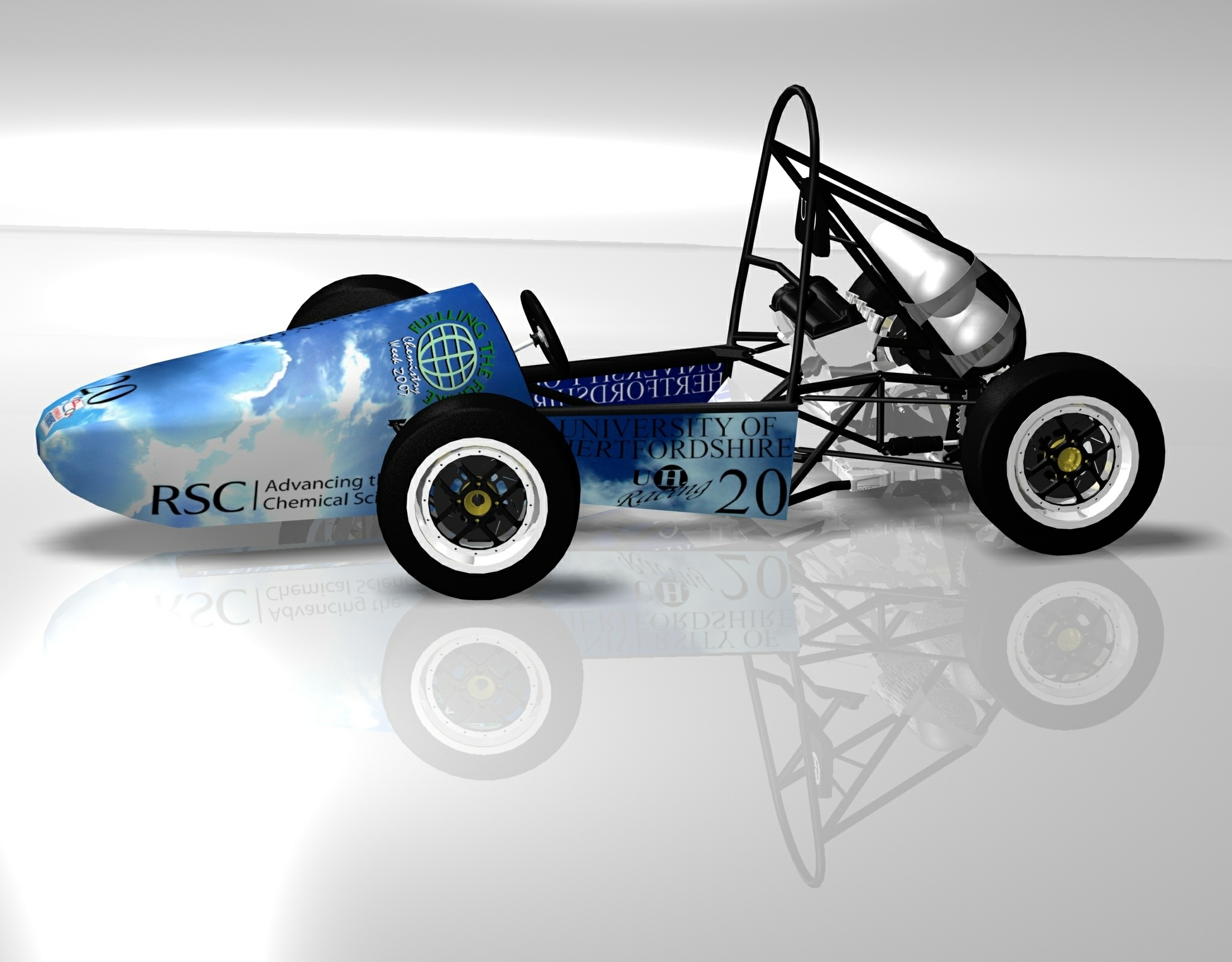
Engineers at the University of Hertfordshire have developed the first hydrogen-powered racing car which they will race this weekend.

A £5,000 grant from the Royal Society of Chemistry has made it possible for John Goddard and James Waters, two PhD students in the University’s new Sustainable Energy Technologies Centre to convert a Formula Student racing car into a hydrogen-powered vehicle.

This is the first time that a hydrogen-powered racing car has been developed anywhere in the world.

Opinions people have about innovations are influenced by the context in which they form their opinion. For example, opinions about a novel energy source like biomass are influenced by thoughts regarding other energy sources.

The less knowledge, interest or time people have, the stronger this effect. Sustainable energy options must therefore be promoted in the right context says Dutch researcher Wouter van den Hoogen.

People frequently form opinions about new technologies, such as novel energy options, despite having a very limited knowledge of the subject concerned. The subject is often complex and people are either not particularly interested or have limited time.

Researchers across the world have been trying to answer the question of how RNAi works for many years. A research group headed by Prof. Renée Schroeder (MFPL) and Dr. Javier Martinez (IMBA) based at the Campus Vienna Biocenter says they have come closer to finding an answer.

RNA interference (RNAi) is a natural cellular defence and regulation mechanism which works by eliminating unwanted RNA molecules. Its potential for use in therapy was officially recognised last year with the presentation of the Nobel Prize in Physiology or Medicine. The first treatments to be based on this mechanism are currently undergoing clinical testing.

On Saturday, 07/07/07, the New 7 Wonders of the World were announced. The announcement got me thinking about other everyday “wonders” that I rely on, and am in constant appreciation of, as a mom. Those little things that have become so ingrained in my everyday routine, that I barely notice them anymore – but that would make my day so much more difficult if I didn’t have. These are the items that make my job as a mom… heck, I’ll just say it – Wonder-ful!

First let's take a look at the Newest 7 Wonders of the World. They were selected by a global poll, where 100 million votes were cast via the Internet and cell-phone text messages.

Elizabeth Rode, Paul Rozin, and Paula Durlach measured the remembered pleasure for meals. It didn’t matter how long the meal lasted. They called this “duration neglect.” To quote the article:

The existence of duration neglect implies that, with respect to memories of a meal, small portions of a highly favored dish will have roughly the same memorial effect as large portions.

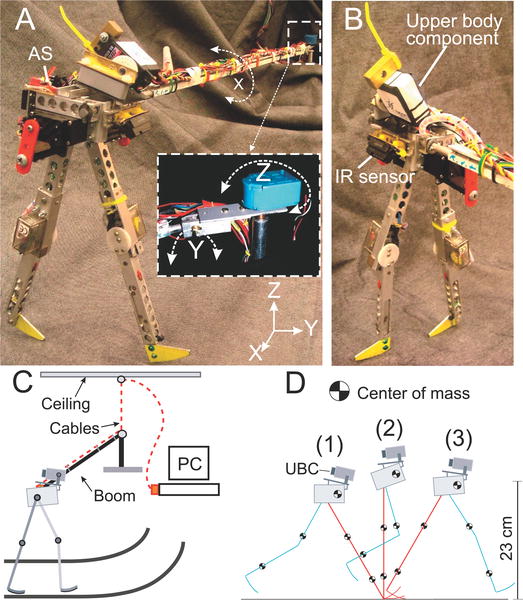
Our bodies, and the biological brilliance built in, are able to move with elegance and efficiency using a combination of appropriate biomechanics, neuronal control, and adaptivity.

Simulating that with technology has so far eluded technological advances because of the motor coordination of complex multi-joint movements and the complicated nature of their dynamics.

Yet now scientists at the University of Göttingen have simulated the neuronal principles that form the dynamics of human walking in a robot.

"RunBot", as it is called, lives up to its name – it holds the world record in speed walking for dynamic machines. Now its inventors have expanded its repertoire. With an infrared eye it can detect a slope on its path and adjust its gait on the spot.

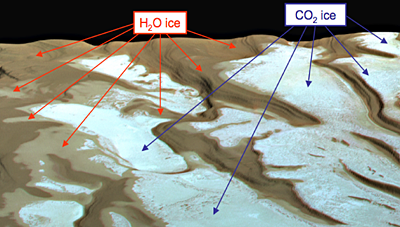
Scientists say that using data from the Mars Express mission and numerical models they can determine how the orbit of Mars around the Sun accounts for the origin and perennial occurrence of water ice at the Martian South Pole.

The OMEGA instrument on board Mars Express had already found previously undetected perennial deposits of water-ice sitting on top of million-year old layered terrains and those provided strong evidence for recent glacial activity.


The OMEGA instrument on board ESA’s Mars Express has characterised the types of ice deposits present in the South polar cap of Mars as the arrows, superimposed on an image taken by the HRSC instrument, indica

A unique set of observations, obtained with ESO's VLT, has allowed astronomers to find direct evidence for the material that surrounded a star before it exploded as a Type Ia supernova. This strongly supports the scenario in which the explosion occurred in a system where a white dwarf is fed by a red giant.

Because Type Ia supernovae are extremely luminous and quite similar to one another, these exploding events have been used extensively as cosmological reference beacons to trace the expansion of the Universe.


Left: artist's impression of the favoured configuration for the progenitor system of SN2006X before the explosion.

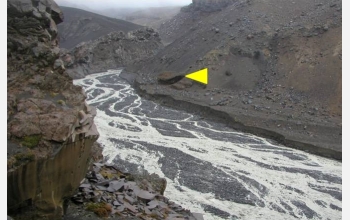
Volcanologist Sarah Fagents from the University of Hawaii at Manoa had an amazing opportunity to study volcanic hazards first hand, when a volcanic mudflow broke through the banks of a volcanic lake at Mount Ruapehu in New Zealand.

Fagents and colleagues were there on a National Science Foundation (NSF)-funded project to study the long-forecast Crater Lake break-out lahar at Mount Ruapehu.

A research team headed by Yadong Yin at the University of California, Riverside has created a liquid that changes its color “on demand” and can take on any color of the rainbow.

Nanoscopic particles made of tiny magnetic crystals coated with a plastic shell self-assemble in solution to form photonic crystals—semiconductors for light. When a magnetic field is applied, the optical properties of the crystals change, allowing their color to be very precisely adjusted through variation of the strength of the field.

The crystals involved are not “conventional” lattices of ions or molecules like the ones for salt. They are colloidal crystals, periodic structures that form from uniform solid particles that are finely dispersed in a liquid.