




When radiation suddenly contaminates the land your family has farmed and lived on for generations, you might not expect soil to protect crops and human health - that is like expecting the mugging victim to track down the criminal - but that is what happens.

On March 11th, 2011, twin perils of a magnitude 9.0 earthquake and tsunami caused widespread destruction in Japan, including peril at the Fukushima Daiichi nuclear power plant. The plant released radioactivity into the environment and the Japanese government evacuated over 100,000 people in the 30 kilometer zone around the plant.


Both vegetarians and elite environmental activists have long considered meat as a vital food to cut if we are to reduce global emissions. For poor people, elites in developed nations believe beans would be a good substitute. While their 'it takes a gallon of gas to make a pound of beef' metric has long been debunked, they are not wrong for believing that livestock leads to emissions that would not be evident if we did not want the world's poorest to be equal to the rich when it comes to nutrition.
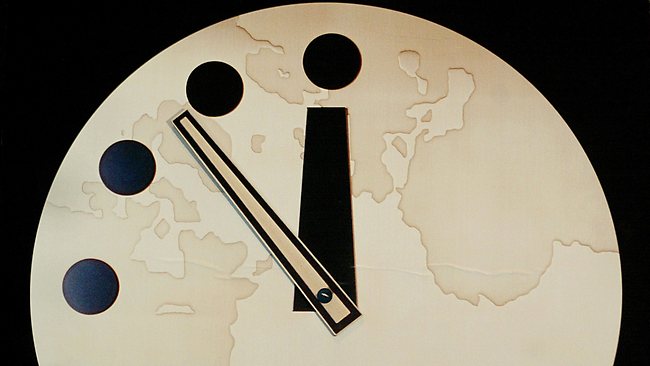
Cyber warfare, killer robots, biological pandemics due to mad scientists, the Bulletin of the Atomic Scientists has grown since the old days of just figuring out how to kill nuclear power.
The Nobel Prize-winning Higgs boson – the “God particle” - believed to be vital for understanding all of the mass in the universe, was found in 2012 at CERN’s Large Hadron Collider, but that's not where the search began.

Instead, the first hint of the boson was inspired by studies of superconductors – a special class of metals that, when cooled to very low temperatures, allow electrons to move without resistance. The discovery of the Higgs boson verified the Standard Model, which predicted that particles gain mass by passing through a field that slows down their movement through the vacuum of space. Now a team of physicists has brought that work full circle, by reporting the first-ever observations of the Higgs mode in superconducting materials. 

Do you ever have trouble telling right from left? For example, you’re taking a driving lesson and the instructor asks you to take a left turn and you pause, struggling to think of which way is left.

If so, you’re not on your own – a significant proportion of our population has difficulty in telling right from left.

Mention the terms “intellectual giftedness” and “learning disability” and there is a general understanding of what each term means. However, most people are unaware that in many circumstances the two can go hand in hand.

Current US research suggests that 14% of children who are identified as being intellectually gifted may also have a learning disability. This is compared to about 4% of children in the general population. No-one has been able to explain this discrepancy.

For people taking glucocorticoids such as prednisone, the increased risk of bone fracture is a well-documented side effect. Used to treat a variety of medical conditions, including autoimmune diseases and allergies, glucocorticoids are known to cause rapid deterioration in bone strength.

Until now, doctors have been able to measure bone loss -- a process that happens slowly, over time -- but haven't had the means for gauging actual bone strength. That has changed thanks to a new hand-held instrument developed in the Hansma Lab at UC Santa Barbara. Called the OsteoProbe, the device uses reference point indentation (RPI) to measure mechanical properties of bone at the tissue level.

While many recent studies have documented that agricultural producers must significantly increase yields in order to meet the food, feed, and fuel demands of a growing population, few have given practical solutions on how to do this. Crop science researchers at the University of Illinois interested in determining and reducing corn yield gaps are addressing this important issue by taking a systematic approach to the problem.

Two-year data show a continued survival advantage for self-expanding transcatheter aortic valve replacement (TAVR) over standard surgery in high-risk patients with severe aortic stenosis, according to research presented at the American College of Cardiology's 64th Annual Scientific Session.

Aortic stenosis--a problem that occurs when the valve in the heart's main artery doesn't open fully--forces the heart to work harder to pump blood and is life-threatening over time. Valve replacement is common when this condition becomes severe, but the health profile of many patients makes standard surgical valve replacement especially risky.

A pair of air pollutants linked to climate change could also be a major contributor to the unparalleled rise in the number of people sneezing, sniffling and wheezing during allergy season. The gases, nitrogen dioxide and ground-level ozone, appear to provoke chemical changes in certain airborne allergens that could increase their potency. That, in combination with changes in global climate, could help explain why airborne allergies are becoming more common.

The findings will be presented today at the 249th National Meeting & Exposition of the American Chemical Society (ACS), the world's largest scientific society. The meeting features nearly 11,000 reports on new advances in science and other topics. It is being held here through Thursday.

