Banner
Social Media Is A Faster Source For Unemployment Data Than Government

Government unemployment data today are what Nielsen TV ratings were decades ago - a flawed metric...

Gestational Diabetes Up 36% In The Last Decade - But Black Women Are Healthiest

Gestational diabetes, a form of glucose intolerance during pregnancy, occurs primarily in women...

Object-Based Processing: Numbers Confuse How We Perceive Spaces

Researchers recently studied the relationship between numerical information in our vision, and...

Males Are Genetically Wired To Beg Females For Food

Bees have the reputation of being incredibly organized and spending their days making sure our...

User picture.
News StaffRSS Feed of this column.

News Releases From All Over The World, Right To You... Read More »

Blogroll

A team of researchers, led by surgeons at the Kimmel Cancer Center at Jefferson in Philadelphia, has found further evidence supporting the ability of a protein to predict how well a patient with advanced pancreatic cancer will do after surgery, chemotherapy and radiation. The levels of the protein CA 19-9 in the blood can be used to determine the need for further therapy, they say.

Adam Berger, M.D., assistant professor of surgery at Jefferson Medical College of Thomas Jefferson University, and his co-workers examined CA 19-9 levels and the survival of 385 patients with advanced pancreatic cancer who were treated with surgery and subsequent chemotherapy and radiation.

Just a few years ago, the average computer user’s documents, applications and even photos seemed to rattle around a 120 GB disk drive. Today’s multimedia-intensive user can exhaust that capacity in no time and engineers expect to max out conventional magnetic storage techniques by about 2010.

At that point, they’ll be looking for nanotechnology to step up.

A magnetic storage surface – the disk of a hard-disk drive -- consists of tiny sectors of magneti-cally-aligned particles. When the read-write head of a disk drive passes over a sector, it flips the magnetic field to the opposite direction – encoding a zero or a one. When it reads, it senses the magnetic field for the whole sector.

Why does putting our feelings into words — talking with a therapist or friend, writing in a journal — help us to feel better? A new brain imaging study by UCLA psychologists reveals why verbalizing our feelings makes our sadness, anger and pain less intense.

From the viewpoint of biology, learning and education can be defined as the processes of forming neuronal connections in response to external environmental stimuli, and of controlling or adding appropriate stimuli, respectively.

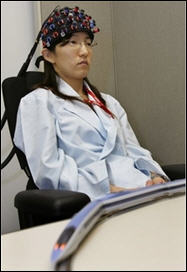
Computers can't do that but researchers in Japan have shown how they can control electronic devices simply by reading brain activity.

The "brain-machine" developed by Hitachi Inc. recently analyzed changes in the Akiko Obata's blood flow and translated those into electric signals which linked to a mapping device that controlled a toy train.


Akiko Obata wears the brain machine and controls a model train in Hatoyama, Japan

Nanobiotechnology holds a lot of promise and people have often speculated how it will impact the world of medicine. Unfortunately promising nanostructured systems so far have turned out to be extremely toxic to humans.

Now a group of researchers at the University of Michigan Nanotechnology Institute for Medicine and Biological Sciences have devised a multifunctional nanoparticle platform comprising nanoparticles synthesized within dendrimers equipped with targeting molecules and dyes. These dendrimer nanoparticle systems are able to seek out and specifically bind to cancer cells.

Buckyballs, or fullerenes, are nanoparticles containing 60 carbon atoms.