Banner
Social Media Is A Faster Source For Unemployment Data Than Government

Government unemployment data today are what Nielsen TV ratings were decades ago - a flawed metric...

Gestational Diabetes Up 36% In The Last Decade - But Black Women Are Healthiest

Gestational diabetes, a form of glucose intolerance during pregnancy, occurs primarily in women...

Object-Based Processing: Numbers Confuse How We Perceive Spaces

Researchers recently studied the relationship between numerical information in our vision, and...

Males Are Genetically Wired To Beg Females For Food

Bees have the reputation of being incredibly organized and spending their days making sure our...

User picture.
News StaffRSS Feed of this column.

News Releases From All Over The World, Right To You... Read More »

Blogroll

If the Listeria monocytogenes bacteria behind food poisoning are starved of oxygen, they are liable to turn really nasty according to research published today. Limiting oxygen produces bacteria up to 100 times more invasive than similar bacteria grown with ample oxygen supplies.

Bjarke Christensen and Tine Licht together with colleagues from Denmark’s National Food Institute set out to investigate whether the growth conditions of Listeria bacteria just prior to being eaten had an effect on their virulence once absorbed by the gut. Guinea pigs were fed food laced with L. monocytogenes, grown either in an oxygen-rich atmosphere, or starved of oxygen. The team used fluorescent labelling to tell the bacteria strains apart.

A major cause of human and animal infections, Staphylococcus aureus bacteria may evade the immune system’s defences and dodge antibiotics by climbing into our cells and then lying low to avoid detection. New research shows how S. aureus makes itself at home in human lung cells for up to two weeks.

A team of 12 researchers from University Hospital of Geneva, Switzerland and the Institute of Food Research, Norwich, UK set out to uncover what S. aureus (6850) did inside human lung epithelial cells (A549) using an in vitro model.

The innate immune response is the body's first line of defense against pathogen infection. Dr. Xin Li (University of British Columbia) and colleagues report that three proteins work together in the MOS4-associated complex (MAC) to execute innate immunity in the mustard weed, Arabidopsis.

Dr. Li and colleagues study a plant autoimmune model in which a mutation in one immune receptor, SNC1, causes constitutive activation of the plant's immune response. Dr. Li's group found that 3 key downstream effectors of the SNC1 pathway -- MOS4, AtCDC5 and PRL1 -- are homologous to components of the human spliceosome-associated nineteen complex (NTC). The researchers speculate that the evolutionarily conserved NTC may also play a role in animal innate immunity.

Researchers at the University of Edinburgh have shown that hormone therapy can extend life in ovarian cancer patients, giving women a new alternative to chemotherapy.

The study has proved for the first time that the targeted use of an anti-oestrogen drug could prolong the life of some patients by up to three years, and delay the use of chemotherapy in others.

Yes, you secretly like giving your money to the government. University of Oregon scientists have found that doing things like donating money to charity or even paying your taxes can give you the same sort of satisfaction you derive from feeding your own hunger pangs.

A cognitive psychologist and two economists gave 19 female participants $100 and then scanned their brains with functional magnetic resonance imaging (fMRI) as they watched their money go to the food bank through mandatory taxation, and as they made choices about whether to give more money voluntarily or keep it for themselves.

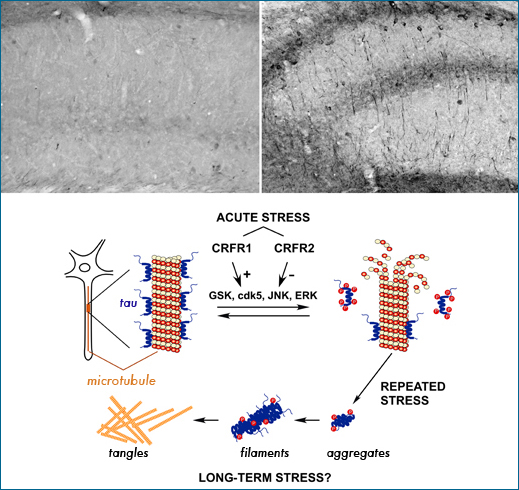
Subjecting mice to repeated emotional stress, the kind we experience in everyday life, may contribute to the accumulation of neurofibrillary tangles, one of the hallmarks of Alzheimer’s disease, report researchers at the Salk Institute for Biological Studies. While aging is still the greatest risk factor for Alzheimer’s disease, a number of studies have pointed to stress as a contributing factor.


Top left: In unstressed animals the hippocampus, which is involved in the formation of memories and learning, is free of phosphorylated tau.