Banner
Object-Based Processing: Numbers Confuse How We Perceive Spaces

Researchers recently studied the relationship between numerical information in our vision, and...

Males Are Genetically Wired To Beg Females For Food

Bees have the reputation of being incredibly organized and spending their days making sure our...

The Scorched Cherry Twig And Other Christmas Miracles Get A Science Look

Bleeding hosts and stigmatizations are the best-known medieval miracles but less known ones, like ...

$0.50 Pantoprazole For Stomach Bleeding In ICU Patients Could Save Families Thousands Of Dollars

The inexpensive medication pantoprazole prevents potentially serious stomach bleeding in critically...

User picture.
News StaffRSS Feed of this column.

News Releases From All Over The World, Right To You... Read More »

Blogroll

As NASA develops its next "flagship" mission to the outer solar system, Jupiter's enigmatic moon Europa should be the target, says Arizona State University professor Ronald Greeley. Although Europa lies five times farther from the Sun than Earth, he notes it may offer a home for life.

Greeley, a Regents' Professor, heads the Planetary Geology Group in ASU's School of Earth and Space Exploration. He is presenting the Europa proposal today (Feb. 18) at the annual meeting of the American Association for the Advancement of Science in San Francisco.

"Europa is unique in our solar system," says Greeley. "It's a rocky object a little smaller than our Moon, and it's covered with a layer of water 100 miles deep." This holds more water than all the oceans on Earth, he explains.

The American Association for the Advancement of Science (AAAS) today released a new video as well as the first consensus statement of its board of directors regarding global climate change during a free public town hall meeting in San Francisco, California.

The town hall meeting, part of the 2007 AAAS Annual Meeting, was organized by AAAS in collaboration with three leading U.S. education organizations -- the California Science Teachers Association, the National Science Teachers Association, and the United Educators of San Francisco (representing the National Education Association and the American Federation of Teachers).

In almost all forms of heart failure, the heart begins to express genes that are normally only expressed in the fetal heart. Researchers have known for years that this fetal-gene reactivation happens, yet not what regulates it. Now, investigators at the University of Pennsylvania School of Medicine have discovered that an enzyme important in fetal heart-cell development regulates the enlargement of heart cells, known as cardiac hypertrophy, which is a precursor to many forms of congestive heart failure (CHF).

The safest possible future for advancing nanotechnology in a sustainable world can be reached by using green chemistry, says James E. Hutchison, a professor of chemistry at the University of Oregon.

“Around the world, there is a growing urgency about nanotechnology and its possible health and environmental impacts,” Hutchison said in his talk Sunday during a workshop at the annual meeting of the American Association for the Advancement of Science. “There is a concern that these issues will hinder commercialization of this industry.”

Scientists need to take a proactive approach to advancing from the current discovery phase in the creation of nanomaterials into a production phase that is efficient and reduces waste, he said.

As climate change scientists develop ever more sophisticated climate models to project an expected path of temperature change, it is becoming increasingly important to include the effects of aerosols on clouds, according to Joyce E. Penner, a leading atmospheric scientist at the University of Michigan.

That's because aerosols, fine particles such as smoke and dust that form droplets in clouds and change cloud thickness, affect how much sun is able to pass through the cloud to Earth, as well as the amount of moisture that's returned to Earth. Both moisture and sunlight play significant roles in climate change.

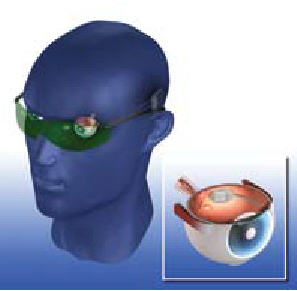
Patients who have gone blind are a step closer to perhaps one day regaining some of their sight.

Researchers at the USC Doheny Eye Institute announced today the next step in their efforts to advance technology that hopefully will help patients with retinitis pigmentosa and macular degeneration regain some vision using an implanted artificial retina.

The announcement by Mark Humayun, professor of ophthalmology at the Keck School of Medicine of USC and associate director of research at the Doheny Retina Institute, came at a press conference at the annual meeting of the American Association for the Advancement of Science in San Francisco.


Dr.