Banner
Social Media Is A Faster Source For Unemployment Data Than Government

Government unemployment data today are what Nielsen TV ratings were decades ago - a flawed metric...

Gestational Diabetes Up 36% In The Last Decade - But Black Women Are Healthiest

Gestational diabetes, a form of glucose intolerance during pregnancy, occurs primarily in women...

Object-Based Processing: Numbers Confuse How We Perceive Spaces

Researchers recently studied the relationship between numerical information in our vision, and...

Males Are Genetically Wired To Beg Females For Food

Bees have the reputation of being incredibly organized and spending their days making sure our...

User picture.
News StaffRSS Feed of this column.

News Releases From All Over The World, Right To You... Read More »

Blogroll

An international team of researchers has determined there was a "whiff" of oxygen in Earth's atmosphere about 2.5 billion years ago, the earliest time any significant amount of oxygen has been detected on Earth. Up to now, scholars believed oxygen levels on Earth were negligible before the "Great Oxidation Event" (GOE) about 2.3 to 2.4 billion years ago.

This latest discovery indicates there was at least a little oxygen in Earth's atmosphere 50 to 100 million years before the GOE. It also provides scholars with more information to help them solve the mystery of the origins of oxygen on Earth.

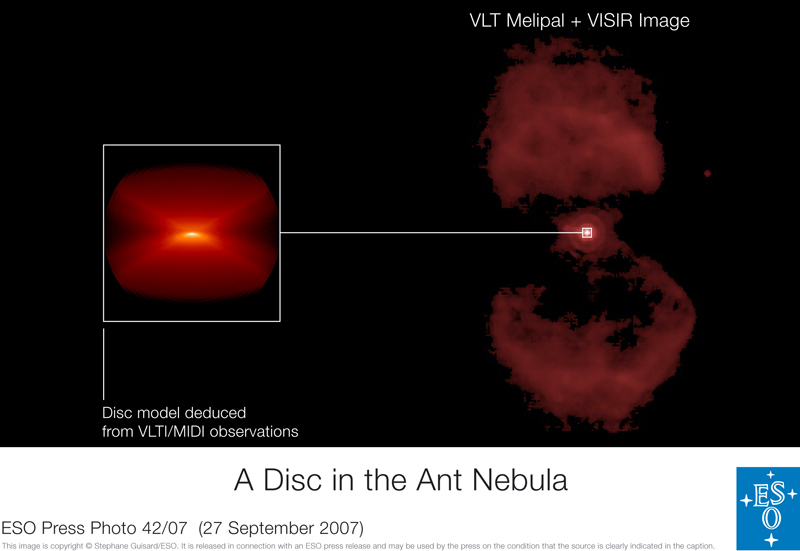
Using ESO's Very Large Telescope Interferometer and its unique ability to see small details, astronomers have uncovered a flat, nearly edge-on disc of silicates in the heart of the magnificent Ant Nebula. The disc seems, however, too 'skinny' to explain how the nebula got its intriguing ant-like shape.

The Ant Nebula is located about 5 000 light-years away. The central star is as bright as 10,000 Suns and has a temperature of 35, 000 degrees Celsius. It is the last phase before this solar-like star will become a white dwarf.

The Ant Nebula is one of the most striking planetary nebulae known.

The H5N1 strain of the bird flu virus can pass through the placenta of pregnant women to the unborn fetus, and can infect organs other than the lungs in adults.

Professor Jiang Gu, Peking University, Beijing, China and colleagues studied post-mortem tissues of two adults – one man and one pregnant woman, and also tested the dead fetus of the dead woman. They investigated how H5N1 – an emerging infectious disease which causes respiratory symptoms and a high fatality rate – affects different organs in the body.

Rheumatoid arthritis is a very common chronic illness that affects around 1% of people in developed countries. It is caused by an abnormal immune reaction to various tissues within the body. As well as affecting joints and causing an inflammatory arthritis, it can also affect many other organs of the body.

A paper published this week in the open access journal PLoS Medicine provides strong evidence that one specific part of the genome is associated with rheumatoid arthritis.

Rene Toes and colleagues from Leiden University Medical Center, the Karolinska Institute, and Celera studied four groups of patients and matched controls.

Cell phones are increasingly sophisticated -- sporting such features as cameras, music players, games, video clips, Internet access and, lest we forget, the capability to phone someone -- but these features come at a price: memory.

Now computer engineers at Northwestern University and NEC Laboratories America, Inc. are the first to do what many thought impossible -- they have developed technology that doubles the usable memory on cell phones and other embedded systems without any changes to hardware or applications.

NASA's Dawn spacecraft is on its way to study a pair of asteroids after lifting off Thursday from the Cape Canaveral Air Force Station at 7:34 a.m. EDT.

Mission controllers at NASA's Jet Propulsion Laboratory (JPL), Pasadena, Calif., received telemetry on schedule at 9:44 a.m. indicating Dawn had achieved proper orientation in space and its massive solar array was generating power from the sun.

"Dawn has risen, and the spacecraft is healthy," said the mission's project manager Keyur Patel of JPL.