Banner
Social Media Is A Faster Source For Unemployment Data Than Government

Government unemployment data today are what Nielsen TV ratings were decades ago - a flawed metric...

Gestational Diabetes Up 36% In The Last Decade - But Black Women Are Healthiest

Gestational diabetes, a form of glucose intolerance during pregnancy, occurs primarily in women...

Object-Based Processing: Numbers Confuse How We Perceive Spaces

Researchers recently studied the relationship between numerical information in our vision, and...

Males Are Genetically Wired To Beg Females For Food

Bees have the reputation of being incredibly organized and spending their days making sure our...

User picture.
News StaffRSS Feed of this column.

News Releases From All Over The World, Right To You... Read More »

Blogroll

Researchers say they have found a key biochemical cycle that suppresses the immune response, thereby allowing cancer cells to multiply unabated. The research shows how the biomolecules responsible for healthy T-cells, the body’s first defenders against hostile invaders, are quashed, permitting the invading cancer to spread. The same cycle could also be involved in autoimmune diseases such as multiple sclerosis.

The scientists used special molecular “nanosensors” for the work.

“We used a technique called fluorescence resonance energy transfer, or FRET, to monitor the levels of, tryptophan, one of the essential amino acids human cells need for viability,” explained lead author and Carnegie Institution Department of Plant Biology scientist Thijs Kaper.

Do you like The Beatles but only certain kinds of their songs? What if you want music to go jogging but you don't know the names of artists you might like for that?

UC San Diego researchers are working on a music search engine that lets you use natural language to find what you want.

In a new paper, the researchers demonstrate that an online music game they created provides crucial data for building the back-end of a music search engine that allows users to type in words in order to find songs.

“When my mom gets up in the morning and is like, ‘I need some energy to go jogging,’ she has no clue what title or artist is going to help her with that,” said Gert Lanckriet, the UCSD electrical engineering professor overseeing the project.

Although anorexia nervosa is categorized as an eating disorder, it is not known whether there are alterations of the portions of the brain that regulate appetite.

Now, a new study finds that women with anorexia have distinct differences in the insulta – the specific part of the brain that is important for recognizing taste – according to a new study by University of Pittsburgh and University of California, San Diego researchers.

The study also implies that there may be differences in the processing of information related to self-awareness in recovering anorexics compared to those without the illness – findings that may lead to a better understanding of the cause of this serious and sometimes fatal mental disorder.

Understanding whether inbreeding accounts for early mortality is a long-standing concern in demographic research. Analyzing Bedouin villages in Bekaa, Lebanon, in which the marriage rate among first cousins is more than twice the national average, a new study finds that the greatest single determinant of infant mortality is not closely related parents – though this does present a significant risk – but short birth intervals.

The Bekka Bedouin are Sunni Muslims.

For more than a decade, University of Georgia researcher Steve Stice has focused on using embryonic stem cells to improve the lives of people with degenerative diseases and debilitating injuries. His most recent discovery, which produces billions of neural cells from a few stem cells, could now aid in national security.

“It's like a canary-in-a-coal-mine scenario,” said Stice, animal science professor and Georgia Research Alliance eminent scholar.

In collaboration with the U.S. Naval Research Laboratory, Stice hopes to use his recently developed neural cell kits to detect chemical threats.
“They have a device that looks like a small tool box that contains neural cells and can detect changes in their electrical activity,” Stice said.

Stars in galaxies are similar to people: during the first phase of their existence they grow rapidly but they slow later, and we can see it, says Dutch astronomer Mariska Kriek with the Gemini Telescope on Hawaii and the Very Large Telescope (VLT) in Chile.

Her research shows that a part of the heavy galaxies stopped forming stars when the universe was still a toddler, about 3 billion years old. Astronomers suspect that black holes exert an influence on this halt in births.

So how does that happen and why are fewer stars being born?


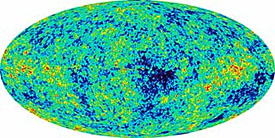
This "baby picture" of the universe shows small changes in temperature from more than 13 billion years ago. That's not long after the big bang would have taken place.