Banner
Social Media Is A Faster Source For Unemployment Data Than Government

Government unemployment data today are what Nielsen TV ratings were decades ago - a flawed metric...

Gestational Diabetes Up 36% In The Last Decade - But Black Women Are Healthiest

Gestational diabetes, a form of glucose intolerance during pregnancy, occurs primarily in women...

Object-Based Processing: Numbers Confuse How We Perceive Spaces

Researchers recently studied the relationship between numerical information in our vision, and...

Males Are Genetically Wired To Beg Females For Food

Bees have the reputation of being incredibly organized and spending their days making sure our...

User picture.
News StaffRSS Feed of this column.

News Releases From All Over The World, Right To You... Read More »

Blogroll

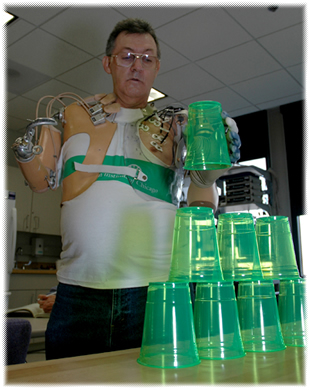
Jesse Sullivan, a double amputee from Dayton, Tenn., has been called the world's first "bionic man" with his thought-controlled, state-of-the-art prosthetic arm. He can eat with a fork, pick up a cup, paint his house or guide a weed eater by bending his advanced appendage's elbow and rotating its forearm. But he still cannot grasp and throw a baseball, cast a fishing line, tie his shoes or type on a computer keyboard as naturally as before.

That may change with the help of numerous organizations including Oak Ridge National Laboratory, some 50 miles north of Sullivan's hometown.

In 2001 while working as a utility lineman, Sullivan lost both arms after a 7000-volt shock in a power-line accident.

Pediatrics researchers at The Children’s Hospital of Philadelphia and McGill University in Montreal have identified a gene variant that raises a child’s risk for type 1 diabetes, formerly called juvenile diabetes. As investigators continue to pinpoint genes contributing to diabetes, they have their eyes on providing a scientific basis for designing better treatments and preventive measures for the disease.

The research adds a new gene and new knowledge to the four genes previously discovered for type 1 diabetes, in which the immune system destroys insulin-producing beta cells in the pancreas and makes patients dependent on frequent insulin injections to keep the body’s blood sugar under control.

Researchers from MIT have uncovered a molecular mechanism that governs the formation of fears stemming from traumatic events. The work could lead to the first drug to treat the millions of adults who suffer each year from persistent, debilitating fears - including hundreds of soldiers returning from conflict in Iraq and Afghanistan.

A study conducted by the Army in 2004 found that one in eight soldiers returning from Iraq reported symptoms of post-traumatic stress disorder (PTSD). According to the National Center for PTSD in the United States, around eight percent of the population will have PTSD symptoms at some point in their lives. Some 5.2 million adults have PTSD during a given year, the center reports.

A tumor paint developed by researchers will help surgeons see where a tumor begins and ends more precisely by illuminating the cancerous cells.

The study shows that the tumor paint can help surgeons distinguish between cancer cells and normal brain tissue in the operating room. The paint is a scorpion-derived peptide called chlorotoxin that is linked to the molecular beacon Cy5.5.Until now there has been no way to allow surgeons to see tumors “live” during surgery.

Preliminary results from DNA tests carried out on a mummy believed to be Queen Hatshepsut is expected to support the claim by Egyptian authorities that the remains are indeed those of Egypt’s most powerful female ruler.

Egyptologists in Cairo announced last month that a tooth found in a wooden box associated with Hatshepsut exactly fitted the jaw socket and broken root of the unidentified mummy.

Now, Dr Angelique Corthals, a biomedical Egyptologist at The University of Manchester, says that DNA tests she helped carry out with colleagues at the National Research Centre in Cairo have promising preliminary results suggesting the identity of the queen.

It may seem odd to think about using metallic structures for transmitting light because light quickly attenuates on passing through a metal, but light waves travelling only a few centimeters don't lose their energy and that discover could change the face of nanotechnology.

The discovery, known as acoustic plasmon, are surface plasmons formed by the group excitation of electrons but it is produced by the interaction between light and metal surfaces.

The advantage of acoustic plasmons over the long-known surface plasmons is that they are created with a different amount of energy.