Banner
Pilot Study: Fibromyalgia Fatigue Improved By TENS Therapy

Fibromyalgia is the term for a poorly-understood condition where people experience pain and fatigue...

High Meat Consumption Linked To Lower Dementia Risk

Older people who eat large amounts of meat have a lower risk of dementia and cognitive decline...

Long Before The Inca Colonized Peru, Natives Had A Thriving Trade Network

A new DNA analysis reveals that long before the Incan Empire took over Peru, animals were...

Mesolithic People Had Meals With More Tradition Than You Thought

The common imagery of prehistoric people is either rooting through dirt for grubs and picking berries...

User picture.
News StaffRSS Feed of this column.

News Releases From All Over The World, Right To You... Read More »

Blogroll

Several neurological and psychiatric disorders, including schizophrenia, alcoholism, and Parkinson’s disease, are associated with changes in the brain that affect the nerves that communicate with each other through the naturally-produced chemical dopamine. One protein that is crucial for dopamine-mediated neuronal communication in animals is DARPP-32. However, very little is known about the function of this protein in humans.

In a study appearing online on February 8 in advance of publication in the March print issue of the Journal of Clinical Investigation, Daniel Weinberger and colleagues from the National Institutes of Health show that the gene that encodes DARPP-32 exhibits genetic variation.

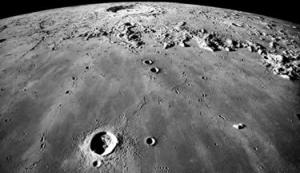
Light has been shed on the dark parts of the Moon with experiments by University of Edinburgh researchers simulating billions of years of lunar evolution.

It is generally believed the Moon was created after an early, semi molten, Earth collided with a planet the size of Mars.

The collision was so great that the orbiting debris would have formed a so-called lunar magma ocean, or liquefied rock, up to several hundred kilometres deep that would have covered the Moon's surface.

Yet until now, it has remained a mystery as to how this magma ocean cooled and how the lunar landscape evolved into white highlands and dark valleys.

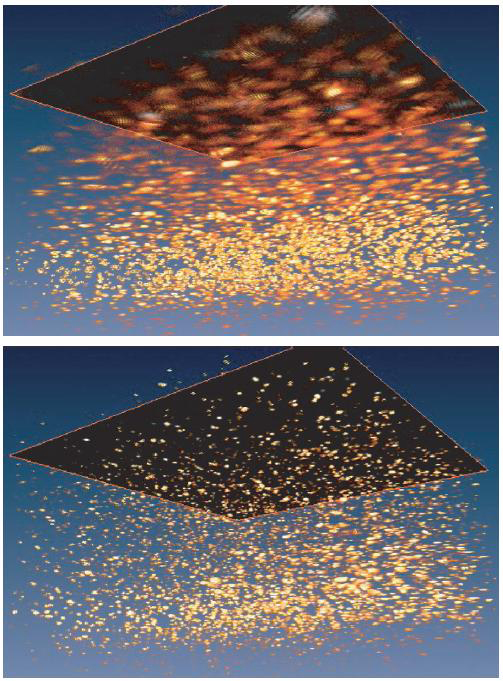
Researchers at the University of Illinois at Urbana-Champaign have developed a novel computational image-forming technique for optical microscopy that can produce crisp, three-dimensional images from blurry, out-of-focus data.

Called Interferometric Synthetic Aperture Microscopy, ISAM can do for optical microscopy what magnetic resonance imaging did for nuclear magnetic resonance, and what computed tomography did for X-ray imaging, the scientists say.


Photo courtesy of Beckman Institute
Representations of a tissue phantom where the scattering points
would represent cells, and images before and after ISAM are shown.

Video games that contain high levels of action, such as Unreal Tournament, can actually improve your vision.

Researchers at the University of Rochester have shown that people who played action video games for a few hours a day over the course of a month improved by about 20 percent in their ability to identify letters presented in clutter—a visual acuity test similar to ones used in regular ophthalmology clinics.

In essence, playing video game improves your bottom line on a standard eye chart.


Perhaps Daphne Bavelier and Shawn Green will work on reasons to skip school and eat Fritos next. (Image courtesy of University of Rochester)

A giant elliptical galaxy seen in an image from the Hubble Space Telescope is the closest gravitational lens yet known, according to information released by the Hubble Heritage Project Tuesday (Feb. 6).

John Blakeslee, an assistant professor with the Department of Physics and Astronomy at Washington State University, working with colleagues from the University of Hawaii and the University of Durham in England, targeted the galaxy for a closer look by Hubble.

Elliptical Galaxy ES) 325-G004 in the Abell Cluster S0740. (Credit: NASA, ESA, and The Hubble Heritage Team (STScI/AURA) / Acknowledgment: J. Blakeslee (Washington State University))