Three years into war with Russia and martial law, public services continue to operate and citizens continue to have confidence in them. A new analysis of survey results in Government information Quarterly says trust in public figures and a sense of cooperation are key factors.
The surveys were conducted in the Dnipropetrovsk region in 2023 and 2024 and included 239 public officials and 882 Ukrainian citizens. Scholars then followed up with ten interviews of public officials and active members of civil society. The humanities scholars conclude that collaboration which was previously sporadic has become more galvanized across all levels of society.
Digital services for people fleeing their homes have gotten high levels of uptake. The authors highlight the government's digital platform Diia, created and controlled by the Ministry of Digital Transformation, and note it has become a central location for government services in Ukraine for the past few years, and over half of all Ukrainians now have the app on their phone.
That would not happen without trust in government. Martial law for years is rarely a positive but Ukrainians have pivoted to overwhelming distrust of government a generation ago to belief that individuals, organizations and public authorities are actually doing what they are supposed to be doing since the Orange Revolution, when mass protests occurred because people believed government had rigged election results.
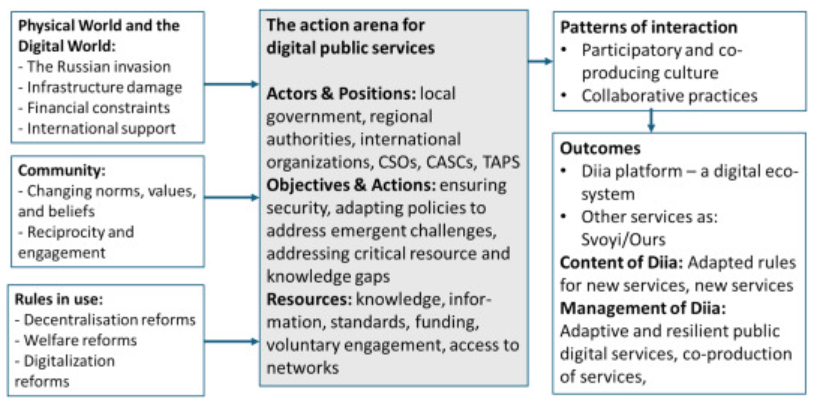
Some still feel like serious problems with corruption remain, the US and all European countries face those same issues, but people maintain confidence in democracy and its institutions because citizens are more active since the crisis. When the public feels disenfranchised, engagement and participation decrease, as seen in the 2024 U.S. presidential election, when votes for the party that changed candidates but didn't allow members to choose the replacement were millions below the 2020 election.
Like all surveys, these results have many confounders. Added into the mix is that this was a small unrepresentative sample in one region of Ukraine, and government was 20% of the responses, but it shows that if government is transparent, citizens will become co-creators of solutions, rather than cynical passive recipients.