
Fake Banner
Living At The Polar Circle

Since 2022, when I got invited for a keynote talk at a Deep Learning school, I have been visiting...

Conferences Good And Bad, In A Profit-Driven Society

Nowadays researchers and scholars of all ages and specialization find themselves struggling with...
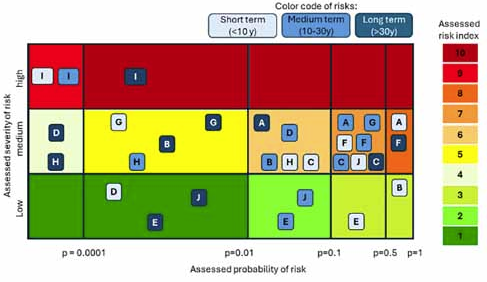
USERN: 10 Years Of Non-Profit Action Supporting Science Education And Research

The 10th congress of the USERN organization was held on November 8-10 in Campinas, Brazil. Some...
Baby Steps In The Reinforcement Learning World

I am moving some baby steps in the direction of Reinforcement Learning (RL) these days. In machine...

User picture.
picture for Hank Campbellpicture for Patrick Lockerbypicture for Heidi Hendersonpicture for Bente Lilja Byepicture for Sascha Vongehrpicture for Johannes Koelman
Tommaso DorigoRSS Feed of this column.

Tommaso Dorigo is an experimental particle physicist, who works for the INFN at the University of Padova, and collaborates with the CMS and the SWGO experiments. He is the president of the Read More »

Blogroll
The results of a third-party investigation of Rossi's E-CAT reactor have appeared on the Cornell arxiv, and the conclusions of the tests are at the very least startling:
"New Physics can appear at any moment but it is now conceivable that no new physics will show up at the LHC"

Guido Altarelli, LHC Nobel Symposium, May 15th 2013

It is funny reading the above quote if you are one who "conceived" that the LHC could find no new physics 7 years ago, as demonstrated by where I put my money...
Finally the decay of Higgs bosons to b-quark pairs is emerging from LHC data, too.
Supersymmetry, the extension of the Standard Model of particle physics that was once sold as an almost certain discovery that the LHC experiments would bump into upon starting to collect proton-proton collisions, is not in a very healthy situation these days.
In 1992 the top quark had not been discovered yet, and it did not make much sense for the CDF collaboration to have a full meeting devoted solely to it; rather, analyses targeting the search of the top quark were presented at a meeting which dealt with both bottom and top quarks. This was called back then "Heavy Flavour meeting".
Two days ago I wrote a quick post to stimulate non-flat-EEG readers to consider an apparently trivial question, which in fact hid many subtleties. The general question I wanted to address was whether an estimate missing an uncertainty was more or less useful than a quoted uncertainty on the same parameter when the estimate itself was missing.