Banner
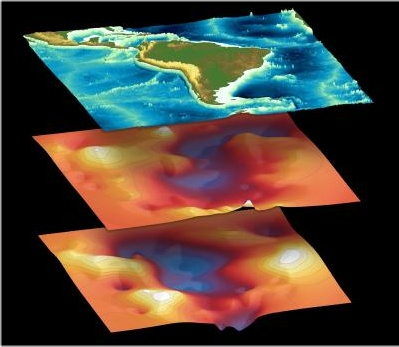
Social Media Is A Faster Source For Unemployment Data Than Government

Government unemployment data today are what Nielsen TV ratings were decades ago - a flawed metric...

Gestational Diabetes Up 36% In The Last Decade - But Black Women Are Healthiest

Gestational diabetes, a form of glucose intolerance during pregnancy, occurs primarily in women...
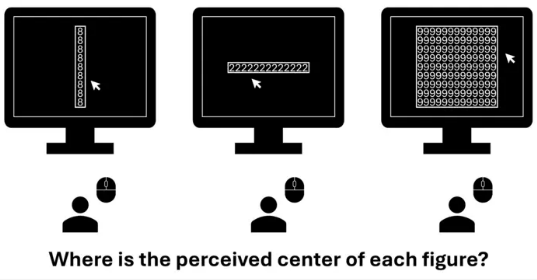
Object-Based Processing: Numbers Confuse How We Perceive Spaces

Researchers recently studied the relationship between numerical information in our vision, and...
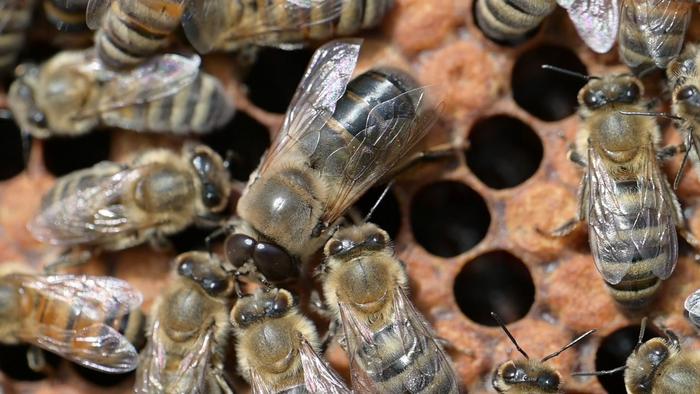
Males Are Genetically Wired To Beg Females For Food

Bees have the reputation of being incredibly organized and spending their days making sure our...

User picture.
News StaffRSS Feed of this column.

News Releases From All Over The World, Right To You... Read More »

Blogroll
Despite the horrors of the Maoist regime, the Communist Party dictatorship in the People's Republic of China continues to exist and retain control, even though tens of millions of people suffered from persecution or were executed for political reasons while he lived. 

Even less likely, the perpetrators and victims have managed to continue living together long after the death of Mao Zedong and the beginning of the reform era in 1978.

Why do we value gold? It's not strong, it's not pretty, it's rare but in the 21st century, given enough energy we can turn lead into gold, the way alchemists once only dreamed about.

It's not just rare on Earth, it's rare in the universe, even though the universe has a fantastic amount of energy, it is a perpetual Philosopher's Stone. Yet even in the infinite universe creating gold is not trivial. Unlike elements such as carbon or iron, gold cannot be created within a star. Instead, it must be born in a more cataclysmic event, like one that was witnessed last month: a short gamma-ray burst.

Neutrinos are the second most abundant particles in the Universe, after photons, but when it comes to being elusive they can compete with anything. That's due to their having extremely weak interactions with all other particles, which leads to them being called  'ghost particles’.

Neutrinos are invisible but could carry as much mass as all other known forms of matter, traveling almost at the speed of light over fantastic distances. Their tiny masses have  important consequences for the structures in the Universe and they are the driving element in the explosion of Supernovae.
A group at the Bristol Robotics Laboratory have developed a novel way of charging mobile phones - using urine as the power source to generate electricity.

Lead author Dr. Ioannis Ieropoulos from the University of the West of England is an expert at harnessing power from unusual sources using microbial fuel cells and says, “We are very excited as this is a world first, no-one has harnessed power from urine to do this so it's an exciting discovery. Using the ultimate waste product as a source of power to produce electricity is about as eco as it gets.”

Basically, the microbial fuel cells contain bacteria that produce electricity from pee. Bet you never thought of that, Muad'Dib.

The Earth has a violent history: About 4.5 billion years ago, a maelstrom of gas and dust circled in a massive disc around the sun, gathering in rocky clumps to form asteroids. These asteroids, gaining momentum, whirled around a fledgling solar system, repeatedly smashing into each other to create larger bodies of rubble — the largest of which eventually cooled to form the planets.

Countless hypotheses, simulations and geologic observations support such a scenario, but there remains one lingering mystery: If the Earth arose from the collision of asteroids, its composition should resemble that of meteoroids, the small particles that break off from asteroids.

On July 16th, 2013, at 12:09 a.m. EDT, the sun erupted with an Earth-directed coronal mass ejection, sending billions of tons of particles into space. These particles cannot travel through the atmosphere to harm humans on Earth, but they can affect electronic systems in satellites and on the ground.   The particles will reach Earth over the next few days.  

Experimental NASA research models, based on observations from NASA's Solar Terrestrial Relations Observatory, show that the CME left the sun at speeds of around 560 miles per second, a fairly typical speed.