Banner
Social Media Is A Faster Source For Unemployment Data Than Government

Government unemployment data today are what Nielsen TV ratings were decades ago - a flawed metric...

Gestational Diabetes Up 36% In The Last Decade - But Black Women Are Healthiest

Gestational diabetes, a form of glucose intolerance during pregnancy, occurs primarily in women...

Object-Based Processing: Numbers Confuse How We Perceive Spaces

Researchers recently studied the relationship between numerical information in our vision, and...

Males Are Genetically Wired To Beg Females For Food

Bees have the reputation of being incredibly organized and spending their days making sure our...

User picture.
News StaffRSS Feed of this column.

News Releases From All Over The World, Right To You... Read More »

Blogroll
To ancient Romans, the depiction of female nudes in mosaics were meant to invoke beauty, carnality and eroticism while male bodies reflected determination, strength and power, according to work from the Universidad Carlos III in Madrid (UC3M) that analyzed the cultural construction and ideological implications of artistic representations in which females predominate compared to those males.

Sometimes art isn't just art. Prior interpretations of Roman mosaics analyzed clothing as an iconographic element that was fundamental in identifying the characters and determining their status, but a new book centers on the opposite theme: the absence of any type of clothing.
To ancient Romans, the depiction of female nudes in mosaics were meant to invoke beauty, carnality and eroticism while male bodies reflected determination, strength and power, according to work from the Universidad Carlos III in Madrid (UC3M) that analyzed the cultural construction and ideological implications of artistic representations in which females predominate compared to those males.

Sometimes art isn't just art. Prior interpretations of Roman mosaics analyzed clothing as an iconographic element that was fundamental in identifying the characters and determining their status, but a new book centers on the opposite theme: the absence of any type of clothing.
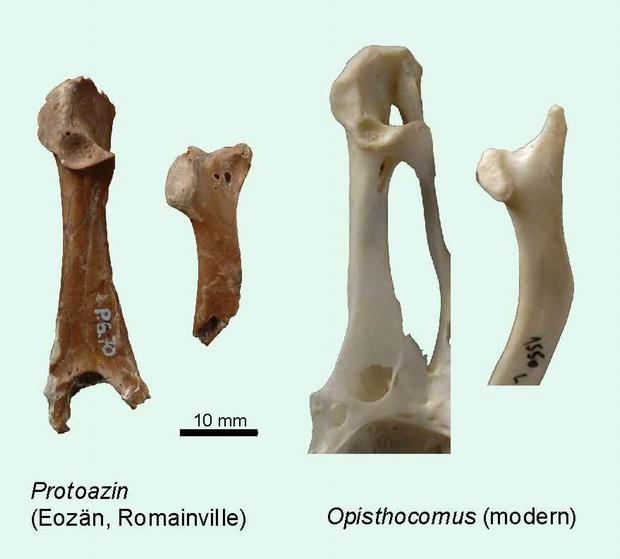
Only one species of hoatzins exists in South America today - or anywhere else. 

Opisthocomus hoazin, also known as the Stinkbird or Canje Pheasant, has an unclear evolutionary history but was assumed to have originated in South America.

Not so, it seems. The oldest known fossils of Hoatzin ancestors reveal that these birds existed around 34 million years ago in Europe, according to paleornithologists at the Senckenberg Gesellschaft für Naturforschung and Flinders University in Adelaide.

You don't need to show kids a frying egg in a pan to get the message across about drugs; just show them this statistic. 

Heroin and cocaine addicts in Spain have a fatality rate that is 14.3 times higher than for the general population, and that is among people seeking treatment. For those who never seek treatment, it is probably far worse. Even users of cocaine alone have a 5.1 times higher fatality rate.

50,000 years ago, the Arctic tundra was not as drab as you might think, being an Ice Age - it was filled with colorful wildflowers and these wildflowers helped sustain woolly mammoths and other giant grazing animals, according to a new paper. The study challenges the view that the arctic landscape in the ice age was largely grasslands. 

The study looked at 50,000 years of arctic vegetation history to understand how fauna had changed with animals and humans. Historically, the belief has been that the ice age's landscape was covered by largely grass-dominated systems -- called steppe. These grasses were replaced by mosses and other boggy vegetation when the ice age ended nearly 10,000 years ago, Craine said.

A lot of coffee is grown on and around Kilimanjaro, which towers almost 20,000 feet in the air. 

The most traditional form of cultivation can be found in the gardens of the Chagga people. In some areas, coffee trees and other crop plants still grow in the shade of banana trees but most coffee is grown on plantations, which still feature a large number of shade trees.

However, Africans reliant on coffee for income have gradually replaced legacy coffee varietals, which prefer shade, with others that are more resistant to fungi and can also grow in the sun.