Banner
Social Media Is A Faster Source For Unemployment Data Than Government

Government unemployment data today are what Nielsen TV ratings were decades ago - a flawed metric...

Gestational Diabetes Up 36% In The Last Decade - But Black Women Are Healthiest

Gestational diabetes, a form of glucose intolerance during pregnancy, occurs primarily in women...

Object-Based Processing: Numbers Confuse How We Perceive Spaces

Researchers recently studied the relationship between numerical information in our vision, and...

Males Are Genetically Wired To Beg Females For Food

Bees have the reputation of being incredibly organized and spending their days making sure our...

User picture.
News StaffRSS Feed of this column.

News Releases From All Over The World, Right To You... Read More »

Blogroll

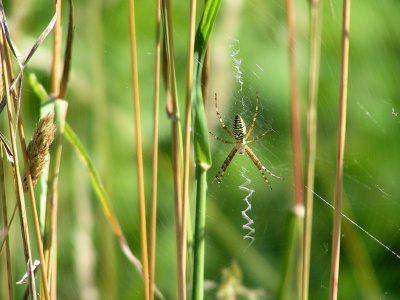
The fact that female wasp spiders have numerous sexual contacts is something which their male partners cannot prevent. What they can do, however, is ensure that no offspring ensue from these tête à têtes with their rivals: the male spiders simply place a chastity belt on their partner while copulating. The tip of their genital breaks off during intercourse, blocking the sexual orifice of the lady spider. Biologists from the universities of Bonn and Hamburg report on this amazing mechanism in the journal ‘Behavioral Ecology’ (vol. 18, pages 174-181, 2007).

When a male wasp spider discovers a potential partner, he turns her on by shaking her web. The female thereupon supports herself on her long legs on the web so that the male, who is much smaller, can then creep under her body.

Psychologists have been fond of stating in recent years that human happiness, or what psychologists call subjective well-being, is largely independent of our life circumstances. The wealthy aren’t much happier than the middle class, married people aren’t much happier than single people, healthy people aren’t much happier than sick people, and so on.

One might reasonably conclude, therefore, that changes in life circumstances would not have long-term effects on our happiness. This indeed has been the dominant model of subjective well-being: People adapt to major life events, both positive and negative, and our happiness pretty much stays constant through our lives, even if it is occasionally perturbed.

Researchers at the U.S.

Researchers at Rensselaer Polytechnic Institute have discovered what likely triggered the eruption of a "supervolcano" that coated much of the western half of the United States with ash fallout 760,000 years ago.

Using a new technique developed at Rensselaer, the team determined that there was a massive injection of hot magma underneath the surface of what is now the Long Valley Caldera in California some time within 100 years of the gigantic volcano’s eruption.

"The Sopranos" have some competition -- brown-headed cowbirds.

Cowbirds have long been known to lay eggs in the nests of other birds, which then raise the cowbirds’ young as their own.

Sneaky, perhaps, but not Scarface.

Now, however, a University of Florida study finds that cowbirds actually ransack and destroy the nests of warblers that don’t buy into the ruse and raise their young.

Jeff Hoover, an avian ecologist at the Florida Museum of Natural History, is the lead author on the first study to document experimental evidence of this peeper payback -- retaliation to encourage acceptance of parasitic eggs.

Findings will be published online in the Proceedings of the National Academy of Sciences March 5.

"It’s the female cowbirds who are running the mafia racket at ou

Students of the evolution of social behavior got a big boost with the publication of the newly sequenced honeybee genome in October 2006. The honeybee (Apis mellifera) belongs to the rarified cadre of insects that pool resources, divide tasks, and communicate with each other in highly structured colonies. Understanding how this advanced state of organization evolved from a solitary lifestyle has been an enduring question in biology.


A honeybee gene originally used in egg production has become an important behavioral modulator and a timekeeper of social life.