Banner
Social Media Is A Faster Source For Unemployment Data Than Government

Government unemployment data today are what Nielsen TV ratings were decades ago - a flawed metric...

Gestational Diabetes Up 36% In The Last Decade - But Black Women Are Healthiest

Gestational diabetes, a form of glucose intolerance during pregnancy, occurs primarily in women...

Object-Based Processing: Numbers Confuse How We Perceive Spaces

Researchers recently studied the relationship between numerical information in our vision, and...

Males Are Genetically Wired To Beg Females For Food

Bees have the reputation of being incredibly organized and spending their days making sure our...

User picture.
News StaffRSS Feed of this column.

News Releases From All Over The World, Right To You... Read More »

Blogroll
Why did the earliest side-scrolling games go left to right? From the 1980s on, they seemed to do that. And in the western world people write left to right. That is enough for psychologist Dr. Peter Walker of Lancaster University to speculate that there may be a fundamental bias in the way people prefer to see moving items depicted in pictures. 

Did video game developers in the early 1980s obey an evolutionary mandate in designing games? An analysis of thousands of items in Google Images led Walker to believe there is widespread evidence for such a left-to-right bias and that could a possible fundamental bias for visual motion. And it may be evidenced thousands of years ago also.
Dr. Harold Roy-Macauley, new Director General of AfricaRice, doesn't want to just improve rice science for Africa, he wants to make the continent a world leader in it.

The rice sector in Africa is going to be “evidenced-based and therefore very solid and powerful,” he says. At a time when the developed world agonizes over the value of science, Africa sees an opportunity to grab a lot of market share by using science to improve their food production and become a next exporter, and then the rest of the world can play catch up.

Mutations in the presenilin-1 gene are the most common cause of inherited, early-onset forms of Alzheimer's disease. In a new study, published in Neuron, scientists replaced the normal mouse presenilin-1 gene with Alzheimer's-causing forms of the human gene to discover how these genetic changes may lead to the disorder. Their surprising results may transform the way scientists design drugs that target these mutations to treat inherited or familial Alzheimer's, a rare form of the disease that affects approximately 1 percent of people with the disorder.

Where you receive medical care impacts many things - including whether or not you receive inappropriate medical tests, according to a new study.

Researchers from NYU Langone Medical Center and its Laura and Isaac Perlmutter Cancer Center, in a new retrospective study publishing online March 12th in JAMA Oncology, conclude that patients with low-risk prostate or breast cancer were more likely to receive inappropriate imaging during treatment, based on the region of the country in which they received medical care.

oday marked the publication of the first ever genome-wide association study of rosacea, a common and incurable skin disorder. Led by Dr. Anne Lynn S. Chang of Stanford University's School of Medicine, and co-authored by 23andMe, the study is the first to identify genetic factors for this condition.

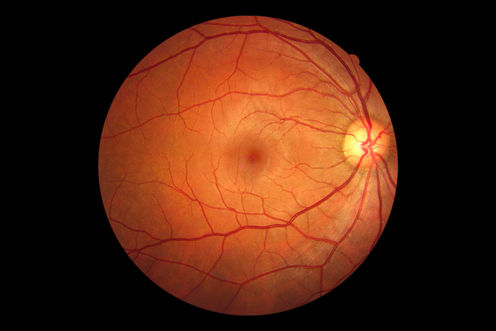
The human eye is optimized to have good color vision at day and high sensitivity at night. 

But until recently it seemed as if the cells in the retina were wired the wrong way round, with light traveling through a mass of neurons before it reaches the light-detecting rod and cone cells.

New research presented at a meeting of the American Physical Society has uncovered a remarkable vision-enhancing function for this puzzling structure.