Banner
Why Antarctic Sea Ice Stopped Growing In 2015

Though numerical models and popular films like An Inconvenient Truth projected Arctic ice...

Wealth Correlated To Loneliness

You may have read that Asian cultures respect the elderly more than Europe but Asian senior citizens...

Ousiometrics Analysis Says All Human Language Is Biased

A new tool drawing on billions of uses of more than 20,000 words and diverse real-world texts claims...

Wavelengths Of Light Are Why CO2 Cools The Upper Atmosphere But Warms Earth

There are concerns about projected warming on the Earth’s surface and in the lower atmosphere...

User picture.
News StaffRSS Feed of this column.

News Releases From All Over The World, Right To You... Read More »

Blogroll

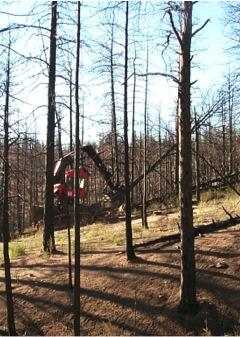
After a wildfire burns a large swath across timberlands, logging companies come in to do salvage logging - they clean up the timber that has not been completely destroyed by the fire. It's a good idea to get economic benefit from devastated land and otherwise it is just rotting tinder for the next fire.

Environmentalists, who object to even the most basic forest management in order to prevent fires, hate logging - even after a fire has burned the place down. They have been raising the alarm about salvage logging because the ecological effects are...unknown.

As World War II ended and the Holocaust became shockingly more real than the rumor or propaganda some believed it was, people wondered how it could happen. Why, somewhere along the way, did not more Germans involved in the genocide object? The same was asked of Stalin's Russia, Mao's China and Pol Pot's Cambodia.

In 1961, psychologist Stanley Milgram set out to answer that, undertaking a series of now infamous experiments on obedience and reprehensible behavior. About two-thirds of Milgram's nearly 800 study subjects, pressed by an authoritative experimenter, were willing to administer increasingly powerful electric shocks to an unseen stranger despite cries of agony and pleas to stop.

Methicillin-resistant Staphylococcus aureus (MRSA) infection has gotten a lot of attention. It is caused by a strain of staph bacteria that's become resistant to the antibiotics commonly used to fight it, but antibiotic resistance is not new. For as long as antibiotics have been manufactured (and nature shows evidence of it well before that) resistance evolves. 

Science has to stay a step ahead in the interests of public health and a new paper details a newly discovered antibiotic that eliminates pathogens without encountering any detectable resistance, which holds great promise for treating chronic infections like tuberculosis and those caused by MRSA. 

An affordable vaccine that has all but rid the 'meningitis belt' of a major cause of deadly epidemics is now going to be available for infants all across sub-Saharan Africa. 

Northern Europeans pride themselves on being tougher than the rest of Europe when it comes to enduring weather. While most people are more likely to die in bad weather, a new paper finds that Norwegian kids were more likely to die when the weather was good.

By studying church records from 1750 to 1900 and looking at life history variables, such as how old women were when they had their first child and their last and how many years passed between the birth of each child and how many of these children survived, Gine Roll Skjaervoe at the Norwegian University of Science and Technology's (NTNU) Department of Biology made a strange finding - kids born in years with a lot of sunshine died more, and that meant fewer grandchildren. 
A paper in the Journal of the Royal Society of Medicine links circumcision in boys to autism spectrum disorder (ASD).

The results were drawn from part a cohort of all children born in Denmark between 1994 and 2003. During the study, over 340,000 boys were followed up to the age of nine between 1994 and 2013 and almost 5,000 cases of ASD were diagnosed. They found that regardless of cultural background circumcised boys may run a greater risk of developing ASD. The researchers also made the observation of an increased risk of hyperactivity disorder among circumcised boys in non-Muslim families.  Risk was particularly high for infantile autism before the age of five, at least in epidemiology.