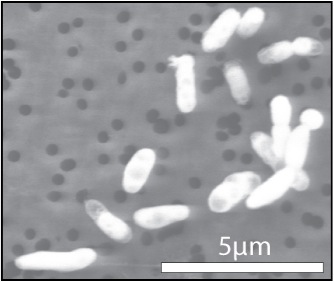
Astrobiology researchers say a new discovery may have expanded the definition of life. Conducting tests in the harsh environment of Mono Lake in California, they have discovered the first known microorganism on Earth able to thrive and reproduce using the toxic chemical arsenic, substituting arsenic for phosphorus in its cell components.
Carbon, hydrogen, nitrogen, oxygen, phosphorus and sulfur are the six basic building blocks of all known forms of life on Earth. Phosphorus is part of the chemical backbone of DNA and RNA, the structures that carry genetic instructions for life, and is considered an essential element for all living cells.
The largest fish species in the ocean, the whale shark, is spectacular for lots of reasons, not the least is that their motion is an astonishing feat of mathematics and energy conservation.
In new research, marine scientists reveal how these massive sharks use geometry to enhance their natural negative buoyancy and stay afloat.
For most animals movement is crucial for survival, both for finding food and for evading predators. However, movement costs substantial amounts of energy and while this is true of land based animals it is even more complex for birds and marine animals which travel in three dimensions. Unsurprisingly this has a profound impact on their movement patterns.
The presence of toxic lead in used consumer products is extremely widespread and at levels far beyond safe limits, researchers conclude in a new study. Research recently found that lead and cadmium were present in cartoon character drinking glasses and now the new study has found that many other items available for purchase throughout the United States – such as toys, home décor items, salvage, kitchen utensils and jewelry – contain surface lead concentrations more than 700 times higher than the federal limit.
The results were published in The Journal of Environmental Health.
Lactococcus lactis, the workhorse bacterium that helps turn milk into cheese, may also lead to understanding of how microbes turn the organic compound cellulose into biofuels, according to new research from Concordia University published in Microbial Cell Factories.
Concordia biology professor Vincent Martin and PhD student Andrew Wieczorek demonstrated how structural or scaffolding proteins on the surface of the bacteria can be engineered in Lactococcus lactis towards the breakdown of plant material. They showed how these scaffold proteins were successful in providing a stable surface outside the cell for chemical activity, e.g. the transformation of plant material into biofuels.
Small, dim stars known as red dwarfs have turned out to be much more prolific than previously thought, which means that the total number of stars in the universe is likely three times larger than realized.
Red dwarfs are relatively small and dim compared to stars like our Sun, so astronomers haven't been able to detect them in galaxies other than our own Milky Way and its nearest neighbors - so there were only conjectures about how much of the total stellar population of the universe is made up of red dwarfs.
Chronic jet lag alters the brain in ways that cause memory and learning problems long after returning to a regular 24-hour schedule, according to research by Berkeley psychologists.
Twice a week for four weeks, the researchers subjected female Syrian hamsters to six-hour time shifts, the equivalent of a New York-to-Paris airplane flight. During the last two weeks of jet lag and a month after recovery from it, the hamsters' performance on learning and memory tasks was measured. As expected, during the jet lag period, the hamsters had trouble learning simple tasks that the hamsters in the control group did well on. What surprised the researchers was that these deficits persisted for a month after the hamsters returned to a normal day-night schedule.


 Here's Where Your Backyard Was 300 Million Years Ago
 Convergent Evolution Cheat Sheet Now 120 Million Years Old
 Synchrotron Could Shed Light On Exotic Dark Photons
 The Pain Scale Is Broken But This May Fix It