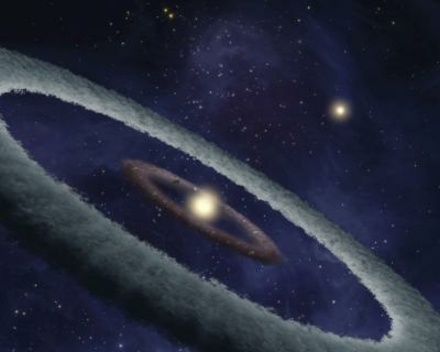
Some of the universe's most massive galaxies may have formed billions of years earlier than current scientific models predict, according to findings in the Astrophysical Journal.
That conclusion was drawn because newly identified galaxies were five to ten times more massive than our own Milky Way. They were among a sample studied at redshift 3≤z<4, when the universe was between 1.5 and 2 billion years old.
Physicists from the University of Bonn have developed a completely new source of light, a Bose-Einstein condensate consisting of photons, something not known to be possible, which may potentially be suitable for designing light sources resembling lasers that work in the x-ray range.
By cooling Rubidium atoms deeply and concentrating a sufficient number of them in a compact space, they suddenly become indistinguishable. They behave like a single huge "super particle." Physicists call this a Bose-Einstein condensate.
This holiday season, starting today when you bite into the cranberry sauce and the tartness smacks your tongue as hard as that snide comment from your sister, consider the power of sour.
Neurobiology researchers at the University of Southern California have made a surprising discovery about how some cells respond to sour tastes.
Of the five taste sensations — sweet, bitter, sour, salty and umami — sour is arguably the strongest yet the least understood. Sour is the sensation evoked by substances that are acidic, such as lemons and pickles. The more acidic the substance, the more sour the taste.
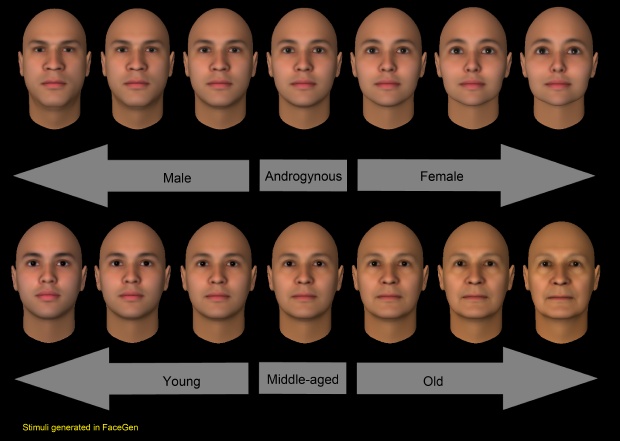
Neuroscientists have discovered that the brain sees some faces as male when they appear in one area of a person's field of view, but female when they appear in a different location, a finding which challenges the longstanding tenet of neuroscience that how the brain sees an object should not depend on where the object is located relative to the observer.
In the real world, the brain's inconsistency in assigning gender to faces isn't noticeable because there are so many other clues, like hair and clothing, but when people view computer-generated faces, stripped of all other gender-identifying features, a pattern of biases based on location of the face emerges.
Researchers have hit on a new way to create a personalized vaccine - an immune response against their own tumors using the tumor itself. This dendritic cell (DC) vaccine was used after surgical resection of metastatic tumors to try to prevent the growth of additional metastases.
Dendritic cells are critical to the human body's immune system, helping identify targets, or antigens, and then stimulating the immune system to react against those antigens. The new research grew dendritic cells from a sample of a patient's blood, mixed them with proteins from the patient's tumor, and then injected the mixture into the patient as a vaccine. The vaccine then stimulated an anti-tumor response from T-cells, a kind of white blood cell that protects the body from disease.
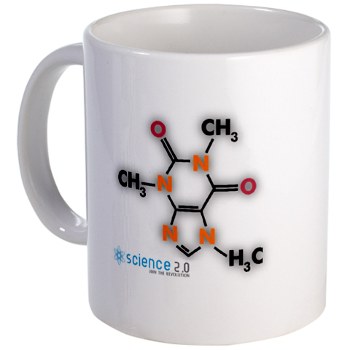
We don't know about yours but this holiday season, the homes of most scientists will be awash with even more coffee than usual. And that means coffee ring stains.
With the volume of science done in coffee houses (like Newton, who ate his meals in one every day) you'd think that anything about coffee, including coffee rings left behind from spillage, would be studied to death.
Not really. In 1997, Robert Deegan and colleagues showed that the coffee ring pattern was due to capillary flow induced by the differential evaporation rates across the drop (1) but since then little has been done. Sometimes science is practical instead of informational and 'just use a coaster' is enough.


 Here's Where Your Backyard Was 300 Million Years Ago
 Convergent Evolution Cheat Sheet Now 120 Million Years Old
 Synchrotron Could Shed Light On Exotic Dark Photons
 The Pain Scale Is Broken But This May Fix It