Banner
Here's Where Your Backyard Was 300 Million Years Ago

We may use terms like "grounded" and terra firma to mean stability and consistency but geology...

Convergent Evolution Cheat Sheet Now 120 Million Years Old

One tenet of natural selection is a random walk of genes but nature may be more predictable than...

Synchrotron Could Shed Light On Exotic Dark Photons

There are many hypothetical particles proposed to explain dark matter and one idea to explore how...

The Pain Scale Is Broken But This May Fix It

Chronic pain is reported by over 20 percent of the global population but there is no scientific...

User picture.
News StaffRSS Feed of this column.

News Releases From All Over The World, Right To You... Read More »

Blogroll
There are two aspects to food research; an industry one, where food additives that can make food taste more or less sweet without calories have benefits, and a therapeutic one, like treating patients who over eat.
Lutetia is a large, primitive asteroid left on the shelf for billions of years, presumably because no planet consumed it as the Solar System formed.  Most measurements affirm this, making the asteroid out to be a 'C-type', which contains primitive compounds of carbon, but some others suggest that Lutetia is an 'M-type', which could mean there are metals in its surface. 

If the second is true, it could be a real find in space science because although metallic asteroids do exist, they are thought to be fragments of the metallic core of larger asteroids that have since been shattered into pieces. If Lutetia is made of metal or even contains large amounts of metal, the traditional asteroid classification scheme may need rethinking. 
In vitro fertilization (IVF) resulted in the first 'test tube baby' in 1978 and now an estimated 1% of all American babies born each year has happened thanks to in vitro fertilization - wonderful for parents with reproductive issues but IVF and other assisted fertility treatments may be creating one problem by solving another, according to new research from Tel Aviv University. 
Polar science will continue to have a global impact, whether you believe in man-made climate change or not, says an expert.

Global warming was always an unfortunate use of 'framing' by policy-oriented scientists who were out of their league and political groups looking to mobilize their base.   Climate change was always the issue and change can mean warming ... which leads to cooling.
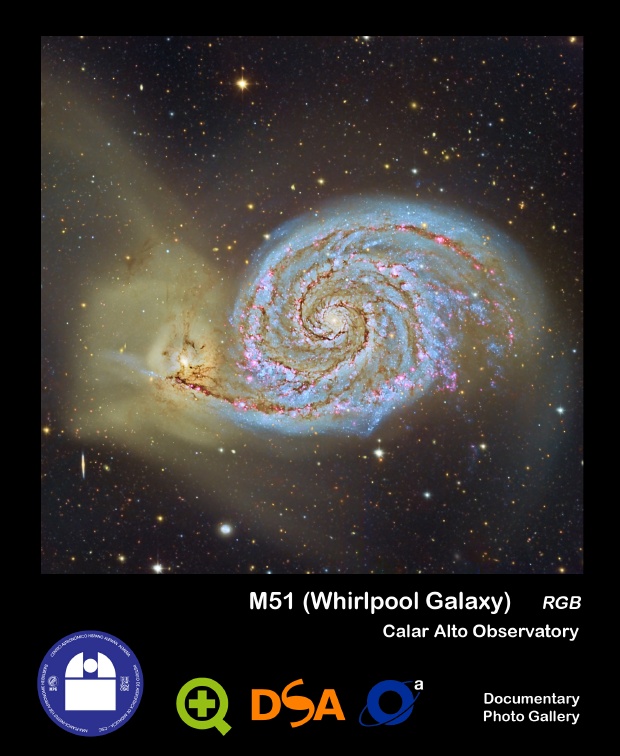
Galaxy M51, now called the Whirlpool Galaxy, was discovered by Charles Messier in 1773 but its spiral structure was first found by William Parsons in 1845, using his huge (and wonderfully named) reflecting telescope called the Leviathan of Parsonstown.  Today even small amateur telescopes can see that this galaxy is not isolated, but has a small companion, a dwarf irregular galaxy NGC 5195.

These two stellar systems are colliding and the spiral shape of M51 is due to the tidal forces unleashed during this process.    At a distance of 23 millions of light-years, the apparent dimensions of M51 mean that that galaxy has to be quite similar to our own, yet somewhat smaller.   

Each day the humans are confronted with a variety of pathogens. Most of them are fended off by our immune system. 

For a successful infection, bacteria must deliver so-called virulence factors through a transport channel located in the bacterial membrane.  Scientists from the Max Planck Society and the Federal Institute for Materials Research and Testing have shown how in some bacteria this transport channel is formed like a syringe, enabling them to inject virulence factors directly into the host cell - an important starting point for the development of new drugs that might interfere considerably earlier than antibiotics in the course of infection.