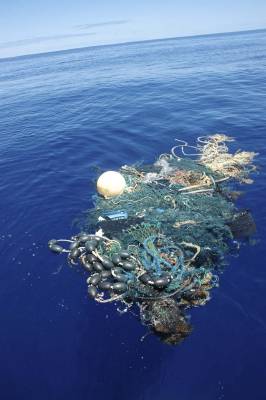
You know there's a lot of garbage floating around out there when it gets a name like "Great Pacific Ocean Garbage Patch."
Scripps Environmental Accumulation of Plastic Expedition (SEAPLEX) researchers decided to find out if it lived up to its moniker.
It wasn't a pretty sight.
The Scripps research vessel (R/V) New Horizon left its San Diego homeport on August 2, 2009, for the North Pacific Ocean Gyre, located some 1,000 miles off California's coast, and returned on August 21, 2009. They surveyed plastic distribution and abundance, taking samples for analysis in the lab and assessing the impacts of debris on marine life.
Bacteria that manufacture hydroxyapatite (HA) could be used to make stronger, more durable bone implants. Professor Lynne Macaskie from the University of Birmingham this week (7-10 September) presented work to the Society for General Microbiology’s meeting at Heriot-Watt University, Edinburgh.
Using Serratia bacteria, the research showed that the bacterial cells stuck tightly to surfaces such as titanium alloy, polypropylene, porous glass and polyurethane foam by forming a biofilm layer containing biopolymers that acted as a strong adhesive. The HA coating then builds up over the surface. For practical use, the HA layer must stick tightly, then the material is dried and heated to destroy the bacteria.
Bacteria that generate significant amounts of electricity could be used in microbial fuel cells to provide power in remote environments or to convert waste to electricity.
Professor Derek Lovley from the University of Massachusetts isolated bacteria with large numbers of tiny projections called pili which were more efficient at transferring electrons to generate power in fuel cells than bacteria with a smooth surface.
The team's findings were reported at the Society for General Microbiology's meeting at Heriot-Watt University, Edinburgh. “Putting Microbes to Work” is the Society for General Microbiology’s autumn conference at Heriot-Watt University, Edinburgh on 7 - 10 September 2009.
Researchers say they have identified a genetic variation in people with type 2 diabetes that affects how the body's muscle cells respond to the hormone insulin.
Previous studies have identified several genetic variations in people with type 2 diabetes that affect how insulin is produced in the pancreas. Today's study shows for the first time a genetic variation that seems to impair the ability of the body's muscle cells to use insulin to help them make energy.
For most of the last century archaeologists, anthropologists, linguists and even geneticists have argued about who the ancestors of Europeans living today were.
People lived in Europe before and after the last big ice age and managed to survive by hunting and gathering and farming spread into Europe from the Near East over the last 9,000 years, which boosted the amount of food that could be produced by as much as 100-fold. But the extent to which modern Europeans are descended from either of those two groups has eluded scientists.
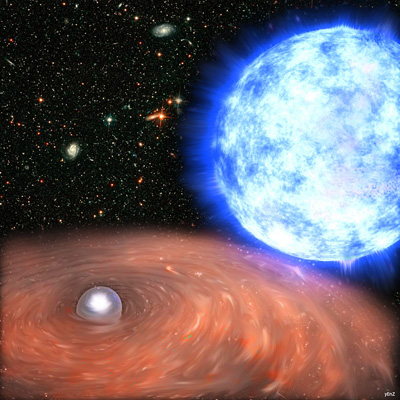
ESA's XMM-Newton orbiting X-ray telescope has uncovered the first close-up of a white dwarf star, circling a companion star, that could explode into a particular kind of supernova.
Well, in a few million years.
Astronomers use these supernovae as beacons to measure cosmic distances and could one day help us understand the expansion of the Universe. They've been on the trail of this particular mystery object since 1997 when they discovered that something was giving off X-rays near the bright star HD49798. Now the mysterious object has been tracked along its orbit and observation has shown it to be a white dwarf, the dead heart of a star, shining X-rays into space.


 Here's Where Your Backyard Was 300 Million Years Ago
 Convergent Evolution Cheat Sheet Now 120 Million Years Old
 Synchrotron Could Shed Light On Exotic Dark Photons
 The Pain Scale Is Broken But This May Fix It