Banner
Here's Where Your Backyard Was 300 Million Years Ago

We may use terms like "grounded" and terra firma to mean stability and consistency but geology...

Convergent Evolution Cheat Sheet Now 120 Million Years Old

One tenet of natural selection is a random walk of genes but nature may be more predictable than...

Synchrotron Could Shed Light On Exotic Dark Photons

There are many hypothetical particles proposed to explain dark matter and one idea to explore how...

The Pain Scale Is Broken But This May Fix It

Chronic pain is reported by over 20 percent of the global population but there is no scientific...

User picture.
News StaffRSS Feed of this column.

News Releases From All Over The World, Right To You... Read More »

Blogroll
Who says politics and science can't mix?   Well, we say they shouldn't mix but we're rare in science media.  Yet sometimes political events can make for great science studies too.

Case in point, the value neuroscientists at the University of Washington got when former President George W. Bush and Iraq's Prime Minister Nouri al-Maliki had shoes thrown at them by a crazy Iraqi 'reporter' during a Baghdad news conference. 

When Bush ducked and Maliki didn't flinch as the first shoe sailed toward them, it was a real-world example supporting the theory that there are two independent pathways in the human visual system. 
Can you tell when your dog has done something wrong by his appearance?   Not really, says Alexandra Horowitz, Assistant Professor from Barnard College in New York, in Behavioural Processes.   It's mostly what you want to see.

Horowitz was able to show that the human tendency to attribute a "guilty look" to a dog was not due to whether the dog was indeed guilty. Instead, people see 'guilt' in a dog's body language when they believe the dog has done something it shouldn't have – even if the dog is in fact completely innocent of any offense.
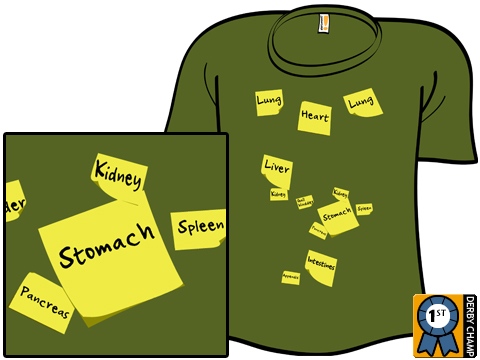
A study of patients and members of the public has shown that most lack even basic knowledge of human anatomy. The research, featured in the journal BMC Family Practice, found that people were generally incapable of identifying the location of major organs, even if they were currently receiving relevant treatment.
The search for planets capable of sustainable life (as we know it) is on, but with an infinite number of planets astronomers are focusing their attention on each system's 'habitable zone', where heat radiated from the star is just right to keep a planet's water in liquid form. They have found planets orbiting red dwarf stars because those make up about three-quarters of the stars close to our solar system. Potentially habitable planets must orbit closer to those stars, perhaps one-fiftieth the distance of Earth to the sun, since they are smaller and generate less heat than our sun.
Matthew C. Nisbet, assistant professor in the School of Communication writing in Nature Biotechnology, says there are changes that must be made to ensure quality science communication in the future. Some of his recommendations, based on the results of a science communication workshop in Washington, D.C., are: 1. Scientists should pursue a trust- and dialogue-based relationship with the public. The goal is not to 'sell the public' but to democratize public input about scientific issues so that members of the public can meaningfully participate in science-related decision making, which is not framing, but then ...
A group of researchers say they have clarified the role that retinoic acid plays in limb development. Their study in Current Biology says that retinoic acid controls the development (or budding) of forelimbs, but not hindlimbs, and that retinoic acid is not responsible for patterning (or differentiation of the parts) of limbs. This research corrects longstanding misconceptions about limb development and provides new insights into congenital limb defects.