Banner
Here's Where Your Backyard Was 300 Million Years Ago

We may use terms like "grounded" and terra firma to mean stability and consistency but geology...

Convergent Evolution Cheat Sheet Now 120 Million Years Old

One tenet of natural selection is a random walk of genes but nature may be more predictable than...

Synchrotron Could Shed Light On Exotic Dark Photons

There are many hypothetical particles proposed to explain dark matter and one idea to explore how...

The Pain Scale Is Broken But This May Fix It

Chronic pain is reported by over 20 percent of the global population but there is no scientific...

User picture.
News StaffRSS Feed of this column.

News Releases From All Over The World, Right To You... Read More »

Blogroll
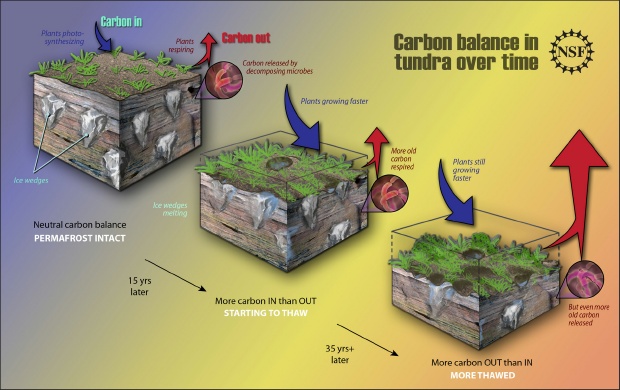
A study in Nature has helped define the potentially significant contribution of permafrost thaw to atmospheric concentrations of carbon, which have already reached unprecedented levels.

A large amount of organic carbon in the tundra is stored in the soil and permafrost. This pool of carbon, deposited over thousands of years, remains locked in the perennially frozen ground. In recent years this area began to thaw, providing increased access to plants and microbes that could shift the carbon from the land to the atmosphere.
You aren't really somebody unless you have an aircraft carrier named after you and 40th US president Ronald Reagan has just that.   Now he will have a Miss California on board too; in this case, Carrie Prejean, who's arguably the most famous beauty queen who didn't actually win, thanks to openly gay judge Perez Hilton making no secret of the fact that her personal opinions on gay marriage had no place in any contest he took part in unless they agreed with his, thus making her a darling of both Christians and conservatives in the process.

As many as 700,000 people in the UK suffer from a heart abnormality called arrhythmia, a potentially fatal condition, which the majority of Londoners have never heard of - according to a recent survey conducted by YouGov[1]. Many of the deaths associated with arrhythmias could be prevented due to advances in the identification and treatment of high risk patients.

A genetic link to caring about global warming?   Al Gore has truly jumped the shark, you may be thinking.    But humans may be programmed by evolution to care about their environment, suggests research published today, because it impacts reproduction and fitness.

Dr Peter Sozou of the University of Warwick suggests that individuals may have an innate tendency to care about the long-term future of their communities, over timescales much longer than an individual's lifespan. This in turn may help to explain people's wish to take action over long-term environmental problems.
A new study demonstrates that when faced with a difficult decision, the human brain calls upon multiple neural systems that code for different sorts of behaviors and strategies. The research in the May 28th issue of Neuron provides intriguing insight into the mechanisms that help the human brain rise to the formidable challenge of adaptive decision making in the real world.
Are parasites evolving to be more or less aggressive depending on whether they are closely connected to their hosts or scattered among more isolated clusters of hosts?  Research led by Geoff Wild, an NSERC-funded mathematician at the University of Western Ontario, with colleagues from the University of Edinburgh.

They decided to move the arguments from words to harder science and developed a formal mathematical model that incorporated variable patch sizes and the host parasite population dynamics. It was then run to determine the underlying evolutionary mechanisms.