Banner
Here's Where Your Backyard Was 300 Million Years Ago

We may use terms like "grounded" and terra firma to mean stability and consistency but geology...

Convergent Evolution Cheat Sheet Now 120 Million Years Old

One tenet of natural selection is a random walk of genes but nature may be more predictable than...

Synchrotron Could Shed Light On Exotic Dark Photons

There are many hypothetical particles proposed to explain dark matter and one idea to explore how...

The Pain Scale Is Broken But This May Fix It

Chronic pain is reported by over 20 percent of the global population but there is no scientific...

User picture.
News StaffRSS Feed of this column.

News Releases From All Over The World, Right To You... Read More »

Blogroll
According to a Time magazine article, “The Male Minority,” women make up almost 60 percent of undergraduate students nationwide.   Science, technology and math are one of the few areas where men have superior numbers but the women are winning there too.

The Spelman College robotics team, SpelBots, tied for first place in the RoboCup Japan 2009 Standard Platform League Nao League humanoid soccer championship on May 10, 2009, in Osaka, Japan.

In today's connected world, networking know-how can be a key resource in finding jobs and business opportunities, but a series of new studies by Dr. Yuval Kalish of the Leon Recanati Graduate School of Business Administration at Tel Aviv University suggests that, in some cases, networking can do more harm than good.

"If you're at the intersection of two previously unconnected niches of a network, you're occupying what I call a 'structural hole,'" says Dr. Kalish. Filling that space can lead to prestige, opportunities and power ― or it may have quite the opposite effect.

When bees collect nectar, how do they hold onto the flower? Cambridge University scientists have shown that it is down to small cone-shaped cells on the petals that act like 'velcro' on the bees' feet. 

New research, published online in today's Current Biology, shows that bumblebees can recognise the texture of petal surfaces by touch alone. More importantly, they choose to land on petals with conical cells that make it easier to grip, rather than on flat, smooth surfaces. With this extra grip, they can extract nectar from the flower more efficiently. 
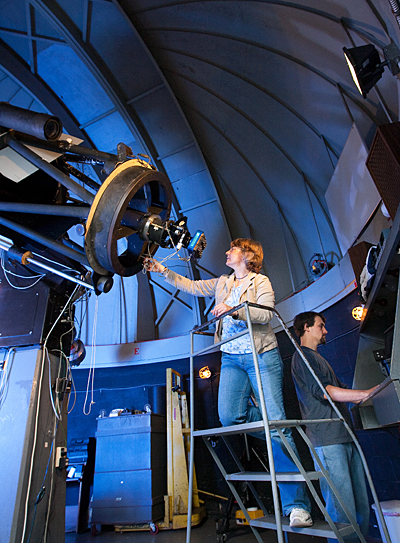
The Whole Earth Telescope (WET), a worldwide network of observatories coordinated by the University of Delaware, is synchronizing its lenses to provide round-the-clock coverage of a cooling star. As the star dims in the twilight of its life, scientists hope it will shed light on the workings of our own planet and other mysteries of the galaxy.

The dying star, a white dwarf identified as WDJ1524-0030, located in the constellation Ophiuchus in the southern sky, is losing its brightness as it cools, its nuclear fuel spent. It will be monitored continuously from May 15 to June 11 by WET, a global partnership of telescopes which was formed in 1986.
Scientists at South Dakota State University are exploring the mechanisms by which a substance derived ultimately from Red Sea coral could help treat skin cancer.

The study built on earlier work by SDSU distinguished professor Chandradhar Dwivedi’s lab looking at the chemopreventive effects of sarcophine-diol, made from a substance called sarcophine that can be isolated from soft coral found in the Red Sea. The new study carried the work beyond looking at sarcophine-diol’s possible use in prevention of skin cancer to consider its potential as a tool in therapies to actually treat skin cancer.

“We are finding that sarcophine-diol could be used both for chemoprevention and as a chemotherapeutic agent,” Dwivedi said.
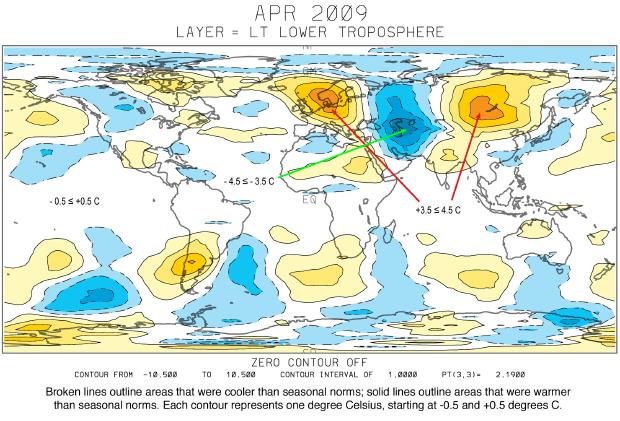
Global warming isn't spiking but the global composite temperature during April revealed an increase above the 20-year average for that month. The report is issued monthly as part of an ongoing joint project between The University of Alabama in Huntsville, NOAA and NASA.

As part of an ongoing joint project between The University of Alabama in
Huntsville, NOAA and NASA, Dr. John Christy, director of U.A. Huntsville's
Earth System Science Center, and Dr. Roy Spencer, a principal research
scientist in the ESSC, use data gathered by microwave sounding units on NOAA
and NASA satellites to get accurate temperature readings for almost all
regions of the Earth. This includes remote desert, ocean and rain forest