Duplicating our organic tissue synthetically isn't as easy as it sounds. Our bodily tissue is both soft and tough but modern implants - and replacement organs - will need to be as close to natural as possible to be effective.
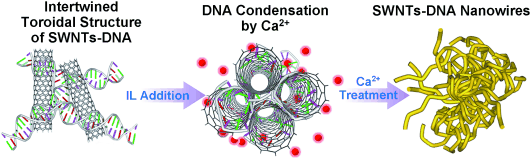
A team of Australian and Korean researchers led by Geoffrey M. Spinks and Seon Jeong Kim has now developed a novel, highly porous, sponge-like material whose mechanical properties closely resemble those of biological soft tissues. It consists of a robust network of DNA strands and carbon nanotubes.
Dartmouth Medical School geneticists say they have made new inroads into understanding the regulatory circuitry of the biological clock that synchronizes the ebb and flow of daily activities, according to two studies published May 15.
Research on the relationship between clocks and temperature, reported in Cell, offers insight into a longstanding puzzle of temperature compensation: why the 24-hour circadian rhythm does not change with temperature when metabolism is so affected. A related study, in Molecular Cell, tracks a clock protein in action, mapping hundreds of highly choreographed modifications and interactions to provide the first complete view of regulation across a day.
Let's be honest, the one thing you worry about most when driving your Hummer and sipping corporate-farmed coffee is how much damage that Union Oyster House ("oldest restaurant in America!") refrigerator magnet in your house is doing to the environment.
You're out of luck. The refrigerator magnets scientists are a step closer to making are for environmentally-friendly 'magnetic' refrigerators and air conditioning systems.
The research group of Dr. Frédéric Charron, a researcher at the Institut de recherches cliniques de Montréal (IRCM), has made a discovery which could help treat spinal cord injuries and neurodegenerative diseases. This new finding has been published in the current issue of Neuron.
The American Civil Liberties Union action in filing a lawsuit yesterday against Myriad Genetics is going to lead to one of the most important legal battles in the history of biotechnology, asserts Genetic Engineering&Biotechnology News(GEN). The ACLU charged that the patenting of two human genes linked to breast and ovarian cancer will inhibit medical research. The organization also claims that the patents are invalid and unconstitutional, though the ACLU didn't disclose which clause of the Constitution it violates.
Should You Share A Higher Genetic Risk?
If you learned that you were at high risk of cancer because you carry the hereditary BRCA1/2 gene mutation, would you tell your children? A recent study at Fox Chase Cancer Center not only considered that question, but also took it to the next level and studied the parent perceptions of the impact of such a decision on children. BRCA1/2 are hereditary gene mutations that indicate an increased risk of developing breast cancer.


 Here's Where Your Backyard Was 300 Million Years Ago
 Convergent Evolution Cheat Sheet Now 120 Million Years Old
 Synchrotron Could Shed Light On Exotic Dark Photons
 The Pain Scale Is Broken But This May Fix It