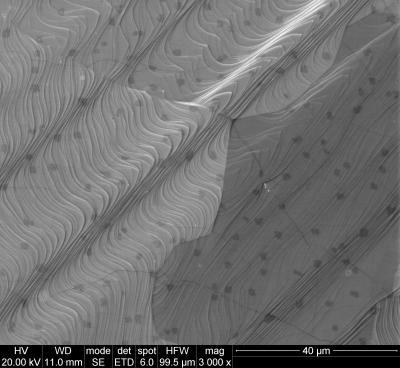
The creation of large-area graphene using copper may enable the manufacture of new graphene-based devices that meet the scaling requirements of the semiconductor industry, leading to faster computers and electronics, according to a team of scientists and engineers at The University of Texas at Austin.
Graphene, an atom-thick layer of carbon atoms bonded to one another in a "chickenwire" arrangement of hexagons, holds great potential for nanoelectronics, including memory, logic, analog, opto-electronic devices and potentially many others. It also shows promise for electrical energy storage for supercapacitors and batteries, for use in composites, for thermal management, in chemical-biological sensing and as a new sensing material for ultra-sensitive pressure sensors.
astric ulcer is an illness that affects a considerable number of people worldwide. Although the introduction of proton-pump inhibitors to the classic anti-ulcer therapy has revolutionized treatment of peptic ulcers and other gastrointestinal disorders, there is still no complete cure for this disease. It has been shown that long term use of these drugs leads to various adverse and side effects. Relapses of the malady, ineffectiveness of different drug regimens and even resistance to drugs are emerging. Thus, there is an urgent requirement to identify more effective and safe anti-ulcer agents.
New research led by investigators at Memorial Sloan-Kettering Cancer Center (MSKCC) identifies three genes that specifically mediate the metastasis, or spread, of breast cancer to the brain and illuminates the mechanisms by which this spread occurs. The study was published online today in Nature.
According to the study, COX2 and HB-EGF — genes that induce cancer cell mobility and invasiveness — were found to be genetic mediators in the spread of breast cancer to the brain. A third gene, ST6GALNAC5, was shown to provide cancer cells with the capability of exiting the blood circulation and passing through the blood-brain barrier to enter the brain tissue.
Children who can stay focused and don't sweat the small stuff have a better shot at good health in adulthood -- especially girls, according to findings reported in the May issue of Health Psychology.
A detailed analysis of the feet of Homo floresiensis, the miniature hominins who lived on a remote island in eastern Indonesia until 18,000 years ago, may help settle a question hotly debated among paleontologists: how similar was this population to modern humans? A new research paper in Nature may help answer this question.
While the so-called "hobbits" walked on two legs, they say, several features of their feet were so primitive that their gait was not efficient.
A new study from Northwestern University shows what many mothers already know: their babies are a lot smarter than others may realize.
Though only five months old, the study's cuties indicated through their curious stares that they could differentiate water in a glass from solid blue material that looked very much like water in a similar glass.
The finding that infants can distinguish between solids and liquids at such an early age builds upon a growing body of research that strongly suggests that babies are not blank slates who primarily depend on others for acquiring knowledge. That's a common assumption of researchers in the not too distant past.


 Here's Where Your Backyard Was 300 Million Years Ago
 Convergent Evolution Cheat Sheet Now 120 Million Years Old
 Synchrotron Could Shed Light On Exotic Dark Photons
 The Pain Scale Is Broken But This May Fix It