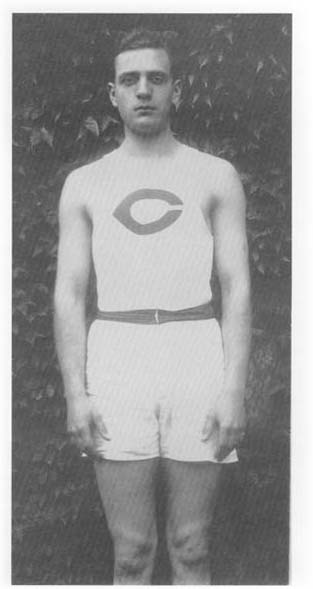
Most people know Edwin Hubble as a famed astronomer, the namesake of the orbiting Hubble Space Telescope (HST). Most probably don't know he also starred as a forward on the University of Chicago Maroons' Big Ten-champion basketball teams in the early part of the 20th century.
As an astronomer, Hubble showed that galaxies besides our own existed in the universe, and that the universe is expanding. These findings formed the cornerstone of the Big Bang theory of the universe's origin and opened the field of cosmology. As a basketball player, the 6-foot-2 Hubble was a member of Chicago teams that posted records of 24-2 in 1907-08 and 10-3 in 1908-09.
Toddlers with autism appear more likely to have an enlarged amygdala, a brain area associated with numerous functions, including the processing of faces and emotion, according to a report in the May issue of Archives of General Psychiatry.
In addition, this brain abnormality appears to be associated with the ability to share attention with others, a fundamental ability thought to predict later social and language function in children with autism.
It's certainly the case that 'dark matter', like 'Smurf' or 'government regulation', has in recent times become a de facto explanation for the unexplained. We aren't big believers in magic so mysterious, undetected forces that explain everything probably actually explain nothing - and tossing out Newton in the process brings on a higher order of scrutiny, since he has been declared irrelevant often before only to survive quite nicely.
Dark matter is currently unable to reconcile all the current discrepancies between measurements and predictions based on theoretical models and competing theories of gravitation have therefore been developed - their problem is that they conflict with Newton's theory of gravitation.
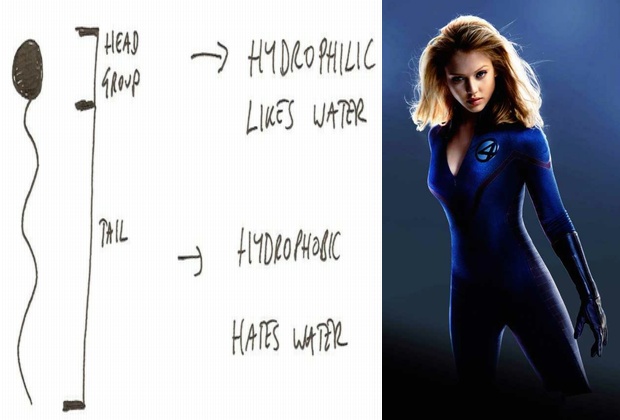
If you want to learn a little something about 'characteristic curvature', you're in the right place. Hydrophilic surfactants love water, but lipophilic surfactants love oils and dislike water.
Okay, if you were expecting an article about Jessica Alba, you can stop reading.
But if chemistry is your thing, a new research protocol developed by Dr. Acosta and colleagues from the University of Toronto's Department of Chemical Engineering and Applied Chemistry builds on more than 30 years of phase behavior studies of microemulsions, the clear, stable liquid mixtures of oil, water and surfactant, and the concept of hydrophilic-lipophilic difference.
NASA's Fermi Gamma-ray Space Telescope, launched June 2008, has certainly started its career with a (big) bang, discovering a new class of pulsars and watching flaring jets in galaxies billions of light-years away.
Now it's going after another cosmic mystery; high-energy particles in cosmic rays.
The description of compounds and interactions between atoms is one of the basic objectives of chemistry. Admittedly, chemical bonding models, which describe these properties very well, already exist. However, any deviation from the normal factors may lead to improving the models further. Chemists with Professor Thomas M. Klapötke at Ludwig-Maximilians-Universität (LMU) München have now analyzed a molecule, which has an extremely short bond length.


 Here's Where Your Backyard Was 300 Million Years Ago
 Convergent Evolution Cheat Sheet Now 120 Million Years Old
 Synchrotron Could Shed Light On Exotic Dark Photons
 The Pain Scale Is Broken But This May Fix It