Banner
Pilot Study: Fibromyalgia Fatigue Improved By TENS Therapy

Fibromyalgia is the term for a poorly-understood condition where people experience pain and fatigue...

High Meat Consumption Linked To Lower Dementia Risk

Older people who eat large amounts of meat have a lower risk of dementia and cognitive decline...

Long Before The Inca Colonized Peru, Natives Had A Thriving Trade Network

A new DNA analysis reveals that long before the Incan Empire took over Peru, animals were...

Mesolithic People Had Meals With More Tradition Than You Thought

The common imagery of prehistoric people is either rooting through dirt for grubs and picking berries...

User picture.
News StaffRSS Feed of this column.

News Releases From All Over The World, Right To You... Read More »

Blogroll
The U.S. Centers for Disease Control and Prevention estimates that drug-resistant bacteria sicken two million U.S. residents annually and cause about 23,000 deaths. Federal officials have called combating antibiotic resistance a national priority.

To aid in that effort, a second-generation antibiotic has shown early effectiveness against common bacterial infections that pose a serious health threat to children and adults. Researchers discovered it by changing the chemical structure of an old antibiotic named spectinomycin, a safe but weak drug first introduced in the 1960s.
A detailed analysis of the remains of a high-status Danish Bronze Age female, known as the Egtved Girl, has revealed information about her movements, what she ate, and where her clothes came from.

The Egtved Girl, a 16–18 year old female, was discovered in the Danish village of Egtved in an oak coffin, calculated to have been buried around 3,400 years ago.
 A new class of magnets that swell in volume when placed in a magnetic field also generate negligible amounts of wasteful heat during energy harvesting.

This "Non-Joulian Magnetostriction" could change the way we think about a certain type of magnetism that has been in place since 1841, when physicist James Prescott Joule discovered that iron-based magnetic materials changed their shape but not their volume when placed in a magnetic field. This phenomenon is referred to as "Joule Magnetostriction," and since its discovery 175 years ago, all magnets have been characterized on this basis.

In 2003, while French youth protested American imperialism, 14,000 mostly elderly people were allowed to die in a heat wave. Heat waves kill a lot more people, it is believed, except they don't. Instead, an analysis of  74 million deaths in 384 locations across Australia, Brazil, Canada, China, Italy, Japan, South Korea, Spain, Sweden, Taiwan, Thailand, UK, and the USA found that cold weather kills about 20 times as many people as hot weather.

Scientists have found stone tools dating back 3.3 million years, long before the advent of modern humans, and by far the oldest such artifacts yet discovered.

The tools, whose makers may or may not have been some sort of human ancestor, push the known date of such tools back by 700,000 years and may challenge the notion that our own most direct ancestors were the first to create new technology.

The discovery is the first evidence that an even earlier group of proto-humans may have had the thinking abilities needed to figure out how to make sharp-edged tools. The stone tools mark "a new beginning to the known archaeological record," say the authors of a new paper about the discovery. 

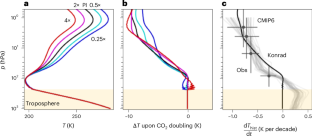
Researchers have confirmed strong warming in the upper troposphere, known colloquially as the tropospheric hotspot, long expected as part of the global warming hypothesis. 

Though the tropospheric hotspot appears in many global climate models, the inability to detect it has been used to suggest climate change is not occurring as a result of increasing carbon dioxide emissions.