Palaeontologists have discovered a new fossil species called Cloudina carinata, a small fossil with a tubular appearance and one of the first animals that developed an external skeleton between 550 and 543 million years ago. The discovery is documented in Precambrian Research.
The fossils were found in the archaeological site El Membrillar (Badajoz), one of the few sites in Europe where the remains of Cloudina can be found. "The specimens display exceptional preservation, they appear preserved in three dimensions, and show their original form and numerous details of the shells", lead author Iván Cortijo says. "Cloudina carinata is characterized by its elaborate ornamentation and complexity of the shells and tube that are formed when inserted."
In a paper appearing today in Science, Los Alamos researchers report that a newly discovered "loading-unloading" effect allows nanocrystalline materials to heal themselves after suffering radiation-induced damage. The discovery may eventually lead to much safer nuclear power plants.
Nanocrystalline materials are those created from nanosized particles, in this case copper particles. A single nanosized particle—called a grain—is the size of a virus or even smaller. Nanocrystalline materials consist of a mixture of grains and the interface between those grains, called grain boundaries.
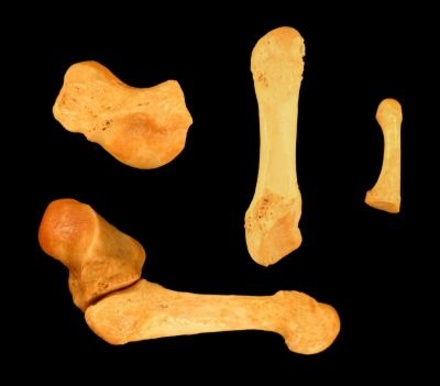
Scientists have identified a hip bone found at Dinosaur Cove in Victoria, Australia that belonged to an ancestor of Tyrannosaurus rex. The discovery is the first evidence that tyrannosaur dinosaurs existed on southern continents.
The find, published in Science, sheds new light on the evolutionary history of this group of dinosaurs. It also raises the crucial question of why it was only in the north that tyrannosaurs evolved into the giant predators like T. rex.
The 30cm-long pubis bone from Dinosaur Cove looks like a rod with two expanded ends, one of which is flattened and connects to the hip and the other looks like a 'boot'.
As a result of the economic growth across much of Asia pollution from the region is being wafted up to the stratosphere during monsoon season, according to a new study in Science.
The new finding provides additional evidence of the global nature of air pollution and its effects far above Earth's surface.
Using satellite observations and computer models, the research team determined that vigorous summertime circulation patterns associated with the Asian monsoon rapidly transport air upward from the Earth's surface. Those vertical movements provide a pathway for black carbon, sulfur dioxide, nitrogen oxides, and other pollutants to ascend into the stratosphere, about 20-25 miles above the Earth's surface.
Satellite measurements of the Atlantic Meridional Overturning Circulation (AMOC), part of the global ocean conveyor belt that helps regulate climate around the North Atlantic, show no significant slowing over the past 15 years and suggest that the circulation may have even sped up slightly in the recent past.
The findings are the result of a new monitoring technique, developed by oceanographer Josh Willis of NASA's Jet Propulsion Laboratory in Pasadena, Calif., using measurements from ocean-observing satellites and profiling floats.
Tumors mimic key features of lymph nodes in order to create a tolerant microenviroment and escape attack from the immune system, say researchers from Ecole Polytechnique Fédérale de Lausanne in Switzerland.
The discovery, published in Science underscores the role of the lymphatic system in cancer and may open up new possibilities for cancer treatment.


 Here's Where Your Backyard Was 300 Million Years Ago
 Convergent Evolution Cheat Sheet Now 120 Million Years Old
 Synchrotron Could Shed Light On Exotic Dark Photons
 The Pain Scale Is Broken But This May Fix It