Banner
You Didn't Feel Continental Mantle Earthquakes, But They Happened. A Lot

A 1979 seismic event was a different kind of earthquake, and it is has intrigued scientists ever...

How To Overcome Leadership Battles

In times of social rancor and strife, most will fight each other, but societies are saved by those...

Thousands Of Unpublished Studies Show Why Conservation Efforts Miss The Mark

Europe alone has so much unpublished, un-catalogued biological data that it is challenging to take...

Why Antarctic Sea Ice Stopped Growing In 2015

Though numerical models and popular films like An Inconvenient Truth projected Arctic ice...

User picture.
News StaffRSS Feed of this column.

News Releases From All Over The World, Right To You... Read More »

Blogroll

Fibromyalgia has emerged as a common yet difficult to treat disorder. A group of investigators of the University of Basel has proposed a new modality of treatment; mindfulness-based stress reduction (MBSR).

Studies suggest improvements in general aspects of well-being, including quality of life (QoL), coping and positive affect, as well as decreased anxiety and depression. A quasi-experimental study examined effects of an 8-week MBSR intervention among 58 female patients with fibromyalgia (mean, 52 ± 8 years) who underwent MBSR or an active social support procedure.

In Central Siberia alone, fires have destroyed 38 000 km2 in the extreme fire year of 2003. In that year the smoke plumes were so huge that they caused air pollution as far as in the United States. An international team of scientists believes that Siberian fires are influenced by climate change. The study was led by the Professor Heiko Balzter of the Department of Geography at the University of Leicester.

Professor Balzter said, “Last century a typical forest in Siberia had about 100 years after a fire to recover before it burned again. But new observations by Russian scientist Dr Kharuk have shown that fire now returns more frequently, about every 65 years.

Phytase research is helping to clean up the waterways in Delaware.

According to recent analyses by David Hansen, University of Delaware assistant professor of soil and environmental quality, there are now about 19 pounds of phosphorus in a ton of Delaware poultry litter compared to 25 to 30 pounds of phosphorus per ton of litter just five years ago. The 30-40 percent reduction is credited to phytase-modified diets and other nutrient management practices adopted by poultry farmers under Delaware's Nutrient Management Law of 1999.

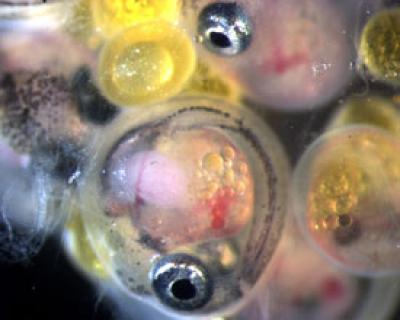
A research team has found experimental evidence that supports a controversial theory of genetic conflict in the reproduction of those animals that support their developing offspring through a placenta.

The conflict has been likened to a “battle of the sexes” or an “arms race” at the molecular level between mothers and fathers. At stake: the fetus’s growth rate and how much that costs the nutrient-supplying mother.

The new research supports the idea of a genetic “arms race” going on between a live-bearing mother and her offspring, assisted by the growth-promoting genes of the father.


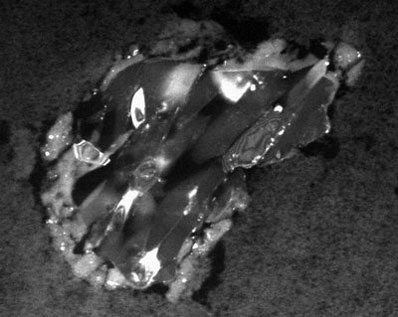
An ovary of the live-bearing placental fish, Poeciliopsis prolifica.

Picture a cool place, teeming with a multitude of hot bodies twirling about in rapidly changing formations of singles and couples, partners and groups, constantly dissolving and reforming.

That's a good description of the shells around dying stars, the place where newly formed elements make compounds and life takes off, said Katharina Lodders, Ph.D., research associate professor of earth and planetary sciences in Arts & Sciences at Washington University in St. Louis.

“The circumstellar environment is where chemistry happens for the very first time,” said Lodders. “It's the first place a newly synthesized element can do chemistry. It's a supermarket of things from dust to gas and dust grains to molecules and atoms.

Neuroscientists have long believed that vision is processed in the brain along circuits made up of neurons, similar to the way telephone signals are transferred through separate wires from one station to another. But scientists at Georgetown University Medical Center discovered that visual information is also processed in a different way, like propagating waves oscillating back and forth among brain areas.

“What we found is that signals pass through brain areas like progressive waves, back and forth, a little bit like what fans do at baseball games,” said the study’s corresponding author, Jian-young Wu, Ph.D., an associate professor in the Department of Physiology and Biophysics at Georgetown.