Banner
You Didn't Feel Continental Mantle Earthquakes, But They Happened. A Lot

A 1979 seismic event was a different kind of earthquake, and it is has intrigued scientists ever...
How To Overcome Leadership Battles

In times of social rancor and strife, most will fight each other, but societies are saved by those...
Thousands Of Unpublished Studies Show Why Conservation Efforts Miss The Mark

Europe alone has so much unpublished, un-catalogued biological data that it is challenging to take...

Why Antarctic Sea Ice Stopped Growing In 2015

Though numerical models and popular films like An Inconvenient Truth projected Arctic ice...

User picture.
News StaffRSS Feed of this column.

News Releases From All Over The World, Right To You... Read More »

Blogroll

People with bipolar disorder – or manic depression – suffer from an accelerated shrinking of their brain, researchers at the University of Edinburgh have found.

The study shows for the first time that bipolar disorder – a condition characterised by periods of depression and periods of mania – is associated with a reduction in brain tissue and proves that the changes get progressively worse with each relapse.

This discovery has implications not only for the way we research the disease, but may also impact the way this condition is treated.

At very young ages, children’s defiant behavior toward their mothers may not be a bad thing. This defiance may in fact reflect children’s emerging autonomy and a confidence that they can control events that are important to them.

Those are the findings of a new study conducted by researchers at the University of Texas at Austin and the University of Michigan.

To understand how very young children react to being controlled by their parents, the researchers videotaped 119 mostly middle-class mothers as they interacted with their 14- to 27-month-old children. Mothers were asked to have their children avoid a set of attractive toys and, when play time was over, to get their children to help them clean up those toys they had been allowed to use.

Two NASA robots are surveying a rocky, isolated polar desert within a crater in the Arctic Circle. The study will help scientists learn how robots could evaluate potential outposts on the moon or Mars.

The robots, K10 Black and K10 Red, carry 3-D laser scanners and ground-penetrating radar. The team arrived at Haughton Crater at Devon Island, Canada, on July 12 and will operate the machines until July 31. Scientists chose the polar region because of the extreme environmental conditions, lack of infrastructure and resources, and geologic features. Also, Haughton Crater is geographically similar to Shackleton Crater at the South Pole of the moon. Both are impact craters that measure roughly 12.4 miles in diameter.

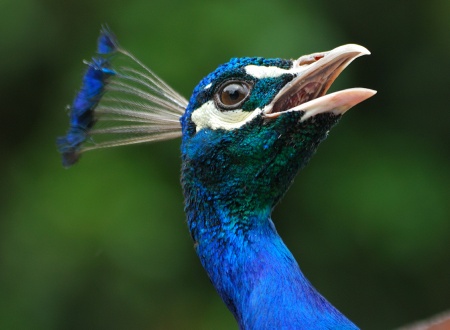
Even in the Animal Kingdom, there are some common sense rules. The more likely to get a big return, for example, the more work will be invested. That goes for male-female relationships as well.

A French team of behavioral ecologists demonstrated that in the Peafowl. They found that females with attractive mates invested more resources in their eggs than females paired with unattractive mates. They laid larger eggs and deposited more testosterone in egg yolk, potentially offering a better prospective to their offspring.

Adeline Loyau, Michel Saint Jalme, Robert Mauget, and Gabriele Sorci of the National Museum of Natural History and the Laboratory of Evolutive Parasitology, Paris, investigated maternal investment in the peafowl (Pavo cristatus).

Scientists have discovered two species of groundwater amphipods that are found solely in Iceland. These finding can only be explained by these animals surviving glaciations in some kind of refugium under the glaciers.

Many scientists believe that the ice ages exterminated all life on land and in freshwater in large parts of the Northern Hemisphere, especially on ocean islands such as Iceland. Scientists at Holar University College and the University of Iceland have challenged that belief, at least when looking at groundwater animals.

They have discovered two species of groundwater amphipods in Iceland that are the only animals species found solely in Iceland.

Researchers at the University of Pennsylvania School of Medicine are the first to observe and measure the internal motion inside proteins, or its “dark energy.” This research, appearing in the current issue of Nature has revealed how the internal motion of proteins affects their function and overturns the standard view of protein structure-function relationships, suggesting why rational drug design has been so difficult.

The situation is akin to the discussion in astrophysics in which theoreticians predict that there is dark matter, or energy, that no one has yet seen,” says senior author A. Joshua Wand, PhD, Benjamin Rush Professor of Biochemistry.