





I was thinking about how us humans have 25,000 or so genes, and I know nothing about 99.9% of them. And I call myself a molecular geneticist! Wouldn't it be nice to know a little more about the strands of DNA that play a big part in making up who we are? I think it would be, so I'm going to start a semi-frequent excersion into the human genome and invite any willing blog readers to join with me.

The first fax machine had no value. It couldn't send a fax to anyone. It was, from a value perspective, useless.

The second fax machine added value to the first because it now had something which could receive faxes. The third added value to the first two and received value from them in the network as well. As each fax machine came into existence, the value it added was nonlinear. The more fax machines that existed, the more value each of them had.

Many things in life are like that.


Peak oil is loosely defined at the point in time when half of all the oil reserves in the earth have been extracted and burned.  This means that we are half way through the oil consumption cycle and move into extracting the remaining 50%.

rose.jpg

Show Notes for Episode 9

Oceanographers have completed an important step in constructing the first deep-sea observatory off the continental United States. Workers in the multi-institution effort laid 32 miles (52 kilometers) of cable along the Monterey Bay sea floor that will provide electrical power to scientific instruments, video cameras, and robots 3,000 feet (900 meters) below the ocean surface. The link will also carry data from the instruments back to shore, for use by scientists and engineers from around the world.


An illustration of the MARS undersea observatory shows its cabled links. Credit: David Fierstein, MBARI

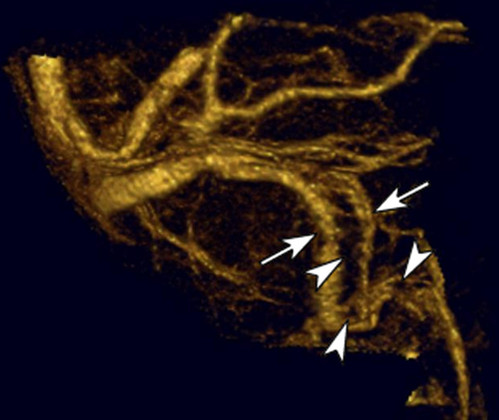
University of Cincinnati (UC) neuroradiologists believe a brain imaging approach that combines standard magnetic resonance imaging (MRI) scans with specialized contrast-enhanced techniques could lead to more effective diagnoses in patients with difficult-to-detect blood clots in veins of the brain.

James Leach, MD, reports these findings in the April issue of the American Journal of Neuroradiology. This is the first study to correlate the clinical importance of data gleaned from standard MRI scans and detailed contrast-enhanced imaging techniques in patients with chronic thrombosis (blood clots) in veins of the brain.

The double sunset that Luke Skywalker gazed upon in the film "Star Wars" might not be a fantasy.

Astronomers using NASA's Spitzer Space Telescope have observed that planetary systems – dusty disks of asteroids, comets and possibly planets – are at least as abundant in twin-star systems as they are in those, like our own, with only one star. Since more than half of all stars are twins, or binaries, the finding suggests the universe is packed with planets that have two suns.

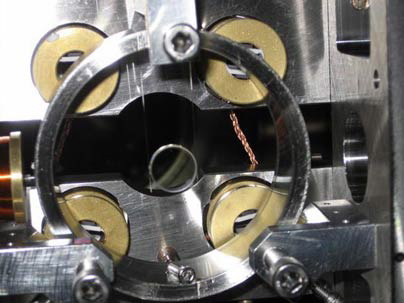
Using a laser-cooling technique that could one day allow scientists to observe quantum behavior in large objects, MIT researchers have cooled a coin-sized object to within one degree of absolute zero.

This study marks the coldest temperature ever reached by laser-cooling of an object of that size, and the technique holds promise that it will experimentally confirm, for the first time, that large objects obey the laws of quantum mechanics just as atoms do.


MIT researchers have developed a technique to cool this dime-sized mirror (small circle suspended in the center of large metal ring) to within one degree of absolute zero. Photo / Christopher Wipf

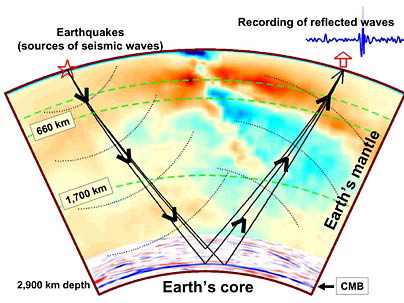
High-resolution images that reveal unexpected details of the Earth's internal structure are among the results reported by MIT and Purdue scientists in the March 30 issue of Science.

The researchers adapted technology developed for near-surface exploration of reservoirs of oil and gas to image the core-mantle boundary some 2,900 kilometers, or 1,800 miles, beneath Central and North America.


Seismic waves from earthquakes penetrate the Earth's mantle and scatter back at the core-mantle boundary to detectors on the surface. Nearly 100,000 such recordings are used to illuminate the planet's deep internal structures. Image courtesy / Robert van der Hilst, MIT

Flexible electronic membranes may overcome a longstanding dilemma faced by brain researchers: How to replicate injuries in the lab without destroying the electrodes that monitor how brain cells respond to physical trauma.

Developed by a team of engineers at Princeton University, Columbia University and the University of Cambridge, the membranes feature microelectrodes that are able to withstand the sudden stretching that is used to simulate severe head trauma. The systems could allow far more nuanced studies of brain injury than previously possible and may lead to better treatments in the minutes and hours immediately following the injury.


