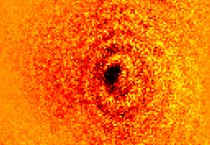
Researchers have been able to photograph the shadow of a single atom for the first time.
And this absorption imaging took five years of work. They basically wanted to investigate how few atoms are required to cast a shadow and they found it takes just one. At the heart of the effort is a super high-resolution microscope, which makes the atom's shadow dark enough to see.
People still use optical microscopes in research? Apparently so. And the Griffith University team claims no other facility in the world has the capability for such extreme optical imaging. They did it by isolating it in a chamber and immobilizing it in free space using electrical forces.
Although boredom very rarely escapes the notice of those suffering from it, constructing a purely technical instrument for reliably recognising boredom in humans is currently rated as a non-trivial task.
But recently, a team from George Mason University, the University of North Carolina, the Georgia Institute of Technology and the Naval Research Lab, Washington, DC have between them devised a provisional system for doing just that.
Plato famously maintained that knowledge is “justified true belief,” meaning that to claim the status of knowledge our beliefs (say, that the earth goes around the sun, rather than the other way around) have to be both true (to the extent this can actually be ascertained) and justified (i.e., we ought to be able to explain to others why we hold such beliefs, otherwise we are simply repeating the — possibly true — beliefs of someone else).*
It is the “justified” part that is humbling, since a moment’s reflection will show that a large number of things we think we know we actually cannot justify, which means that we are simply trusting someone else’s authority on the matter. (Which is okay, as long as we realize and acknowledge that to be the case.)
Rolf is drawing the conclusions. He just asked the audience:
"I think we have it. Do you agree ?" And a roar of consensus fills the auditorium.
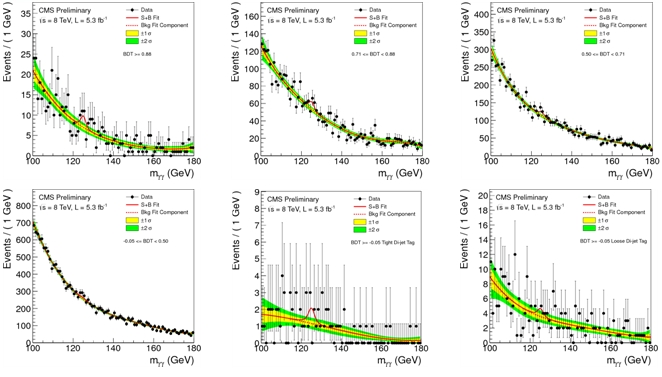
The slide says "The observation of a new particle consistent with a Higgs boson".
It is a historic milestone, but only the beginning.
A standing ovation follows. Then a connection with Melbourne, with the other auditorium applauding. Now questions in the CERN site ensuing.
Theorists take the stage, Higgs saying it is an extraordinary achievement for the lab, and that he is glad that it happened in his lifetime.
A very moving finale !
At CERN, the European Particle Physics Laboratory, the ATLAS and CMS experiments presented their latest results in the search for the Higgs particle. Both experiments see strong indications for the presence of a new particle in the mass region around 125-126 GeV and a 4.9-5 sigma signal.
When the results from the two experiments are combined, they should show a 5-sigma signal and be a discovery. If this is indeed a new particle, then it must be a boson and it would be the heaviest such particle ever found.
[ The previous entries of this live blogging series are available
here (part 1) ,
here (part 2) ,
here (part 3) ,
here (part 4), and
The Higgs boson
has been discovered last year. There is no news today. It is merely the significance level that is a little higher now, but even a level of so called “five sigma” (don’t worry if you do not understand it, it is arbitrary anyway) does not prove anything.
The long and complicated journey to detect the Higgs boson might finally have reached its goal, said experimental physicists at the European Laboratory for Particle Physics, CERN, near Geneva - and they said it with a telltale bump on a slide.
The Higgs boson is the final building block that has been missing from the "Standard Model," which describes the structure of matter in the universe. The Higgs boson combines two forces of nature and shows that they are, in fact, different aspects of a more fundamental force. The particle is also responsible for the existence of mass in the elementary particles.
[ The first three entries of this live blogging series are available
here (part 1) and
here (part 2) and
here (part 3) and
here (part 4) and
[ The first three entries of this live blogging series are available
here (part 1) and
here (part 2) and
here (part 3) and
here (part 4)].