

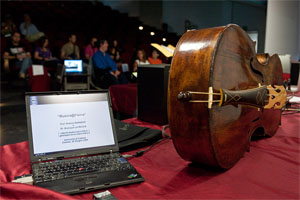



This morning I attended the first session of the Physics in Collisions conference in Kobe, which dealt with Electroweak Physics. The four talks I could listen to were all of very good quality, and I am not ashamed to say that I did learn a thing or two, despite this is a field of investigations on which I have focused for over a decade. Also, I decided that conferences featuring few, long talks are definitely better than ones which try to cram dozens of small contributions in tight schedules: at least, the session conveners are not required to play the watchdog and struggle to keep people within their allotted time, and post-talk questions and comments are actually encouraged rather than suppressed.
Functional magnetic resonance imaging (fMRI) is a technique widely used tdoay in studying the human brain but its actual value in correlation is unclear.   No one knows exactly how fMRI signals are generated at brain cell level but it is crucially important to interpreting these imaging signals.

Scientists from the Academy of Finland's Neuroscience Research Programme (NEURO) say they have discovered that astrocytes, support cells in brain tissue, play a key role in the generation of fMRI signals.
Do you long to hear the dulcet sounds of the salpinx, barbiton, aulos or the syrinx?   Of course not, because no one has heard them in centuries.   Most people have never even heard of them.

But you will soon have the chance to experience musical instruments familiar to ancient civilizations but long since forgotten.

Ancient instruments probably got lost because they were too difficult to build or too difficult to play.    The ASTRA (Ancient instruments Sound/Timbre Reconstruction Application) team is tasked with bringing them back to life and already have successfully reconstructed the sound of an earlier instrument called the 'epigonion'.
If you've read this site for any length of time, you know we are fans of open access.    The notion that research funded by taxpayers should be in the hands of billion-dollar media companies who charge scientists to publish and then hold the copyrights is ridiculous.

President Bush signed into law the Consolidated Appropriations Act of 2007 (H.R. 2764) and it immediately came under attack by media lobbyists and the politicians they support.   
Today I wish to offer you the preview of a poster which I am going to show on September 1st in Kobe, Japan, at a session of the 29th edition of the Physics in Collisions conference.
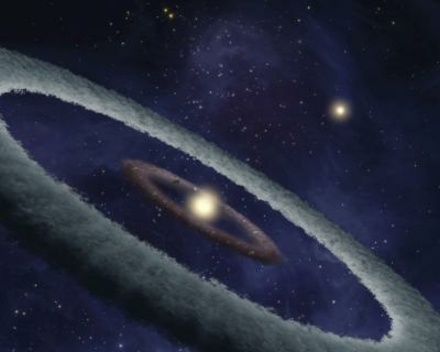
People sometimes think the space between stars is 'empty' but that's not the case.   That area is filled with patches of low-density gas and when a relatively dense clump of gas gets near a star, the resulting flow produces a drag force on any orbiting dust particles. The force only affects the smallest particles -- those about one micrometer across, or about the size of particles in smoke. 

This explains the otherwise difficult to understand shapes of those dust-filled disks, according to a team led by John Debes at NASA's Goddard Space Flight Center in Greenbelt, Md.
Who are you?  Who are you online?  Are you the same to everyone?  Should you be?

There's been a lot of talk about Google Wave as a new communications paradigm.  I like Wave.  I also think it's retro, harkening back to Nelson and Engelbart's work in the 60s.  Evolutionary rather than revolutionary, as the quote goes.  But even Wave assumes you are a single 'you'.  They need to look at handling multiple personas.
Finally an article that blasts the preposterous mythology suggesting that human longevity is a relatively recent phenomenon and primarily due to advances in medical technology.
http://www.livescience.com/health/090821-human-lifespans.html
In reviewing some of the comments made to the article it is clear that there is still a great deal of confusion surrounding the difference between "expectancy" and "lifespan".  The basic point in the article is that human life span is fundamentally unchanged over 2,000 years and quite possibly for a much longer period before that.
Scientific Blogging's University Writing Competition kicks off next Tuesday, September 1st.  There's been a lot of buzz and excitement about our first-ever writing competition that will give one lucky grad student a $2,500 cash prize, and a paid 3-month writing internship at Scientific Blogging.


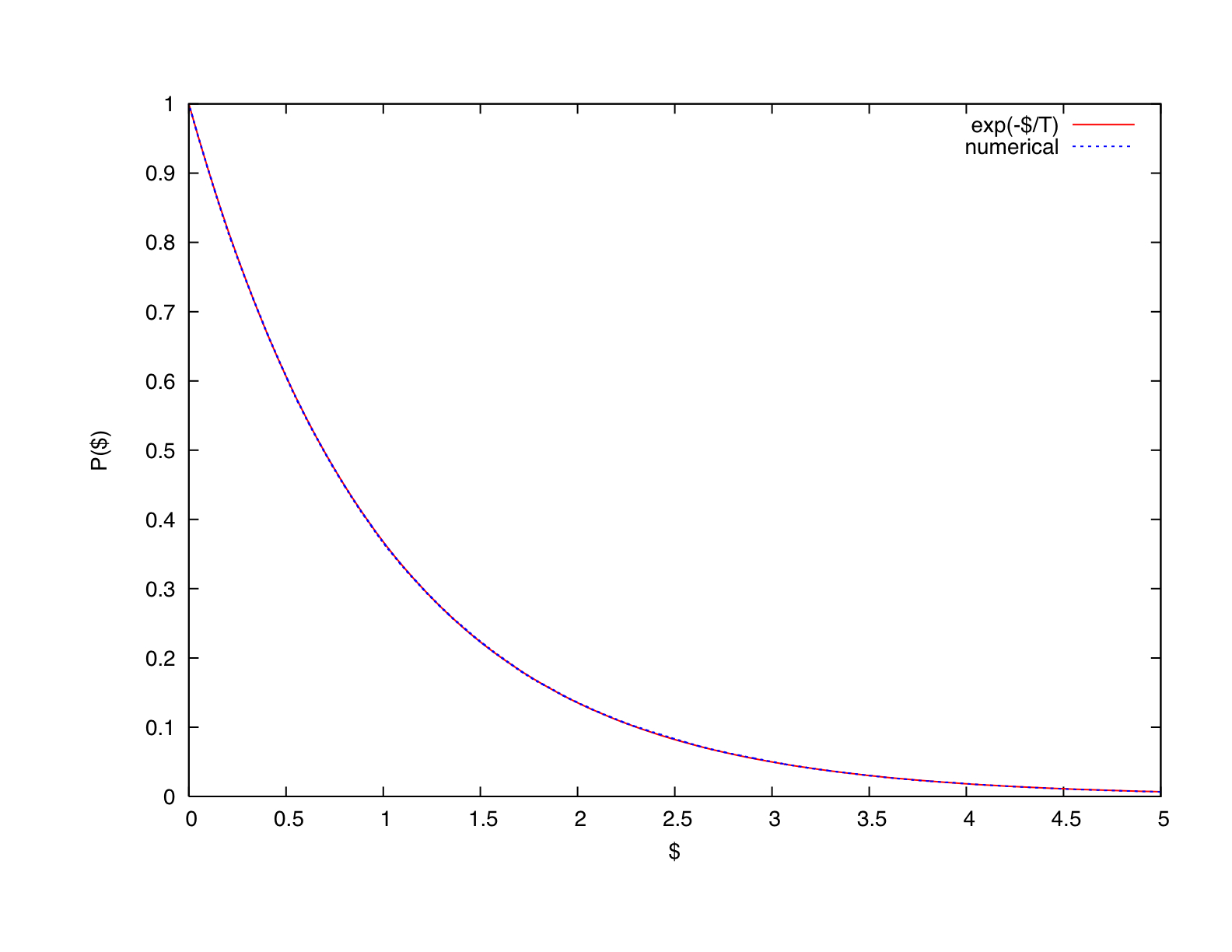
Data on the distribution of wealth is apparently hard to come by directly, but inheritance tax data from the UK for some years is available.  This data, it turns out, can be well-fit by an exponential function, over most of the UK population [1].  That is, the probability of having w amount of wealth appeared to be proportional to exp(-w/T), for some constant T.  Income tax data from the US from 1983 through 2005 [1-5], the UK from 1994 through 1999 [1], and Australia from 1989 through 2000 [4] also followed an exponential curve.


