Recombination, the process by which a molecule of (usually) DNA is broken and joined to another one, is one of the main sources of genetic diversity in sexual organisms. Meiotic recombination takes place during the meiotic division (which gives rise to the gametes), and through the process chromosomes show crossover (see figure 1).
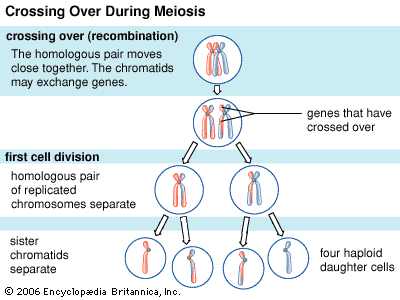
Figure 1: An illustration of crossing over during the meiotic division.
We’ve just finished a documentary on Stephen Hawking and I hand Bobby the dvd and ask him to put it in. “What now, Mama?”
“Wait and see,” I tell them.
As the film starts, my three children, all at various points in the spectrum, all engaged in their own private worlds, perk up and stop to look at the tv where sounds of a person humming begin spontaneously upon the dvd loading.
All three set aside their cards or books and watch. Lily peppers me with questions as music plays and a child(?) draws people in vibrant markers.
Everyone is a journalist due to the modern Internet, we are told. Not so, says a University of Georgia analysis. Instead, 2 percent of people who start discussions attract about 50 percent of the replies and that is good news for traditional journalism.
The downside is they used Internet newsgroups to validate this belief - if you aren't familiar with newsgroups, that's because Web-based interfaces killed their popularity but throughout much of the 1990s newsgroups were popular and even Google makes the newsgroup interface more attractive.
And here they come. Much
awaited (and
anticipated), today the DZERO collaboration presents their findings in the search of the same dijet resonance which made it to the New York Times as well as to several physics blogs around the web, and which brought frantic theorists back to the blackboard to try and figure out a model that could allocate the cumbersome new find.
Did science in newspapers die? By 2009, USA Today, the Washington Post, and the Wall Street Journal ended their Science sections, leaving just the New York Times as a major paper with a dedicated science section. CNN cut their entire science and tech team.
Dana Topousis of the NSF discussed the role of the National Science Foundation in the new media landscape at a DCSWA workshop in 2009. She noted that the NSF.gov's "Discoveries" gets the most traffic of the NSF site. NSF sees its role as protecting scientist's free speech. One venture they launched is Science360.gov, as a 1-stop shop for any science news.
Before getting to the review, I thought I'd share some of the lighter side of what comes from actively engaging people who think vaccines are responsible for all of today's ills.
You know you've spent too much time on the internet when you dream that Seth Mnookinborg (fascinating combination, no idea why, except for anti-vaccine folks linking all of the science-based writers together in various combinations that have me as a minion, an accolyte, or even Orac-in-a-skirt) is advising you on something related to blogging about vaccines.
Most people know that we have tried to judge what may happen during global warming by creating gigantic models of the Earth system, and see how it responds to forcing from different factors.
Another way that we approach the problem, is, (in my opinion) a much more interesting line of research, and that is looking in the geological record to see how the Earth responded in the past to global warming events, and to use these to inform us about what may happen now.
Domesticated rice, Oryza sativa indica (indica) and Oryza sativa japonica (japonica), are major staple crops in Asia. Evolutionary biologists and historians have long wondered if both once had an original point of domestication in common, or they were domesticated independently twice.
My pal
Julie Stewart tags Humboldt squid. She catches squid, attaches little recording devices to them, then drops them back in the ocean and waits for the tag to pop off a few days later. When it pops off, it's supposed to chirp out a satellite signal. That's Julie's cue to hop in a boat, pick up the tag and (hopefully) decode all the tag data to learn about the day-to-day lives of the squid.
That's the ideal model, and it doesn't always work out. Tags malfunction and the ocean is unpredictable, and a certain number are lost at sea. It happens.
The diving bell spider, Argyroneta aquatica, spend their entire lives underwater - they even lay their eggs in their 'diving bells'.
A new study shows that each spider constructs a net of silk in vegetation beneath the surface and fills it with air carried down on its abdomen - and the spiders can use the diving bell like a gill to extract oxygen from water to remain hidden beneath the surface.








 and japonica (J).png "Like Rice? Thank A Pirate!")