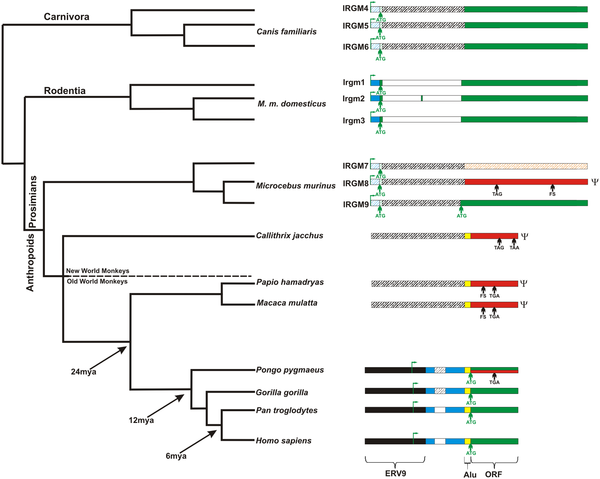
Researchers have discovered that a long-defunct gene was resurrected during the course of human evolution. This is believed to be the first evidence of a doomed gene – infection-fighting human IRGM – making a comeback in the human/great ape lineage.
The truncated IRGM gene is one of only two genes of its type remaining in humans. The genes are Immune-Related GTPases, a kind of gene that helps mammals resist germs like tuberculosis and salmonella that try to invade cells. Unlike humans, most other mammals have several genes of this type. Mice, for example, have 21 Immune-Related GTPases. Medical interest in this gene ignited recently, when scientists associated specific IRGM mutations with the risk of Crohn's disease, an inflammatory digestive disorder.
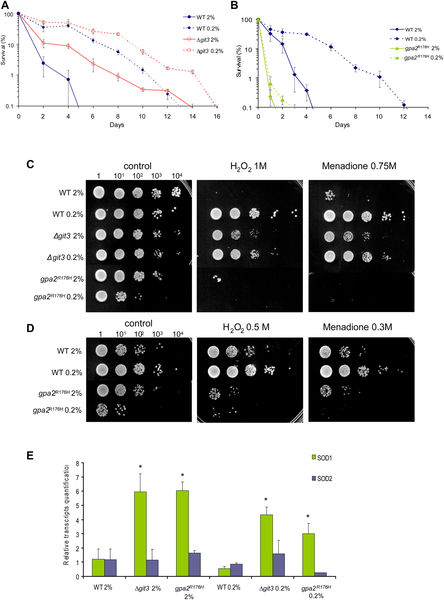
We know that lifespan can be extended in some animals by restricting calories such as sugar intake shortly after birth. Université de Montréal scientists now say that it's not sugar itself that is important in this process but the ability of cells to sense its presence.
Aging is a complex phenomenon and the mechanisms underlying aging are yet to be explained. What researchers do know is that there is a clear relationship between aging and calorie intake. For example, mice fed with half the calories they usually eat can live 40 percent longer. How does this work?
Dual catalysts may be the key to efficiently turning carbon dioxide and water vapor into methane and other hydrocarbons using titania nanotubes and solar power, according to Penn State researchers.
Burning fossil fuels like oil, gas and coal release large amounts of carbon dioxide, a greenhouse gas, into the atmosphere. Rather than contribute to global climate change, producers could convert carbon dioxide to a wide variety of hydrocarbons, but this makes sense to do only when using solar energy.
Two highly lethal viruses that have emerged in recent outbreaks are susceptible to chloroquine, an established drug used to prevent and treat malaria, according to a new basic science study by researchers at Weill Cornell Medical College in the Journal of Virology.
The two henipaviruses that are the subject of the study -- Hendra Virus (HeV) and Nipah Virus (NiV) -- emerged during the 1990s in Australia and Southeast Asia. Harbored by fruit bats, they cause potentially fatal encephalitis and respiratory disease in humans, with a devastating 75 percent fatality rate. More recently, NiV outbreaks in Bangladesh involving human-to-human transmission have focused attention on NiV as a global health concern.
Scientists identified seven new species of bamboo coral discovered in the deep waters of the Papahānaumokuākea Marine National Monument. Six of these species may represent entirely new genera, a remarkable feat given the broad classification a genus represents. A genus is a major category in the classification of organisms, ranking above a species and below a family. Scientists expect to identify more new species as analysis of samples continues.
Overweight children and adolescents, with the active involvement of their parents and families, can successfully lose weight.
People are not biologically inclined to have a particular food addiction so patience and support are key but so is recognizing that it won't happen unless the kids are determined to change and they get some help; parents who have always bought junk food, for example, need to stop. And kids who may have always had an unhealthy lifestyle need to recognize that and make some changes.
A team of experts that includes physicians and psychologists propose a new model of care for treating childhood and teen obesity which includes dietary, fitness, and lifestyle changes, education, and as a final option, if needed, surgery.
Scientists at the Sol Goldman Pancreatic Cancer Research Center at the Johns Hopkins Kimmel Cancer Center have used "personalized genome" sequencing on an individual with a hereditary form of pancreatic cancer to locate a mutation in a gene called PALB2 that is responsible for initiating the disease. The discovery marks their first use of a genome scanning system to uncover suspect mutations in normal inherited genes.
The coding error in PALB2, which stands for "partner and co-localizer of BRCA2" causes a shortened version of the protein encoded by this gene, rendering it incapable of working with another cancer-related gene, BRCA2, to repair broken DNA. Mutations in BRCA2 are also known to cause hereditary forms of cancer.
In the past two years, University of Texas Southwestern researchers have used a computer-based text-searching tool they developed, called eTBLAST, to analyze millions of abstracts randomly selected from Medline, one of the largest databases of biomedical research articles. They turned up nearly 70,000 highly similar citations.
Their subsequent analysis of a small sampling of these, including human inspection of the articles in question, revealed 207 pairs of articles with signs of potential plagiarism.
In a commentary appearing in Science, the UT Southwestern researchers outline the wide range of reactions they received when they followed up with both victims and perpetrators of possible misconduct, as well as responses from journal editors.
Nature -- presumably through the mechanism of Darwinian selection -- has endowed us with a balanced system of pains and pleasures that correspond respectively to the sort of things we should avoid or seek in order to further our survival and reproduction. It is not surprising that the brain produces a sensation of pain when we bleed: if it didn't we may run the risk of bleeding to death without noticing (or noticing too late). Similarly, it is hardly surprising that our brain releases pleasure chemicals (literally, neural drugs) to reward us when we do something useful, like finding and eating a sugar or fat-ladened substance.
The latest news on napping would have you believe that it’s a harbinger of doom. The Research Institute at the California Pacific Medical center studied communities of elderly women and linked napping and excess sleep in general to increased death from anything. By this logic, the entire nap-happy nation of Spain should watch out for falling pianos.