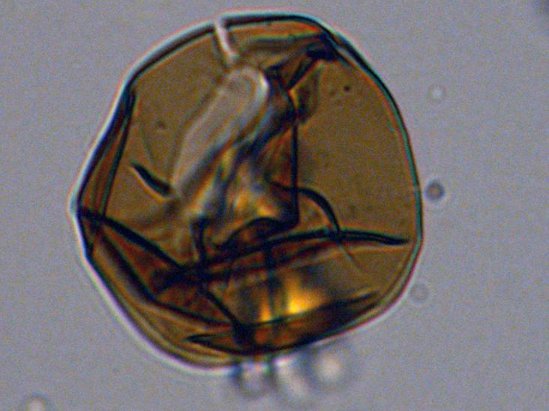
Before the Oligocene epoch some 33.6 million years ago, the Earth was a warm place with a tropical climate. In this region, plankton diversity was high until glaciation - the Antarctic continental ice cap - reduced the populations leaving only those capable of surviving in the new climate.
Since that time, we have had seasonal primary productivity of plankton communities. This ice-cap is associated with the ice-pack, the frozen part that disappears and reappears as a function of seasonal climate changes. This phenomenon, still active today, influences global food webs, according to a paper in Science which used information contained in ice sediments from different depths.
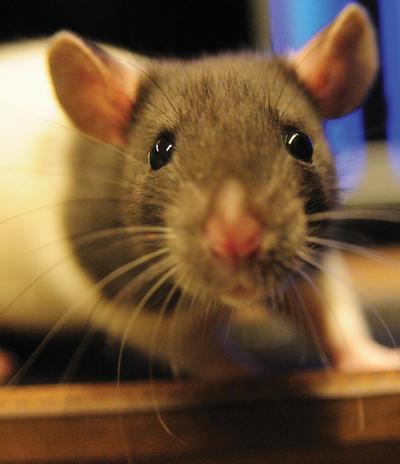
Rats move their eyes in opposite directions in both the horizontal and the vertical plane when running around. Each eye moves in a different direction, depending on the change in the animal’s head position, according to a behavioral tracking study that used miniaturized high-speed cameras.
Like many mammals, rats have their eyes on the sides of their heads. This gives them a very wide visual field, useful for detection of predators. However, three-dimensional vision requires overlap of the visual fields of the two eyes. Thus, the visual system of these animals needs to meet two conflicting demands at the same time; on the one hand maximum surveillance and on the other hand detailed binocular vision.
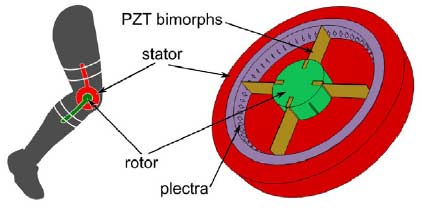
“The modern drive towards mobility and wireless devices is motivating intensive research in energy harvesting technologies.” say two research fellows at Cranfield University in the UK, who are currently examining the question – ‘Why not harvest energy from people’s knees?’
Modern human mothers wean their babies earlier than our closest primate relatives - well, not all human mothers. As a TIME magazine cover made famous, some mothers never stop.
But what about our extinct relatives, the Neanderthals? Teeth tell the tale.
Archaeologists think they have some responses for the hypothesis that our early forebears were forced out of the trees and onto two feet when climate change reduced tree cover.
Our earliest ancestors changed from tree dwelling quadrupeds to upright bipeds capable of walking and scrambling and the authors in Antiquity ('Complex Topography and Human Evolution: the Missing Link') say our upright gait may have its origins in the rugged landscape of East and South Africa, which was shaped during the Pliocene epoch by volcanoes and shifting tectonic plates.
As men get older they are more likely to suffer from andropausal syndrome (AS), also known as 'menopause' and by other complicated terms 'androgen deficiency in the aging male' or' late-onset hypogonadism'.
Men with andropausal syndrome have decreased levels of anabolic hormones, including testosterone, and it has been suggested that these hormone deficiencies are what cause the clinical symptoms.
Saturn's moon Titan might be in for some wild weather as it heads into its spring and summer, if two new models are correct.
Scientists think that as the seasons change in Titan's northern hemisphere, waves could ripple across the moon's hydrocarbon seas, and hurricanes could begin to swirl over these areas, too. The model predicting waves tries to explain data from the moon obtained so far by NASA's Cassini spacecraft. Both models help mission team members plan when and where to look for unusual atmospheric disturbances as Titan summer approaches.
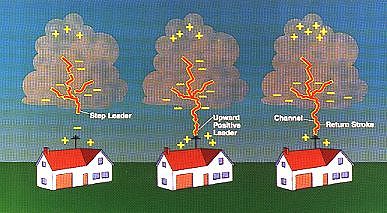
I recently read an article about an
individual that had been struck by lightning, while it was interesting to read about the experience it was disturbing to read some of the comments that followed and their gross misunderstanding of lightning.
In particular the following comment illustrates the problem.
Lightning happens when a really huge negative charge builds up in the ground, corresponding to a positive charge overhead, and the differential becomes sufficient to jump the gap. (and, as others are pointing out repeatedly, air is an excellent insulator, so it takes a whacking huge voltage differential to make the arc.)
The human intestinal tract is the home of a diverse array of bacterial colonies, settling in as soon as their host begins life. While these colonies were considered to merely coexist with the host for their own survival, decades of study have shown the interaction between bacteria and host is mutually beneficial. The bacterial colonies benefit by finding their home in the host, while the host benefits from the bacteria’s ability to keep the intestinal tract healthy, specifically by aiding in the absorption of nutrients, and by preventing disease-causing bacteria from taking root.