The publication of the complete human genome sequence in 2007 made the genetic code readily accessible to researchers and served as a platform for the countless advances in science,medicine, and sequencing technology which were to follow.
Following the completion of the human genome project, researchers set out to develop a comprehensive ‘map’ of which genes coded for which gene products, or proteins.This allowed researchers to track how a protein was affected when a gene sequence was altered and the resulting changes within the cell. Subsequently, a number of diseases and disorders were linked to changes-or mutations- within protein coding genes.
Never in a million years.
That was my first reaction to finding out that the University of Leicester (where I am based) was about to commence an archaeological dig to uncover the bones of Richard III.
But, a press conference this morning has showed be to be totally wrong - or at least, woefully pessimistic. Because, it seems that a team of archeaologists has uncovered some bones that are indeed very likely to have been Richard III's.
There are LEED-certified buildings and there are zero-energy buildings. And then there’s Villa Åkarp outside of Malmo, Sweden — an energy-plus residential home. In other words, a home that produces more energy than it uses.
Since construction was completed on the three-bedroom, two-bathroom house in 2009, it has raised the bar for what is possible in home construction. Villa Åkarp takes its design cues from the passive house, or
Passivhaus, movement, a design program for creating super-insulated houses that rely on window orientation, thermal recovery and other elements for heating and cooling.
But Villa Åkarp ups the ante.
The James Randi Educational Foundation (JREF) famously offers $1000000 to anyone who can demonstrate paranormal abilities. Its has helped to stem the spread of pseudoscience. The Quantum Randi Challenge is quite similar (although its main purpose for you personally is to teach you quantum mechanics intuitively): The large reward it offers is instant fame. Whoever overcomes the challenge would deserve a Nobel Prize in physics! But the Quantum Randi Challenge does not depend on a foundation that is
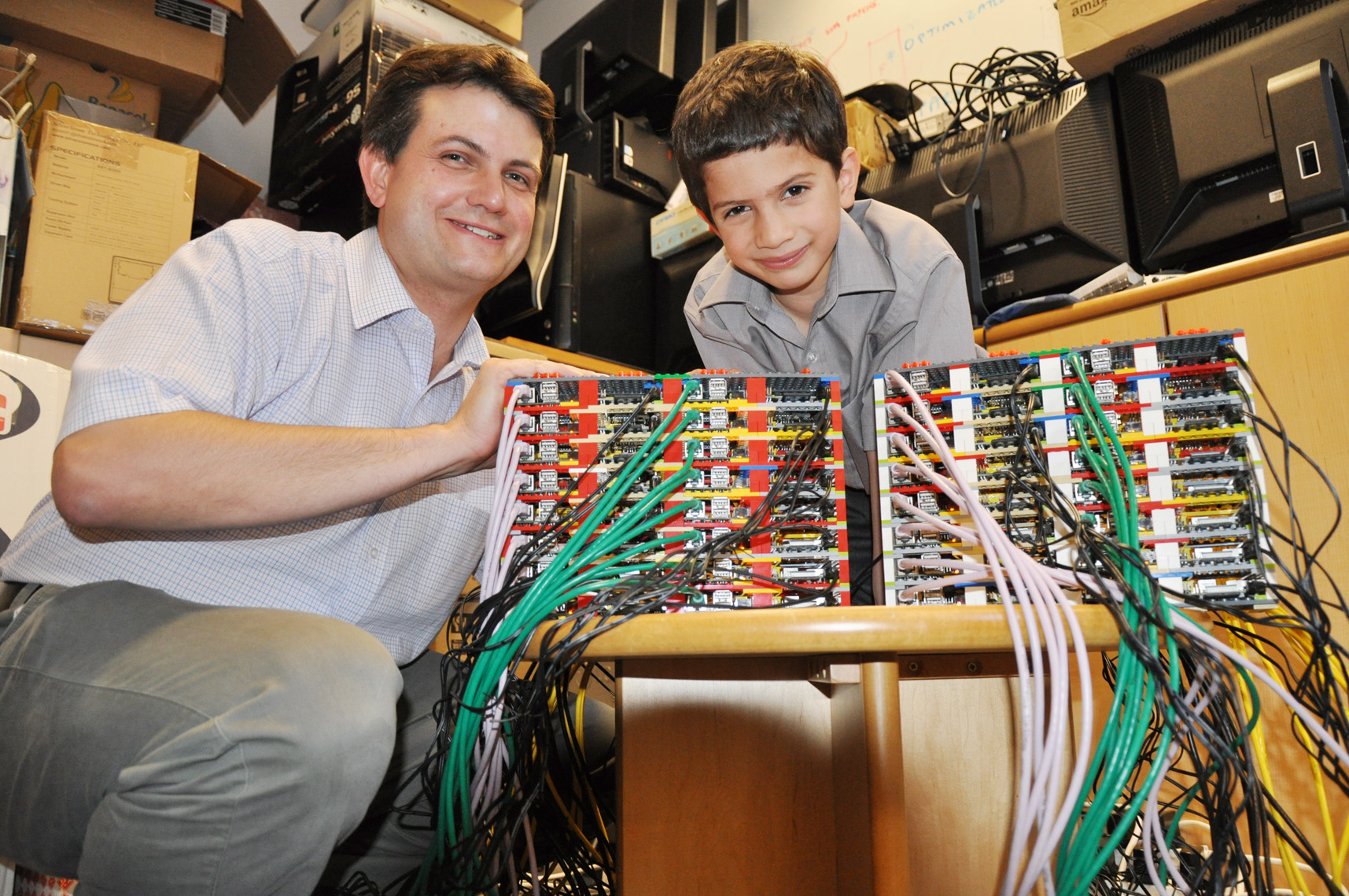
How cheaply can you build a supercomputer? A group from the University of Southampton just made one using 64 Raspberry Pi ARM GNU/Linux boxes ($25 each) and Lego blocks. The machine, named "Iridis-Pi" after the University's Iridis supercomputer, runs off a single 13 Amp mains socket and uses MPI (Message Passing Interface) to communicate between nodes using Ethernet.
The team was led by Professor Simon Cox and included Richard Boardman, Andy Everett, Steven Johnston, Gereon Kaiping, Neil O'Brien, Mark Scott and Oz Parchment. Professor Cox's son, six-year-old James Cox, assisted with specialist support on Lego and system testing.
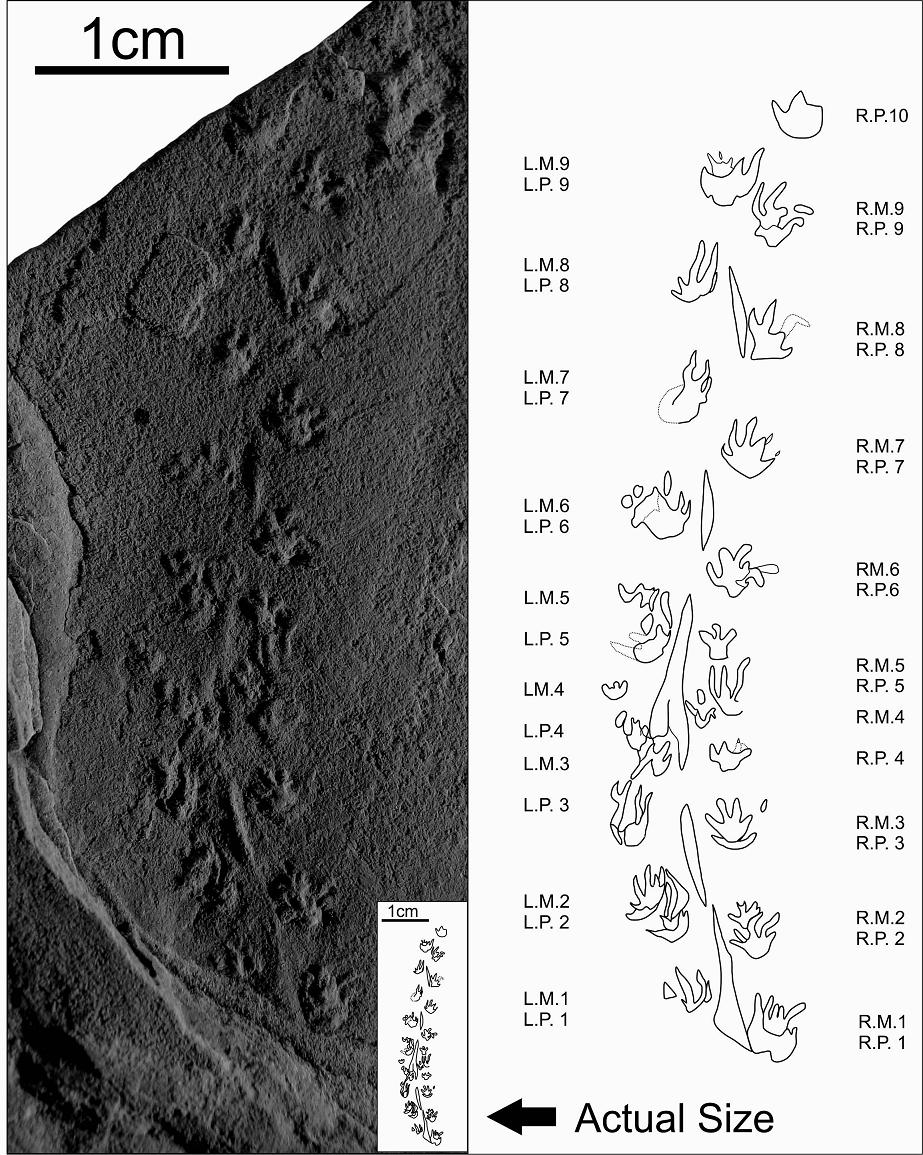
A set of fossil footprints in Joggins, Nova Scotia have been identified as the world’s smallest - among vertebrates to-date, anyway.
The footprints were found at Joggins Fossil Cliffs. A fossil specimen of the ichnogenus Batrachichnus salamandroides was collected by local amateur paleontologist Gloria Melanson, daughter of Don Reid, the famed Keeper of the Joggins Cliffs, while walking the Joggins beach. Joggins Fossil Cliffs is a UNESCO World Heritage Site.
It sometimes happens that my comments in the threads of my own blog get long and detailed (do not take this as me boasting about anything - it is just a fact). When that happens, I reason that they deserve to be promoted to a post by themselves, because threads are read by way fewer readers, and some of them might thus lose some interesting bit.
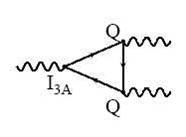
Because of the above I am (re)posting the text below, which explains some "a priori" reasons why quarks come with fractional electric charges in multiples of one third, why the sum of charges of fermions in one family nullify, and why our universe chose to have quarks of three colours. Beware, some non-trivial concepts of quantum field theory are needed, but I will try to make this as painless as possible (but not more).
When Western scrub jays summon others to screech over the body of a dead jay, they come a'runnin', and those 'funerals' can last for up to half an hour.
But why? Western scrub jays live in breeding pairs and are not particularly social birds. “They’re really territorial and not at all friendly with other scrub-jays,” said Teresa Iglesias, a U.C. Davis graduate student and co-author of a new study in Animal Behaviour. It turns out that death seems to signify danger, which opens up an even odder set of questions.
Researchers have discovered how to store diverse forms of artificial short-term memories - in isolated brain tissue.
Memories are often grouped into two categories: declarative memory, the short and long-term storage of facts like names, places and events; and implicit memory, the type of memory used to learn a skill like playing the piano. In the study, researchers sought to better understand the mechanisms underlying short-term declarative memories such as remembering a phone number or email address someone has just shared.
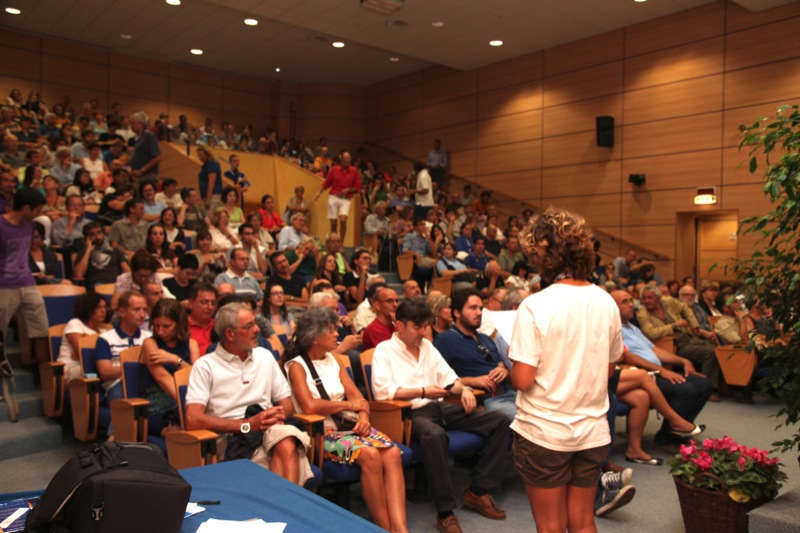
Last Saturday night Gian Francesco Giudice and I
discussed the discovery of the Higgs boson and its aftermath in front of a wide audience gathered in the Aula Magna of Mantova University.
The event was #173 in the wide program of the town's
literature festival, a week of seminars, interviews, performances by authors of books, journalists, and intellectuals in a broader sense.