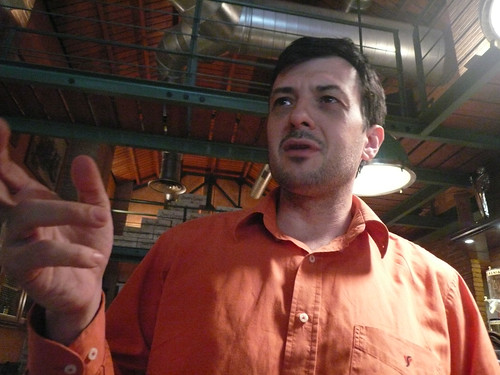





The text below was graciously written for this blog by Alejandro Rivero (below),  a friend who has contributed to this blog other times in the past. His theoretical ideas are off the mainstream, but in a way which makes them interesting to me. I hope some of you will appreciate reading about the whole thing in summary here - Alejandro has a few papers out which you may want to read if you are specifically interested in the matter.

For most of human history, technology changed very little during a person’s lifetime. Certainty, their life was not constant with the hard agricultural life being interrupted by war, disease, and famine. However, very few new technologies would come into their life. In contrast, my grandparents saw tremendous change throughout the 20th century as planes, cars, electricity, radio, and computers enter during their lives. Politically, the U.S. grew from a minor player to a world leader. Socially, many rights were obtained. In my life, I have also experienced rapid change, but it seems a bit different than my grandparents’.

For example, the biggest change is the way computers have grown to dominate many products and processes. But why do I have a computer now?

By the time Dr. Maciej Zwieniecki returned to the blackboard, I’d gotten sufficiently lost in the intricacies of fluid dynamics that I wasn’t sure how much more I could absorb from his lecture on vertical water transport in trees.  Still, I could objectively admire his off-the-cuff artwork as he brushed away a cross-section of a tree and quickly outlined a perfectly recognizable…fighter jet?

The audience watched, bemused. Maciej chuckled, then explained how mechanisms borrowed from tree physiology might one day be used to efficiently transfer heat from jet wings to the cockpit.  At least, that’s what the Department of Defense, which funded his basic research on tree mechanics, hoped.

Update: I am keeping out of this, but you may well be interested in reading what Gibbs, Woit, and Motl have to say about recent leaks on the ATLAS and CMS results. So I hope I won't be crucified for three general links now!

Update 2: And it is now public that a seminar at CERN will be given by ATLAS and CMS on December 13th. So the wait is almost over, officially...

I have not written in a while - a full week. This is uncharacteristic enough that I owe you some sort of explanation.

I don’t understand, sometimes, how people put together their web pages. Who really thinks that, say, pink text on a red background looks good? Seventeen different typefaces on one page? A background image that makes people’s eyes cross?

Space is three dimensional: Length, Depth and Height, or X, Y, and Z, that makes three. Since any modest agnostic holds a Multiverse extremely likely though, and moreover also our own universe likely has hidden extra dimensions, nerds keep wondering what life in four dimensional space looks like.

Alternative alliterative title: Long-tailed Light-up Loliginids!

I've mentioned the two flavors of squid before: the open-ocean oegopsids and the nearshore myopsids. Most myopsids are in the family Loliginidae, which contains all your familiar calamari squid, market squid, and so on. Loliginids are traditional, uncomplicated, straightforward squid. They always look like squid--unlike oegopsids, which sometimes look like jellyfish or manta rays or piglets.
People who meditate seem to be able 'switch off' areas of the brain associated with daydreaming as well as psychiatric disorders such as autism and schizophrenia, according to a new brain imaging study published in the Proceedings of the National Academy of Sciences.

Meditation's ability to help people stay focused on the moment has been associated with increased happiness levels, said Judson A. Brewer, assistant professor of psychiatry and lead author of the study. To find out more, the
team conducted functional magnetic resonance imaging scans on both experienced and novice meditators as they practiced three different meditation techniques.
An East Asian human fossil from Maba, China and dated to the late Middle Pleistocene age has provided evidence of interhuman aggression and human induced trauma occurred 126,000 years ago.

A report in the Proceedings of the National Academy of Sciences suggests that a 14 mm ridged, healed lesion with bone depressed inward to the brain resulted from localized blunt force trauma. Was it an accident or interhuman aggression?

The Maba cranium was discovered with the remains of other mammals in June 1958, in a cave at Lion Rock in Guangdong province, China. The Maba cranium and associated animal bones were unearthed at a depth of one meter by farmers removing cave sediments for fertilizer.

