


Can music lead to better CPR? Yes and no.  Any mnemonic hook that helps rescue personnel deliver a good number of chest compressions to heart attack victims is likely good but one song, "Disco Science" by Mirwais, does well yet can only achieve half the CPR goal.

If you are a fan of Guy Ritchie's film "Snatch" you have heard "Disco Science" but may not know that it has 100 beats per minute, around the optimal range for CPR. However, it does not help at all in  improving the depth of compression, which may mean it's time to give up on trying to find the best musical gimmick to aid in CPR and just teach it the old fashioned way.

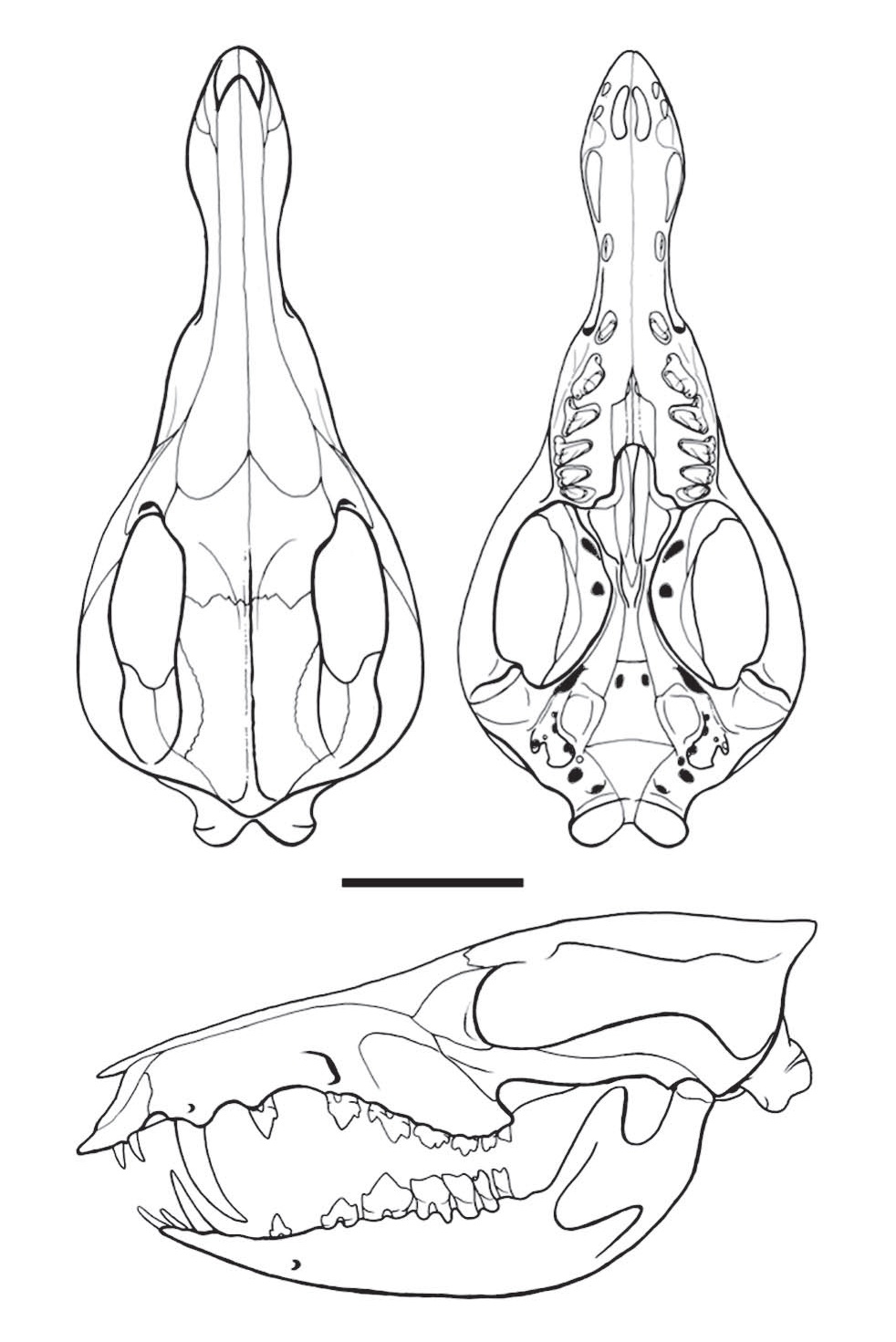
A newly discovered fossil, found in South America, bears resemblance to Scrat, the sabre-toothed squirrel well-known for his antics in the Ice Age movies. In reality, though, the creature is known by the slightly more complicated name of Cronopio dentiacutus. It was found in the La Buitrera locality in the Rio Negro Province, Argentina. It belongs to the dryolestoids, an extinct mammal group that belongs to the lineage that led to modern marsupials and placental mammals.

The following is an excerpt from a book I am working on intermittently. I do not know whether the project will ever see the light, and it just occurred to me that I could share a tiny bit of it with you in my blog. Enjoy!

----

Throughout the history of politics, the discourse has been rancorous. If your parents did not tell you never to discuss religion or politics in polite company, you learned that lesson on your own. 'Blame the media' thinking was popular even in the 1700s.

A University of Missouri analysis of recent political blogs - i.e., basically meaningless, but fun to talk about - indicates politics are getting nastier due to digital media.  Why?  The digital world has made it easier for polarized interest groups (which is basically every interest group) to reach other people who are similarly polarized.

Wait, what? Don't we know, like, almost nothing about colossal squid (Mesonychoteuthis hamiltonii)? How could we have any idea whether they need protection or not?

On the other hand, the fact that we've seen so few individuals rather suggests that there aren't that many of them to begin with. As with any scarce resource, perhaps caution is the better part of valor . . . or something like that. I might be getting my aphorisms mixed up.
RETRACTION: I have decided to retract three blogs (Deriving … 4/5, 5/5, 6/5+1). I was unable to figure out a reasonable statement concerning gauge symmetry. When the blogs were initially written, I focused on the field equations, mainly the Gauss-like law, and ignored the force equations entirely. Finding a solution that works with the the field and force equations were not looked for. A consistent proposal should do all three things (fields, forces, and solutions) with grace. I have concluded it is not possible to achieve these goals with the Lagrangian as written, hence the retraction.
The hypercomplex gravity and unified GEM Lagrange densities was wrong.

There is a certain amount of confusion on the relationship between Einstein's Theory of Relativity and the recent experimental results that seem to point towards neutrinos that are faster than light by an amount of about 7 km/s. So let me try to clarify things by answering to the following question:

If neutrinos travel faster than light by 7 km/s, do we need to modify Relativity?

The answer is a clear-cut "Yes"; let me explain why.

Lorentz invariance, which is embodied in the theory of Relativity, has the unescapable consequence that there exists a precise relationship between a free particle's energy E, its momentum p and its mass m:
Homo Stupidus

Homo Stupidus

Oct 31 2011 | comment(s)

You are in a game with one hundred other players. They don't know you, you don't know them, and you can not communicate with any of them. The game is called 'even/odd(s)' and is explained to you as follows:

"You have the choice between two selections: 'even' or 'odd'. The hundred other contestants face the same choice. You all make your choice simultaneously. If the total group of players select an even number of 'evens' and an odd number of 'odds', those who selected 'odd' will receive $3, and those who selected 'even' will receive $4. However, if the result amounts to an odd number of 'evens' and an even number of 'odds', no-one will receive a penny. Now go ahead and make a choice!"

What is your choice?


