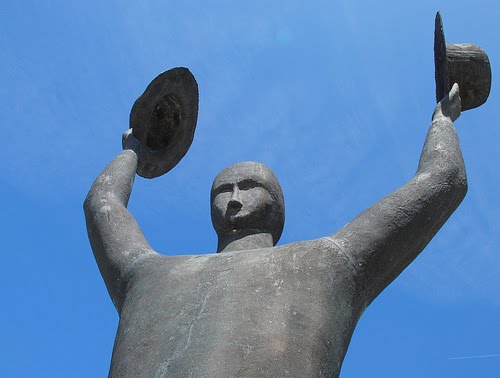




One of the issues that emerged in the discussion of whether researchers should be bloggers is the fact that it is always dangerous to wear multiple "hats", i.e. carrying multiple responsibilities which may sometimes come in conflict with one another.

Wearing two hats

Of course this is a very common and old problem. I am indebted to Jim S.M., who sent me a few excerpts from Churchill's autobiography, which are very relevant to the issue besides being quite amusing:
Is your cell phone a known carcinogen? Do cell phones give you cancer?  Well, the precautionary principle contends unless you can prove cell phones can't give you cancer, then they are a concern.  Fortunately, the precautionary principle isn't overused by everyone (though when it is, the politically like-minded dismiss it as policy disagreement and not being anti-science) but any time you have an anti-science hotbed, it will get trotted out.

It's "Second Life"...for monkeys.  And a lot more real.   Scientists have demonstrated a two-way interaction between a primate brain and a virtual body - they learned to employ brain activity alone to move an avatar hand and even identify the texture of virtual objects. 

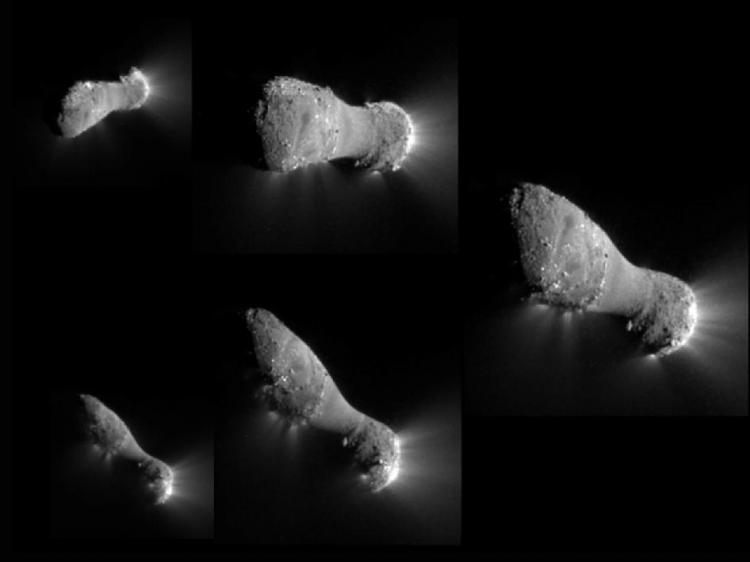
Did comets deliver a significant portion of the Earth's oceans millions of years after the Earth formed?  Some new evidence in Nature lends weight to the idea.

Using HiFi, the Heterodyne Instrument for the Infrared on the Hershel Space Observatory, researchers found that the ice on a comet called Hartley 2 has the same chemical composition as our oceans. Both have similar D/H ratios - the proportion of deuterium, or heavy hydrogen, in the water. A deuterium atom is a hydrogen with an extra neutron in its nucleus. 

This was the first time ocean-like water was detected in a comet.

“The sweetest and most inoffensive path of life leads through the avenues of science and learning; and whoever can either remove any obstruction in this way, or open up any new prospect, ought, so far, to be esteemed a benefactor to mankind” —David Hume

In a few short weeks, it will once again be time for the Open Science Summit (yay!!), a yearly event which brings together researchers, life science professionals, students, and science enthusiasts to discuss the future of open scientific discovery, publication, and collaboration.  

Bribery and corruption rise and fall with the level of collective feeling in a society, according to research by Pankaj Aggarwal, University of Toronto Scarborough professor of marketing in the Department of Management, and Nina Mazar, University of Toronto professor of marketing.

Aggarwal and Mazar say that people in more collectivist cultures, where individuals have more communal belief and see themselves as interdependent with larger society, are more likely to offer bribes than people from more individualistic cultures where independence and freedom are more valued.

Their work suggests that people in collectivist societies may feel less individual responsibility for their actions and therefore less guilty about offering a bribe.

We've done articles on rainbows, and double rainbows and even showed you how to make a rainbow appear for that special someone - but have you ever seen a triple rainbow?
It makes environmental activists crazy, in that 'believe scientists when science agrees with us but scientists are out to kill us when science doesn't agree' kind of way, but a large study of U.S. adults found that the more science they knew and the more independent they were, the less they were worried about climate change.
"Search.  The final frontier.  These are the voyages of the frustrated Web surfer.  Its five-year mission: To explore strange new content, to seek out new ideas and new expressions.  To boldly know when someone is pulling our leg or being sincere." I'm not waiting for William Shatner to record that monologue but there are days when I can almost hear it rolling about in my head.  Search is such a universal thing for people -- we were born to it.  We resonate with memories of failed searches every time we hear someone gasp, "What did I do with my keys?"
Why would anyone build a Tubesat when the Cubesat open standard tends to dominate the picosatellite world?  Well, first, there's only been a bit over a dozen Cubesats, so it's a wide open field.  Second, the Tubesat design is actually a kit, including schematics that are pre-integrated, rather than being an open spec like Cubesat. 
In some ways, it's a little odd to compare them, much like you can't really compare an iPhone to an Android smartphone.  iPhones are a device; Android is an operating system used in over 75 different devices.  Similarly, Tubesat is a device; Cubesat is a specification that people fit their own ideas into.  Different approaches.


