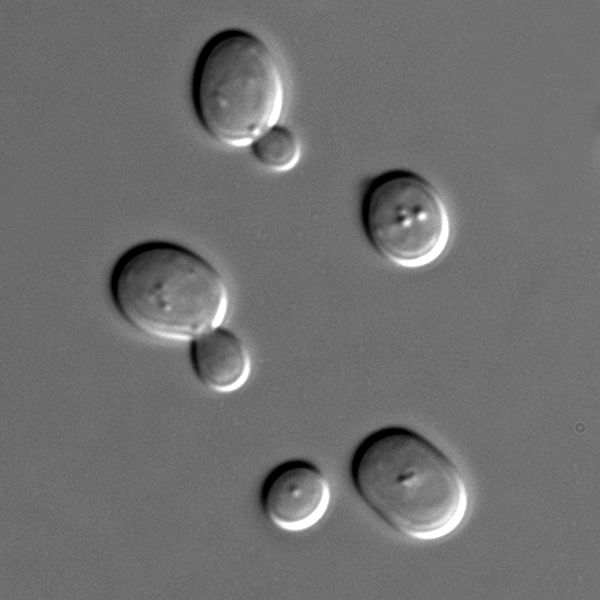





A research team at John Hopkins Medical Institutions has introduced synthetic chromosomes into yeast (Saccharomyces cerevisiae, see figure 1), in an effort to better understand how genomes work, and potentially allow some ‘control’ at genome level. As part of the synthetic yeast genome project, or Sc2.0, the researchers have introduced a synthetic right arm of the ninth chromosome, synIXR, and a partially synthetic left arm of the sixth, semisyn-VIL.


Figure 1: S. cerevisiae.

(Source: Wikimedia Commons, user: Masur)


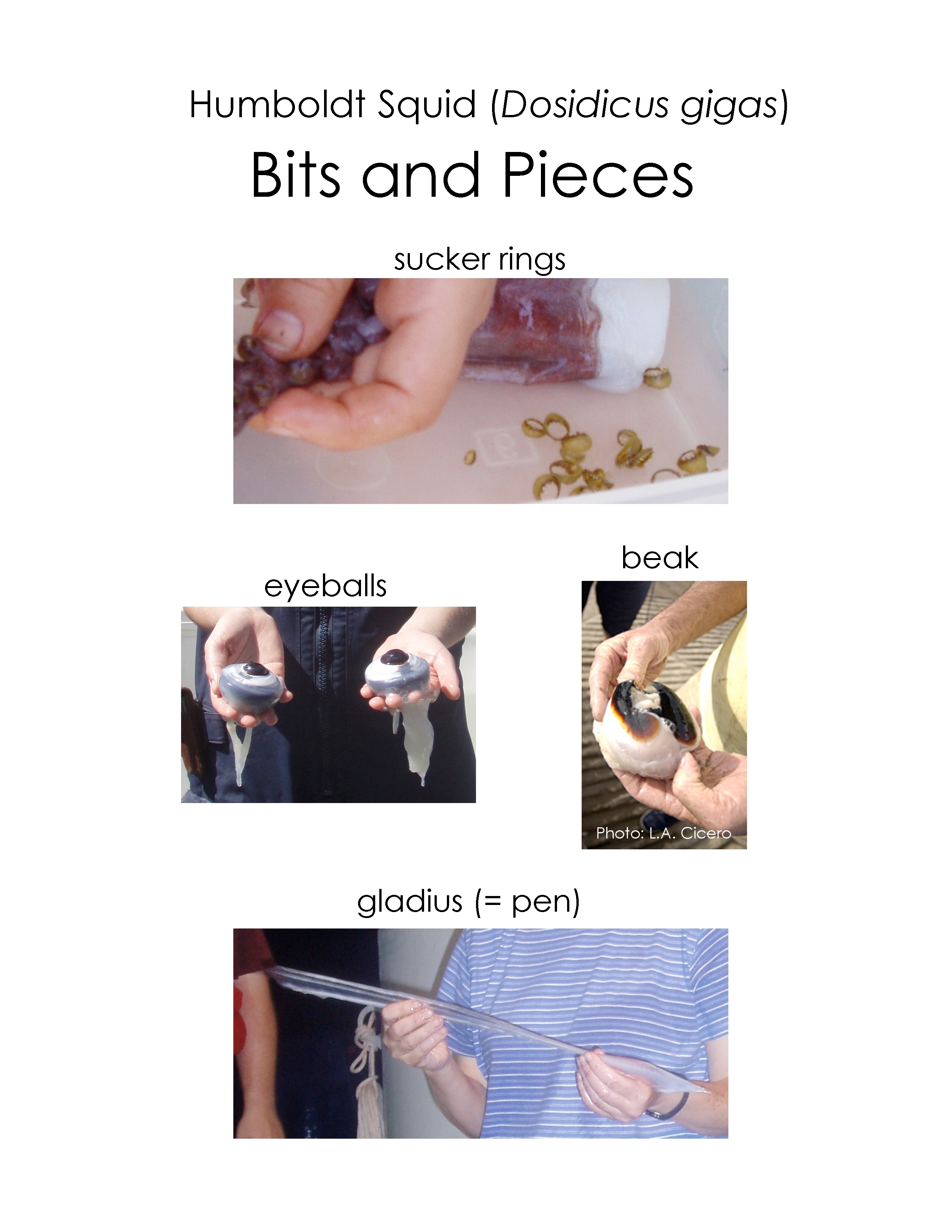
I must have missed that section in the What to Expect books on how to react when your child comes home from school with a Ziploc bag filled with squid parts in his backpack.
Thus begins an entertaining account by Beth Braccio in the Chicago Parent about all the exciting things her son has brought home from school. To her credit, she didn't immediately make him throw the bag of squid away:
In 1997, Ray Stanford, a citizen scientist dinosaur tracker who often spent time looking for fossils close to his Maryland home, was searching a creek bed after an extensive flood and discovered a fossil which he identified as a nodosaur. 

Nodosaurs have been found in diverse locations worldwide, but they've rarely been found in the United States.  The area had originally been a flood plain, where the dinosaur originally drowned and it was tiny -  only 13 cm long, just shorter than the length of a dollar bill. Adult nodosaurs are estimated to have been 20 to 30 feet long.
Sometimes, when things are bad enough, we'll cave in and buy into concepts and products that we otherwise wouldn't have. As one example, hurt bad enough and you'll try just about anything to ease that pain. And unfortunately, common sense isn't nearly as common as it should be and we are none of us as skeptical as we could be. Except for those Missourians, of course, who live by the motto, "Show me." I'm honestly not too sure of that, though, as "showing" people works all too well or those power bracelets and other pseudoscience-based products wouldn't be so popular.
A 3-D inkjet printer can generate 3-dimensional solids from a wide variety of materials very quickly by applying the material in layers of defined shape and then bonding these layers are with UV radiation.  It can create microstructures but 3-D printing technology is still too imprecise for the fine structures of capillary vessels.

Perhaps not for long.

Researchers at Fraunhofer are applying new techniques and materials to come up with artificial blood vessels in their BioRap project. In the future that may mean artificial tissue and maybe even complex organs in future. 
I enjoyed a lot reading a "discussion" prepared by Maury Goodman on the value of "confidence level", discovery thresholds, and what physicists believe or not. If you are a HEP physicist and you want to widen your horizons on the value of statistical claims in experimental results, you are bound to read it. But you might find it thought-provoking and enlightening even if you are a layman, provided you can use three neurons in a row.

A few random excerpts should convince you to read the whole piece:

Manjib:  No reasonable high energy physics will believe a two sigma effect.

Does playing music lead to less age-related hearing problems or do people without hearing problems continue to play music?

Hearing studies have shown that trained musicians have highly developed auditory abilities compared to non-musicians but a new study concludes hearing abilities in musicians and non-musicians differs, across the age spectrum from 18 to 91 years of age, and that musicians retain a keener ability to  detect and discriminate acoustic information from the environment.

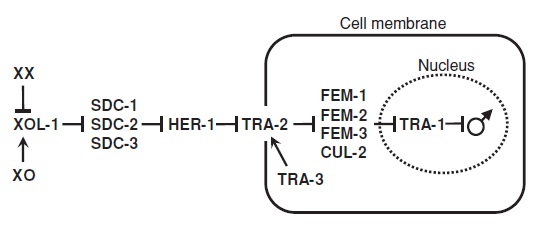
Sex determination is obviously an important developmental event with great ecological and evolutionary consequences. A large variety of sex determination mechanisms exists, and the evolution of many of these is still relatively poorly understood. Previous work suggests that compensatory adaptations to mutations in involved genes might be relevant in the evolution of these pathways.

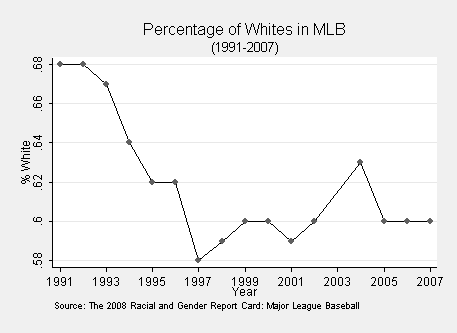
The highest paid player in baseball has the last name "Rodriguez" and 3 of the top 10 highest paid players in major league baseball are black - but major league umpires are racist, argues Johan Sulaeman, a financial economist at Southern Methodist University.

They looked at 3.5 million pitches from 2004 to 2008 and found that minority pitchers are so convinced white MLB umpires call strikes more often for white pitchers than for minority pitchers that they throw 'safe' pitches and therefore hurt their own performance.
The Maxwell equations govern light, electricity and magnetism as a trinity. The Big Goal for the next five weeks is to understand my variations on those equations. I want readers to see both the forest and the trees, the planet and the subatomic particles, the math behind the curtain.

Many may fear they don't have the math chops to follow this five week march. The names of the players and their jobs will be explained. There is repetition in this process which may make the steps start to sound familiar. After three weeks, the diligent reader will be rewarded with a deeper understanding of the mathematical intricacies of light, unknowable to poets or priests. My variations are nothing more than that, variations.

