


Most scientists and science journalists argue vehemently for basic research - and even more taxpayer money should be devoted to it, they say.   Politicians usually disagree and feel like taxpayer-funded research should have a goal or at least a defined result in its framework.
It's not often that paleontology makes the news. This week, however, it did - in a big way. And let me tell you, it wasn't the edgy paper on a new assemblage of South American bivalves ("Barremian Bivalves from the Huitrín Formation, West-Central Argentina: Taxonomy and Paleoecology of a Restricted Marine Association") that was all over the rolling news channels.

No; it's the news that Archaeopteryx may be knocked off its pedestal as the earliest bird in the fossil record, based on a new phylogeny by Xu et al. Archaeopteryx is now deemed to be just another deinonychosaur; probably closer to velociraptor than to birds.
COLUMBUS, OHIO -- After a full day in and out of airplanes and airports, there’s really nothing like stepping out of the terminal and taking your first breath of unfiltered, unconditioned, unpressurized air.  Sure, the curbside may be cluttered with exhaust fumes, and filled with the noise of honking taxi drivers, but it’s still undeniably fresh.

Too bad that last Sunday, I took that breath in the state with the worst air pollution record in the country.
According to a press release from Climatic Research Unit (CRU) at the University of East Anglia, a UK ruling forces the release of other nations property, in this case climate data. We are talking about some legal left-overs in the so-called Climategate case where scientists were wrongfully accused of refusing to share data (national and international).

Cancer is one of the scourges of modern society. An increasing number of people are fighting it, and a lot of research is being done in order to understand it better, hopefully leading to treatments or cures.

At present, the dominant theory is that cancer arises from a handful gene mutations. But recently, Peter Duesberg and his colleagues at UC Berkeley have launched the idea that cancer instead arises from chromosome disruptions, and that this, in fact, constitutes a form of speciation. So, according to this view, cancers are newly evolved species, as they have new chromosomal karyotypes. On top of this, cancers are autonomous and don’t need other cells for survival.

As a 20-year-long (ok well, 19) member of the CDF collaboration, I am very proud of this wonderful experiments' accomplishments in all areas of high-energy physics, from exotic searches to Higgs searches, from top quark measurements to b-physics measurements, and what not. CDF is a landmark in experimental physics, and the longest-lasting physics experiment ever. But it is not foulproof - nobody is in this wild world of statistical flukes and impossible-to-unearth systematic effects.

One of the fundamental precepts we laid out in the original Science 2.0® vision was collaboration.  It's tricky stuff, collaboration, it requires scientists who are often competitors to other labs to be more open - and that may never happen, but for smaller groups who want it to happen, there are tools in the works that can help.  

One of those, Mendeley, has come out of beta and released Mendeley Desktop v1.0 for Windows, Mac, and Linux, following two other milestones for the company, 1 million users who have now downloaded the application and a database with its 100 millionth paper uploaded. 

There hasn't been much of a debate about this paper at Science 2.0, so I thought I might briefly review it, and see what everybody else thinks. But, before we start, I should make one thing clear. I'm not a psychologist. I'm not even an evolutionary psychologist; I'm a paleontologist. And I should also make it clear that I am often very dubious of a lot of the findings of evolutionary psychologists, which often seem to me like pontificating on very banal things with very little actual science going on.
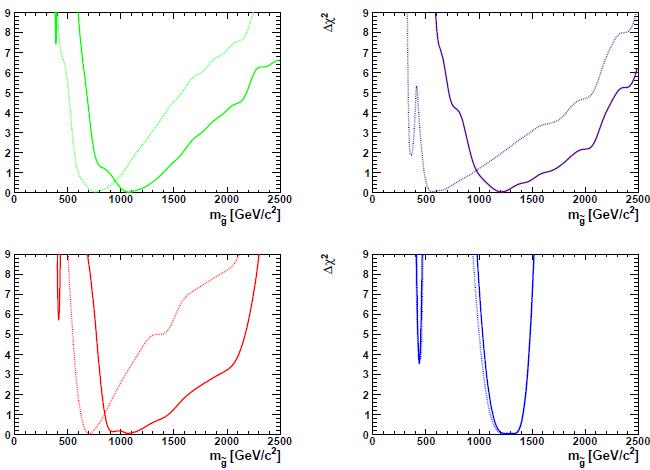
While experimentalists gathered in Grenoble present the latest results on High-Energy Physics searches and measurements, phenomenologists like Sven Heinemeyer are working 24/7 to update the picture of the breathing space left for Supersymmetry, in the light of the most recent searches.

You of course do not need to be reminded that Supersymmetry is not a theory but a framework, within which a host of possible manifestations of subnuclear physics are configurable based on the value of 120-or-so free parameters. Because of that, if one wants to discuss in detail what are the most likely versions of SUSY left on the table, and what is the value of the most representative and critical theory parameters, one needs more than paper and pencil.

Mark Osteen's One of Us


There are many memoirs out there, many stories by individuals about their journeys as parents of disabled children, and some are good, some are great, and others are neither. Some writers are polished and offer their journeys with a luminosity of prose that leaves your soul fed. Other memoirs, while polished and offering a distinct voice, a unique insight, leave you with a heavy heart, a soul weighed down by the limbo, the purgatory, the family finds itself in. Osteen's tale, One of Us, does that: leaves the reader weighted and yet lost.

