





Does your dog know if you've had a bad day? Probably, but don't expect your cat to catch on.

Do chimpanzees understand why those who can't see them don't offer them treats?

Do vampire bats have the ability to show gratitude by returning a favor?

Some Texas A&M University researchers examining ancient Egyptian mummies may have unwrapped – literally – some of the mysteries that embalmers used to preserve bodies more than 3,000 years ago.

Mahlon "Chuck" Kennicutt II, MoonKoo Kim and Yaorong Qian of Texas A&M's College of Geosciences, along with colleagues from the University of Alexandria, have discovered that tar originating from natural oil seeps in the Middle East area was used in the preservation and mummification process by Egyptians thousands of years ago.

Examining areas near the Suez Canal, Kennicutt and the team also learned that tar fueled fires in glass factories used by the surrounding communities.

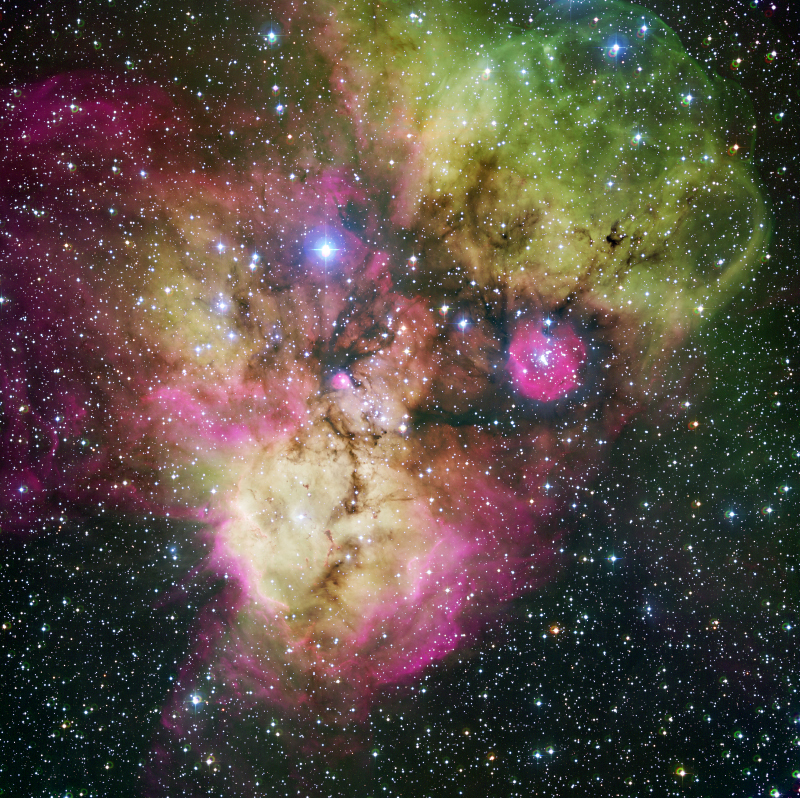
Two of ESO's telescopes captured various stages in the life of a star in a single image - a cosmic ghost.

ESO PR Photo 42a/05 shows the area surrounding the stellar cluster NGC 2467, located in the southern constellation of Puppis ("The Stern"). With an age of a few million years at most, it is a very active stellar nursery, where new stars are born continuously from large clouds of dust and gas.

The image, looking like a colorful cosmic ghost or a gigantic celestial Mandrill [1] , contains the open clusters Haffner 18 (center) and Haffner 19 (middle right: it is located inside the smaller pink region - the lower eye of the Mandrill), as well as vast areas of ionized gas.

Astronomers have found possible proofs of stellar vampirism in the globular cluster 47 Tucanae. Using ESO's Very Large Telescope, they found that some hot, bright, and apparently young stars in the cluster present less carbon and oxygen than the majority of their sisters.

A biotech company, Tensor Biosciences of Irvine, California, has developed a method to keep pieces of living brain tissue alive for weeks, which will allow research on entire neural networks rather individual cells.

"We are building stripped-down mini-brains, if you will, directly on a chip," says Miro Pastrnak, business development director of Tensor.

"Behaviour is the result of the electrical activity of billions of brain cells connected in complex circuits, not the activity of a cell or a receptor acting in isolation," says Pastrnak. Currently, drugs are only tested on individual nerve cells because larger pieces of brain tissue couldn't be kept alive for more than a few hours.

Vampire bats, the only mammals to feed exclusively on blood, including human blood, recognize their prey by the sound of its breathing. In a study published today in the open access journal BMC Biology, vampire bats of the species Desmodus rotondus could recognise recorded human breathing sounds much better than human participants could.

Vampire bats feed on the same prey over several nights and the authors of the study propose that the bats use breathing sounds to identify their prey in the same way as humans use voice to recognise each other.

Vampires, Mummies, Ghosts, Zombies - we have it all today. Not all of these articles are exactly new(s), some of them are even old, but they're all science.

So if you're a Goth chick, you won't want to read Are Vampires Real? Physics Professor Drives Scientific Stake Into The Heart Of Supernatural Myths  but if you're trick or treating anyway, make sure to wear clothes made from fabric that glows.

Cooked or raw, garlic has been a favorite ingredient of cooks for thousands of years, but almost any cook will tell you there's a major difference: raw garlic is much more pungent than cooked.

Now, a group of scientists from The Scripps Research Institute, the Genomics Institute of the Novartis Research Foundation, and the Korea University College of Medicine is explaining the biological basis of raw garlic's burn.

In the latest issue of the journal Current Biology, the scientists, led by Scripps Research Associate Professor Ardem Patapoutian and Lindsey Macpherson, who is a graduate student in the Kellogg School of Science and Technology at Scripps Research, describe the cellular and molecular basis of raw garlic's pungency.

Burdensome though it is, the $5.2 trillion national debt never killed anyone. But the national sleep debt is another story, according to Cornell University psychologist and sleep expert James Maas - the man who coined the term 'power nap.' One hundred thousand traffic accidents caused by drivers falling asleep claim some 1,500 lives each year in the United States, Maas reports, while sleep deprivation and sleep disorders cost the American economy at least $150 billion a year.

"We've become a nation of walking zombies. More than half the adult population of the United States is carrying a substantial sleep debt," Maas said.

Werewolves notwithstanding, the full moon does not influence the frequency of epileptic seizures, reports a University of South Florida study.

"Contrary to the myth, epileptic seizures are not more common during a full moon," said Selim Benbadis, MD, associate professor of neurology and neurosurgery at the USF College of Medicine. "In fact, we found the number of epileptic seizures was lowest during the full moon and highest in the moon's last quarter."

The study was published in the journal Epilepsy & Behavior.

Dr. Benbadis said he decided to investigate the possible relationship between phases of the moon and the frequency of seizures after repeatedly hearing patients claim that their seizures were triggered or worsened by the full moon.

