










In 2002 on Christmas Eve, two-year-old Bryce Faber was diagnosed with neuroblastoma, a deadly. The toddler's treatment, in addition to surgery, included massive amounts of radiation followed by even more massive amounts of antibiotics, and it no doubt saved his life. But those mega-doses of antibiotics, while staving off infections in his immunosuppressed body, caused a permanent side effect: deafness.

"All I remember is coming out of treatment not being able to hear anything," said Bryce, now a healthy 14-year-old living in Arizona. "I asked my mom, 'Why have all the people stopped talking?'" He was 90 percent deaf.

"The loss has been devastating," said his father, Bart Faber. "But not as devastating as losing him would have been."


To Tolkien, the machine represents a means to attain power over others. His orcs -- deformed and ugly creatures, whose hands are sometimes replaced with weapons -- embody this lust for power. LOTR Wikia

By Richard Gunderman, Indiana University-Purdue University

Despite high wages, there has been a shortage of primary care physicians in America and the Affordable Care Act, coupled with an increased 'teach to the protocol' environment in medical school, is going to make the shortage worse. 

With medical school costing so much, and increasing procedural limitations on how patients can be treated, doctors are starting to wonder how much of medicine actually requires a general practitioner. Becoming a general medical doctor may not be worth it, according to recent recommendations from doctors that qualified students pursue careers as nurse practitioners rather than as primary care physicians.

Don't mobile payments make more sense? US Navy

By Ethan Zuckerman, Massachusetts Institute of Technology

Apple’s product launches are covered with breathless enthusiasm usually reserved for royal weddings and vaccines for dread diseases.

The recent launch of the iPhone6 featured an exciting new technology - ApplePay - which, if widely adopted, will allow Apple’s discerning customers to make electronic payments from their phones in situations where they would have used credit cards or cash.

Researchers have solved a puzzle in traffic research, namely why so many people 'jerk' the wheel when they steer a car. 

Groups like the U.S. Environmental Protection Agency and the Food and Drug Administration set the gold standard worldwide for science - but they are still soundly criticized. Every time the EPA clears a pesticide it is blasted because the studies it mandates are "industry-funded", which is required by law. As are trials for drugs.

For many people, the disclaimers about side effects of drugs at the end of television drug commercials (along with the omnipresent 'see our ad in Golf magazine' small print) are somewhat laughable - like with Proposition 65 'cancer-causing chemicals' here in California, when everything is a problem, nothing is - but they have a serious societal impact when the FDA says it.


Okay, but that's not the way to extract it. fabriceh_com, CC BY-NC-SA

By Benjamin Burke, University of Hull

In the development of new drugs, taking something from nature and modifying it has been a successful tactic employed by medicinal chemists for years.

Now, with the help of nanotechnology, researchers are turning once-discarded drug candidates into usable drugs.

A new study shows that plasma waves buffeting the planet's radiation belts are responsible for scattering charged particles into the atmosphere, creating the most detailed analysis so far of the link between these waves and the fallout of electrons from the planet's radiation belts.

The belts are impacted by fluctuations in "space weather" caused by solar activity that can disrupt GPS satellites, communication systems, power grids and manned space exploration.

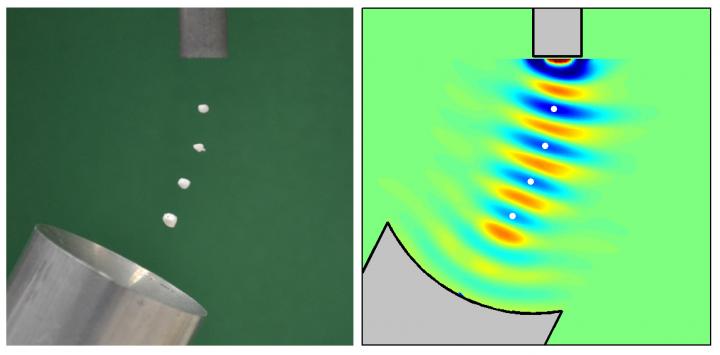
Acoustic levitation has been done in the past but it required a precise setup where the sound source and reflector were at fixed "resonant" distances. This made controlling the levitating objects difficult and isn't really proof-of-concept for anything practical.

Now a team of researchers have developed a new device that can levitate polystyrene particles by reflecting sound waves from a source above off a concave reflector below  - with more control than any instrument created before. Changing the orientation of the reflector allows the hovering particle to be moved around.

