







Central Michigan University Research Corporation and Dendritic Nanotechnologies, Inc. have developed technology capable of absorbing toxic chemicals from ground water that could lead to a revolutionary ground water purification system.

The U.S. Department of Defense’s Strategic Environmental Research and Development Program has awarded CMU-RC and DNT a $1.3 million contract to refine the process using DNT's Priostar dendrimer-based nanotechnology.

The project focuses on a worldwide breakthrough that will result in a cost effective ground water purification system. Its anticipated commercial launch is set for September 2008.

A newly developed DNA vaccine appears safe and may produce beneficial changes in the brains and immune systems of individuals with multiple sclerosis, according to a new study.

In patients with multiple sclerosis (MS), the immune system attacks the myelin sheaths that protect nerve cells in the brain and spinal cord, according to background information in the article. The nerve cell’s axon, which transmits messages to other neurons, is eventually destroyed. The cause of MS is unknown, but evidence points to the involvement of immune cells and antibodies that recognize and attack specific substances in the myelin, such as myelin basic protein. Certain cytokines, small proteins produced by cells that trigger inflammation, also may play a role.

A major surprise emerging from genome sequencing projects is that humans have a comparable number of protein-coding genes as significantly less complex organisms such as the minute nematode worm Caenorhabditis elegans. Clearly something other than gene count is behind the genetic differences between simpler and more complex life forms.

Increased functional and cellular complexity can be explained, in large part, by how genes and the products of genes are regulated. A University of Toronto-led study reveals that a step in gene expression (referred to as alternative splicing) is more highly regulated in a cell and tissue-specific manner than previously appreciated and much of this additional regulation occurs in the nervous system.

Glaucoma is one of the most common causes of blindness worldwide. There are various types of glaucoma, all of which lead to damage in the optic nerve and progressive loss of vision.

Exfoliation glaucoma is caused by the buildup of fibrous deposits on the surfaces on the front of the eye. Between 10-20% of people over the age of 60 are believed to have some degree of exfoliation syndrome, and perhaps more than half of these individuals will go on to develop exfoliation glaucoma.

The progression of glaucoma can be slowed using various medications that promote the drainage of fluids from the eye and reduce pressure on the optic nerve. However, exfoliation glaucoma is often resistant to drug treatment.

Substance abuse increases among acculturated Hispanic immigrants, according to new research presented today by Oregon State University assistant professor Scott Akins at the American Sociological Association’s Annual Meeting in New York.

The study surveyed 6,713 adults in Washington – of which 1,690 persons identified themselves as “Hispanic.” It is the first of its kind in the Pacific Northwest.

Previous research on the effect of acculturation on drug use has been conducted in states with larger Hispanic enclaves such as California, Florida and the Southwest. In these states Hispanics are more likely to live in heavily concentrated ethnic communities, which may slow their acculturation or assimilation.

Scientists are trying a plumber’s approach to rid the brain of the amyloid buildup that plagues Alzheimer’s patients: Simply drain the toxic protein away.

That’s the method outlined in a paper published online August 12 by Nature Medicine. Scientists from the University of Rochester Medical Center show how the body’s natural way of ridding the body of the substance is flawed in people with the disease. Then the team demonstrated an experimental method in mice to fix the process, dramatically reducing the levels of the toxic protein in the brain and halting symptoms.

Humans and chimpanzees share 99 percent of their genetic makeup but how those genes are used is the key difference, say Duke researchers.

In two major traits that set humans apart from chimps and other primates – those involving brains and diet – gene regulation, the complex cross-talk that governs when genes are turned on and off, appears to be significantly different.

“Positive selection, the process by which genetic changes that aid survival and reproduction spread throughout a species, has targeted the regulation of many genes known to be involved in the brain and nervous system and in nutrition,” said Ralph Haygood, a post-doctoral fellow in the laboratory of Duke biology professor Gregory Wray.

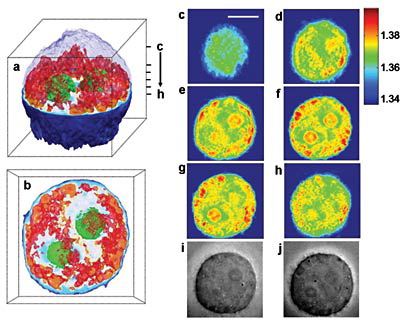
A new imaging technique developed at MIT has allowed scientists to create the first 3D images of a living cell, using a method similar to the X-ray CT scans doctors use to see inside the body.

The technique, described in a paper published in the Aug. 12 online edition of Nature Methods, could be used to produce the most detailed images yet of what goes on inside a living cell without the help of fluorescent markers or other externally added contrast agents, said Michael Feld, director of MIT's George R. Harrison Spectroscopy Laboratory and a professor of physics.

"Accomplishing this has been my dream, and a goal of our laboratory, for several years," said Feld, senior author of the paper.

Last weeks's M 7.6 West Java earthquake was detected, located and sized after only 4 minutes and 38 seconds by the German Tsunami Early Warning System (GITEWS) currently under construction in Indonesia. The location of the earthquake has been established after just 2 minutes and 11 seconds. For comparison: The Pacific Tsunami Warning Center (PTWC) in Hawaii published the location and magnitude of this earthquake after about 17 minutes.

Such a rapid analysis was possible due to the new software system called "SeisComP" (Seismological Communication Processor) developed by GFZ Potsdam that was installed at the Meteorological and Geophysical Agency of Indonesia (BMG) in Jakarta, in the last weeks.

Scientists at Keele University in Staffordshire have questioned the safety of aluminium added to sunscreens and sunblocks.

The researchers, Scott Nicholson and Dr. Christopher Exley, measured the aluminium content of sunscreens/sunblocks, which either include or do not include an aluminium salt (for example, aluminium hydroxide, aluminium oxide, aluminium silicate, aluminium stearate, aluminium starch octenylsuccinate) as an ingredient.

Aluminium was present in all seven products tested and its content was of particular significance in three products, each of which listed it as an ingredient.

