Fake Banner
Theory Of Mind Is Wrong About Autistic People

For four decades, a controversial idea has shaped how autism is understood by researchers, healthcare...

Bacteroides Fragilis May Be A Fifth Columnist Helping Colon Cancer In Your Body

The gut bacterium Bacteroides fragilis has long presented researchers with a paradox. It has been...

Losing Weight Improves The Heartbreak Of Psoriasis For Some

For many people living with psoriasis, the red, scaly skin patches are only part of the story....

Healthcare In Space - The First Medical Evacuation From The ISS

For the first time in 25 years of continuous crewed operations, an astronaut has been medically...

User picture.
The ConversationRSS Feed of this column.

The Conversation is an independent source of news and views, funded by the academic and research community and delivered direct to the public. The Conversation launched in Australia in March 2011.... Read More »

Blogroll

The latest dubious tactic of global soft-drink giant Coca-Cola has now been revealed for what it is - a move by an industry with a threatened financial future to confuse science, policy and the public, in order to buy time, and protect profits.

We know that our universe has already lived through great number of exciting phases.
But new research released overnight shows the universe has long passed its peak and is slowly but surely dying.

The research was presented at the year’s largest gathering of astronomers at the International Astronomical Union’s General Assembly in Hawaii.

Before we start writing any obituaries, let’s have a quick recap of the good times.

We humans have an innate tendency to recognize patterns. This ability has helped us survive by learning important skills such as how to distinguish danger (predators and poisonous plants, for instance) from important resources (food sources and safe shelter) and knowing the right time of year to plant crops.

But the same ability can sometimes convince us we’re seeing a meaningful pattern when it isn’t there. Gamblers detect “patterns” in lottery numbers and roulette wheels, fortune tellers detect “meaning” in chance events and weave a story. As a society we carry all kinds of similar superstitions, such as “bad things happen in threes.”

It’s never been easy for readers to know what to believe in academic research. The entire history of science publishing has been riddled with controversy and debate from its very beginning when Hobbes and Boyle, scientists at the Royal Society in London, argued over the scientific method itself.

Even a cursory glance at academic publishing since then shows articles contradicting each others’ findings, papers subsequently shown to contain half truths (even in the serious matter of clinical trials) and yet more that are simply fabricated. Shaky and controversial results have been a part of science since it began to be documented.

August 10, 1915. The Gallipoli sun beats down on the back of a Turkish sharpshooter. He is patient and used to the discomfort.

He wipes the sweat from his eyes and peers back down the sight of his rifle, sweeping back and forth across the enemy lines.

He’s hoping to spot a target worth taking a shot at as each muzzle flash risks giving his position away.

His sight settles on the shoulder pip of a second lieutenant. The target bends down out of sight, then reappears, now with a phone at his ear.

He stands still as he sends his dispatch. It’s an easy shot for the sniper. He squeezes the trigger and yet another young man dies.

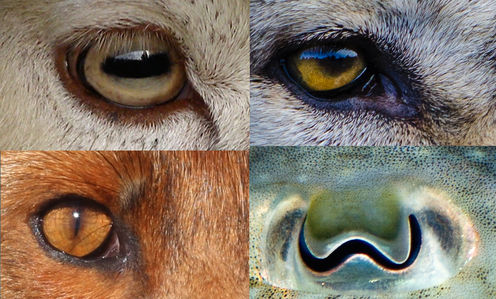
Wolves and foxes are closely related and share many of the same characteristics.


But look at their eyes – where wolves have rounded pupils like humans, foxes instead have a thin vertical line.

But it isn’t just canines –across the animal kingdom, pupils come in all shapes and sizes. So why the differences?

It’s a question that has long interested scientists working on vision and optics. In a new study published in the journal Science Advances, colleagues from Durham, Berkeley and I explain why these pupil shapes have developed.