




Cranberries were actually the first modern chemophobia scare, when anti-science activists got government to first do what they have since done to weedkillers, trans fats, ultraprocessed foods, BPA, you name it - terrify the public about a product using bad epidemiology despite there being no science basis for it.(1)
The first crack in the ability of science to be a shield against scaremongering happened on Sept. 6th, 1958, when environmental lobbyists got Democrats, led by Congressman James Delaney of New York, to pass the Food Additives Amendment of 1958, which modified the U.S. Food, Drug, and Cosmetic Act of 1938, and said that any food, even one Generally Recognized As Safe (GRAS) which was found to have a chemical "linked" to cancer, must be banned.

Should you be worried? Photo by Kristina Makeeva
I can "link" organic food to autism and DDT use in France to greater fertility in French men but progressive activists would want to tear down my methodology. Except it is the exact same methodology they used when they promoted claims that a pesticide used on golf courses turned frogs gay and that vaccines caused autism. For decades. You probably see the problem in 2025, thanks to former Democrat and Natural Resources Defense Council lawyer Robert F. Kennedy, Jr. joining a Republican administration and putting their beliefs into action. "Linked", along with "correlated", "suggested", and more mean the claims are not science, they are only epidemiology. They are in the EXPLORATORY pile instead of the science one.
Yet cranberries of all things, led the way, just like they are scaring people now. Without any reason.
Just before Thanksgiving in 1959, Arthur Flemming, the Secretary of Health, Education, and Welfare, declared that, under the new law Democrats had passed, FDA had detected "traces" of the weed killer aminotriazole (C2H4N4) in some Ocean Spray cranberry products, so those products were banned.
Government forced schools to dump cranberries into the garbage and restaurants took them off menus. Sales of canned cranberries plummeted 80 percent and Mamie Eisenhower, the first lady, made a public display of serving applesauce at Thanksgiving.
This is the same thing groups like International Agency for Research on Cancer in France and the National Institute of Environmental Health Sciences do now. Any dose of a possible carcinogen is a killer and must be banned, even if they used 10,000X the dose in rats rather than what humans might get.(2)
All because science was ignored over epidemiology. Aminotriazole did sometimes create a thyroid issue, which might cause cancer in rats, but scientists noted the dose required to do so was equivalent to a rat consuming 15,000 pounds of cranberries, every day, for its entire life.
Eventually newspapers and TV networks, who make money creating hysteria and then by noting the hysteria they promoted was unfounded, began to publish the truth.
During a presidential campaign stop in Wisconsin, Republican Vice-President Richard Nixon had four helpings of cranberries that tested positive for “contamination.” When people cheered that Republicans were standing up for science, his opponent, Democratic Senator Sen. John F. Kennedy, drank two cranberry juice cocktails.
That small battle was won but activists are in a war of extinction against science, and they quickly realized that if people could be scared of cranberries, they could be scared of things they did not understand, like DDT. “Fear entrepreneurs” who engaged in “care-orism” became a paid arm of environmental groups. Soon enough, increasing sensitivity of tests meant parts per million could be detected in parts per quadrillion.(3) And it was open season on food, chemicals, and eventually all of science.
Cranberries are no more risky in 2025 - but modern media claim they are
Cranberries are in shock media once again, this time due to...spiders.
"In every single cranberry field there could be thousands of spiders crawling all over everybody’s favorite holiday fruit," warns one TikTok post, while Reddit zealots insist wolf spiders are crawling up the faces of farm employees. It isn't true, any more than any other bug is crawling on food.
The worst thing, of course, will be eating them. During the Obama years, Starbucks responded to progressive concerns about food coloring and did a trial of a natural alternative. Sales cratered. Because they had to use bugs.
That was bad, even for people who think organic food has no pesticides.
The natural reality is that people may not want to eat bugs, but we are.
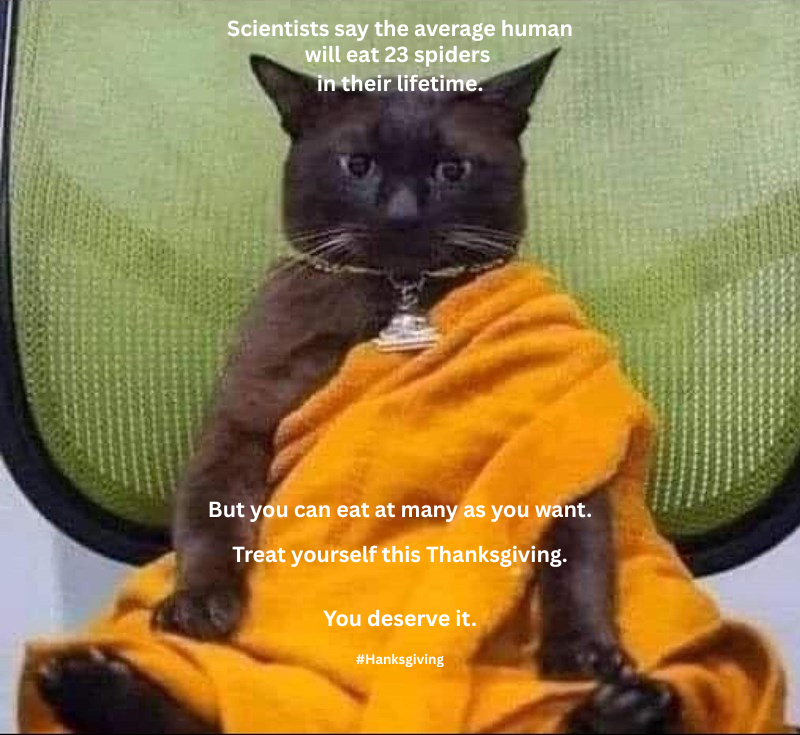
We just don't know it, because a whole bug of any kind in food is rare. Much of our problem instead is fear of the unknown. Only 2% of Americans today know anything beyond what media tell them about agriculture. Obviously, it is a big science win that we can feed the country affordably with so few people, especially compared to the 1800s when Republicans created the Department of Agriculture because over 90% of the country was involved in farming. In 2025, few people even pick apples. The closest they get to knowledge about food is a farmer's market or grocery store. Some pick apples but very few experience a cranberry bog.
But they watch TikTok videos and think those are real.
Fun fact: You can tell where someone was raised if they call it a cranberry bog or a marsh
Bogs exist because they flood the plants to cause the cranberries to rise to the surface. There are other ways to accomplish that, but it is tradition, just like rice does not need to be grown in flooded fields.(4)
Tradition does not explain why the same demographic who believes PFAS in the pizza box made them fat rather than the pizza thinks spiders are in their cranberry juice. Nature has lots of bugs but people don't obsess over them. Yet spiders have been the target of cranberry media posts for years - because they are a little larger and float during a flood just like cranberries do.
The fun science thing is people aren't seeing anywhere near as many bugs as there really are. Most just swim until they can get out of the water, which happens long before any shock media type takes a photo. Or stages one.
Why have cranberries been targeted so often? It may be because it is a native fruit. There are no stories of a cranberry version of Johnny Appleseed planting them to create an industry because they were here before humans were. When something is as foundational to American identity as cranberries are, environmentalists and people in shock media are going to target them.
I don't know how much jelly and jam I have made, but I have never found a bug. And the people who get these from me at Christmas have never complained they are too worried about spiders to enjoy it.
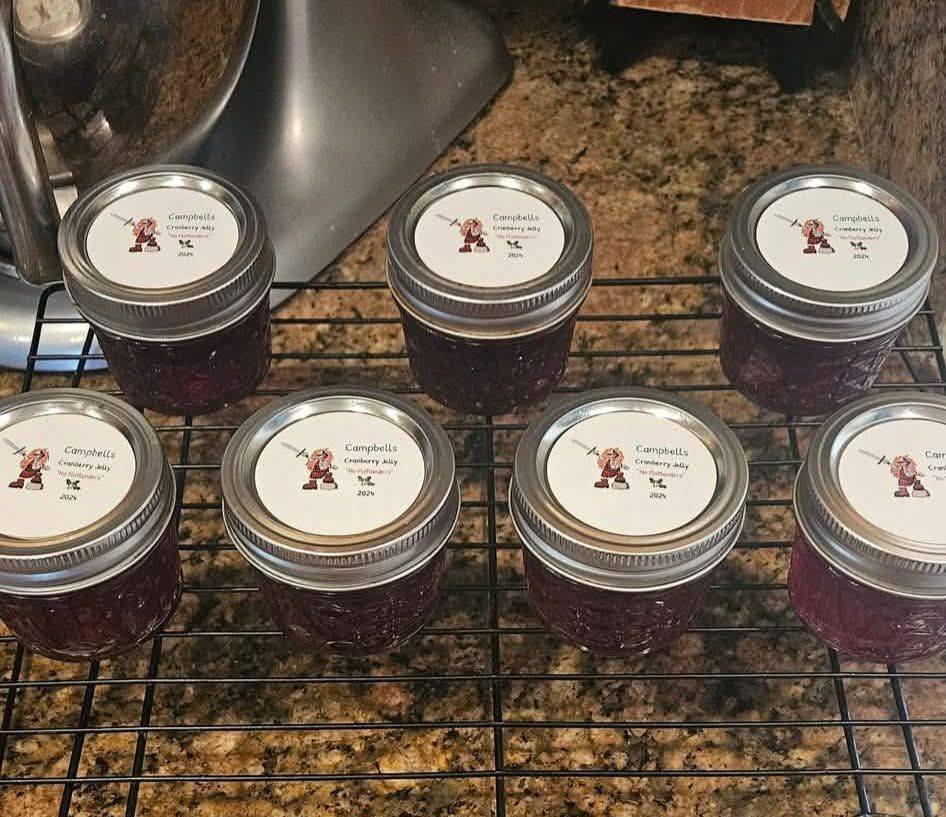
My Campbell jam for friends at Christmas last year.
NOTES:
(1) Activism is, of course, a luxury. The countries with 2,000,000,000 people using dung and wood for fuel in their homes don't spend millions of dollars promoting solar power, they instead wish the World Bank would stop mandating that they only centralized energy rich countries will give loans to provide be solar and wind. In rich countries, environmental groups rake in $3,000,000,000 per year from governments and corporations plus a fraction from individuals and foundations.
(2) And it worked. Decades ago, California outsourced all of its science to IARC in France, the only government to do so, and why the state laughably has 'may cause cancer warnings' on over 80,000 products. Lawsuits are so lucrative that they hold entire conferences in San Francisco where they teach lawyers where to find products to sue over - and to be sure to file in San Francisco, arguably America's most anti-science city in America's most anti-science state. Even the French think that is ridiculous.
(3) To epidemiologists and the environmental lawyers who will hire them as "expert witnesses" if they play ball, any dose is a poison. Paracelsus would absolutely spin in his grave.
(4) Worse, in a desert state like California, where water is scarce and therefore expensive, the government subsidizes rice paddies. Because Asia can easily produce rice cheaper and even with export it is more affordable. But that's California for you.



Comments