Why Both Stimulating And Blocking GLP-1R Helps People Lose Weight
Understanding which brain circuits respond to weight loss medications and how they behave could lead to better weight loss with fewer side effects.
Understanding which brain circuits respond to weight loss medications and how they behave could lead to better weight loss with fewer side effects.


Investigators from the Ludwig Institute for Cancer Research (LICR) and the University of California, San Diego (UCSD) have made a breakthrough in identifying functional elements in the human genome, according to a report published online today in Nature Genetics.
While the DNA sequence can identify genes (the ‘what’) within the genome, it cannot answer the more fundamental questions of ‘how,’ ‘when’ and ‘where’ gene products are expressed. However, the LICR team and collaborators have developed a novel method to identify and predict the ‘promoter’ and ‘enhancer’ regions that switch on transcription, the first step in gene expression.
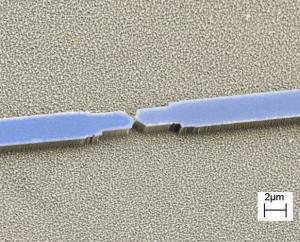
A Georgia Tech physics group has discovered how and why the electrical conductance of metal nanowires changes as their length varies. In a collaborative investigation performed by an experimental team and a theoretical physics team, the group discovered that measured fluctuations in the smallest nanowires’ conductance are caused by a pair of atoms, known as a dimer, shuttling back and forth between the bulk electrical leads. Determining the structural properties of nanowires is a big challenge facing the future construction of nanodevices and nanotechnology. The paper appears in the January 26th issue of Physical Review Letters.
Colorized scanning electron micrograph of the device showing the two electrical leads.

The transition from an ice age to an ice-free planet 300 million years ago was highly unstable, marked by dips and rises in carbon dioxide, extreme swings in climate and drastic effects on tropical vegetation.
"This is the best documented record we have of what happens to the climate system during long-term global warming following an ice age," said Isabel Montañez, professor of geology at the University of California, Davis, and lead author on the paper. But she added that these findings cannot be applied directly to current global warming trends.
In the mid-Permian, 300 million years ago, the Earth was in an ice age. Miles-thick ice sheets covered much of the southern continent, and floating pack ice likely covered the northern polar ocean.
Women who become pregnant in spring are more vulnerable to preterm birth than those who conceive in other seasons, according to researchers at the University of Pittsburgh.
Also, read Scientific Blogging columnist Seth Robert's interview with Brian Wansink here.
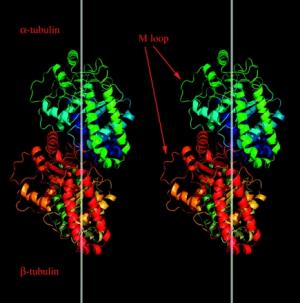
Researchers at Canada's National Institute for Nanotechnology (NINT) are learning which molecular scale factors affect the assembly and disassembly of microtubules that are part of a cell's skeleton. Microtubules control the division of all cells with a nucleus by constantly assembling at one end while they disassemble at the other.
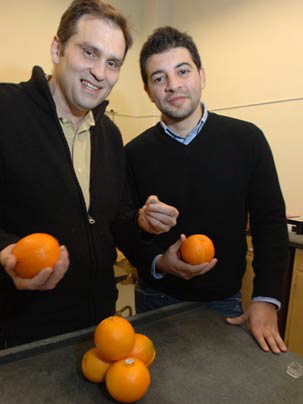
While government leaders argue about the practicality of reducing world emissions of carbon dioxide, scientists and engineers are seeking ways to make it happen.
One group of engineers at MIT decided to focus its work on the nanostructure of concrete, the world's most widely used material.

Virginia Tech researchers in computer science and biology have used the university's supercomputer, System X, to create models and algorithms that make it possible to simulate the cell cycle -- the processes leading to cell division. They have demonstrated that the new mathematical models and numerical algorithms provide powerful tools for studying the complex processes going on inside living cells.
System X. (Image courtesy of Virginia Tech)

The first major global assessment of climate change science in six years has concluded that changes in the atmosphere, the oceans and glaciers and ice caps show unequivocally that the world is warming.
The Intergovernmental Panel on Climate Change (IPCC) concludes that major advances in climate modelling and the collection and analysis of data now give scientists “very high confidence” (at least a 9 out of 10 chance of being correct) in their understanding of how human activities are causing the world to warm.
UAB (University of Alabama at Birmingham) researchers have developed a method to increase bone density in mice, a development that might have future benefit for humans in the treatment of osteoporosis and bone fracture. The research, published in the Jan. 29 issue of Proceedings of the National Academy of Sciences, involves manipulation of the Pten gene, which contributes to the process by which cells die, known as apoptosis.
"Bone density can increase either because more bone cells divide or fewer cells die due to apoptosis. Pten is a tumor suppressor gene that applies a break on the main cell survival pathway, causing cells to die," said Thomas L.
In an advance that could lead to composite materials with virtually limitless performance capabilities, a University of Wisconsin-Madison scientist has dispelled a 50-year-old theoretical notion that composite materials must be made only of "stable" individual materials to be stable overall.
Writing in the Feb. 2 issue of the journal Physical Review Letters, Engineering Physics Professor Walter Drugan proves that a composite material can be stable overall even if it contains a material having a negative stiffness, or one unstable by itself-as long as it is contained within another material that is sufficiently stable.
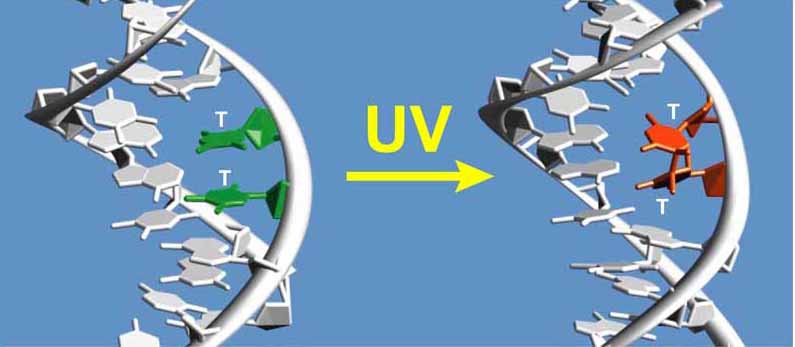
For the first time, scientists have observed DNA being damaged by ultraviolet (UV) light.
Ohio State University chemists and their colleagues in Germany used a special technique to watch strands of DNA in the laboratory sustain damage in real time.
They observed the most common chemical reaction among a family of reactions on the DNA molecule that are linked to sunburn, and discovered that this key reaction happens with astounding speed -- in less than one picosecond, or one millionth of one millionth of a second.
An undamaged stack of thymine bases is colored green in the DNA double helix on the left.