
Why Both Stimulating And Blocking GLP-1R Helps People Lose Weight
Understanding which brain circuits respond to weight loss medications and how they behave could lead to better weight loss with fewer side effects.
Understanding which brain circuits respond to weight loss medications and how they behave could lead to better weight loss with fewer side effects.


Expectant parent' desire to see images of their unborn children has given rise to commercial companies offering keepsake ultrasound scans without medical supervision, often referred to as "boutique ultrasonography."
In a special report in this week's British Medical Journal, journalist Geoff Watts considers whether this non-medical use of the technique can be justified.
Improvements in ultrasound technology have transformed antenatal scans from two dimensional black and white images to 3D, 4D and even moving pictures of the unborn child.
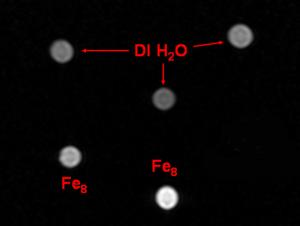
Nanoscale magnets in the form of iron-containing molecules might be used to improve the contrast between healthy and diseased tissue in magnetic resonance imaging (MRI)--as long as the concentration of nanomagnets is carefully managed--according to a new report* by researchers at the National Institute of Standards and Technology (NIST) and collaborators. Molecular nanomagnets are a new class of MRI contrast agents that may offer significant advantages, such as versatility in design, over the compounds used today.
NIST studies show that molecular nanomagnets create concentration-dependent contrast in magnetic resonance imaging (MRI).

The time is ripe for scientific organizations to adopt codes of ethics, according to a scientist and bioethicist from Wake Forest University School of Medicine in the current issue of Science and Engineering Ethics.
"Medical practice and human subject research is influenced by the Hippocratic tradition," said Nancy L. Jones, Ph.D., "but no similar code of ethics has been formalized for the life and biomedical sciences.

Carbon dioxide, a greenhouse gas that has become a bane of modern society, may have saved Earth from freezing over early in the planet's history, according to the first detailed laboratory analysis of the world's oldest sedimentary rocks.
Scientists have theorized for years that high concentrations of greenhouse gases could have helped Earth avoid global freezing in its youth by allowing the atmosphere to retain more heat than it lost.
A novel experiment conducted by Carnegie Mellon University Professor George Loewenstein and colleagues may explain why people try a drug, such as heroin, for the first time despite ample evidence that it is addictive. The results of the study, which are being published in the Journal of Health Economics, reveal that even longtime addicts underestimate the influence that drug cravings have over their behavior.
Almost all drugs produce a craving in their users. Loewenstein and his colleagues hypothesized that people experiment with drugs that they know are addictive in part because they can't appreciate the intensity of drug cravings, and thus underestimate the likelihood that they will become addicted.
A novel experiment conducted by Carnegie Mellon University Professor George Loewenstein and colleagues may explain why people try a drug, such as heroin, for the first time despite ample evidence that it is addictive. The results of the study, which are being published in the Journal of Health Economics, reveal that even longtime addicts underestimate the influence that drug cravings have over their behavior.
Almost all drugs produce a craving in their users. Loewenstein and his colleagues hypothesized that people experiment with drugs that they know are addictive in part because they can't appreciate the intensity of drug cravings, and thus underestimate the likelihood that they will become addicted.
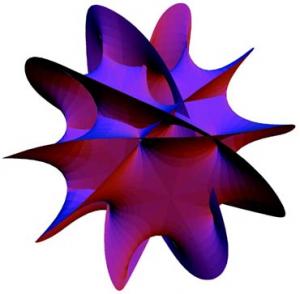
Peering backward in time to an instant after the big bang, physicists at the University of Wisconsin-Madison have devised an approach that may help unlock the hidden shapes of alternate dimensions of the universe.
A new study demonstrates that the shapes of extra dimensions can be "seen" by deciphering their influence on cosmic energy released by the violent birth of the universe 13 billion years ago. The method, published today (Feb.
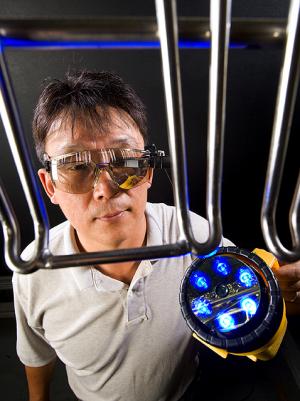
Portable inspection devices that detect food safety and quality problems are being developed by Agricultural Research Service (ARS) scientists. Recent food safety outbreaks highlight the need for "space-age" ways to prevent such problems at every step in the food production process -- from farm field to grocery store or restaurant.
Scientists led by Yud-Ren Chen at the ARS Instrumentation and Sensing Laboratory, Beltsville, Md., are designing such portable inspection devices by adapting optical technology used for remote sensing of Earth.
Prototypes include binoculars with lenses that detect fecal matter on meat, produce or processing equipment--as well as diseases or quality defects.

In releasing its latest comprehensive report, the Intergovernmental Panel on Climate Change (IPCC) focuses an important spotlight on the current state of the Earth’s climate.
Climate change is just one of the many symptoms exhibited by a planet under pressure from human activities. "Global environmental change, which includes climate change, threatens to irreversibly alter our planet," says Kevin Noone, Executive Director of the International Geosphere-Biosphere Programme (IGBP).
Polar bear on ice. (Image Credit: Dan Crosbie, courtesy of Canadian Ice Service / Environment Canada)
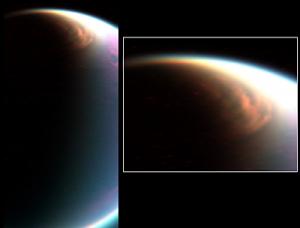
A giant cloud half the size of the United States has been imaged on Saturn’s moon Titan by the Cassini spacecraft. The cloud may be responsible for the material that fills the lakes discovered last year by Cassini's radar instrument.
Cloaked by winter's shadow, this cloud has now come into view as winter turns to spring. The cloud extends down to 60 degrees north latitude, is roughly 2400 kilometers in diameter and engulfs almost the entire north pole of Titan.
The new image was acquired on 29 December 2006, by Cassini's visual and infrared mapping spectrometer (VIMS).
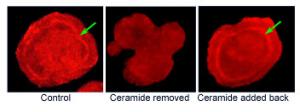
A little-known lipid plays a big role in helping us grow from a hollow sphere of stem cells into human beings, researchers have found.
They found that in the first few days of life, ceramide helps stem cells line up to form the primitive ectoderm from which embryonic tissues develop, says Dr. Erhard Bieberich, biochemist at the Medical College of Georgia.
Probably 90 percent of ceramide gathers at the top or apical end of these early stem cells, literally helping cells have direction. “We have cell polarity, an up and down, a head and foot of the cell, and that is what ceramide most likely regulates,” says Dr. Bieberich.
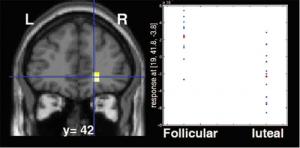
Fluctuations in sex hormone levels during women's menstrual cycles affect the responsiveness of their brains' reward circuitry, an imaging study at the National Institute of Mental Health (NIMH), a component of the National Institutes of Health (NIH), has revealed. While women were winning rewards, their circuitry was more active if they were in a menstrual phase preceding ovulation and dominated by estrogen, compared to a phase when estrogen and progesterone are present.
Brain activity in the orbitofrontal cortex (yellow), part of the brain's reward system, was increased during women's pre-ovulatory (follicular) menstrual phase compared to their-post-ovulatory (luteal) phase


