Why Both Stimulating And Blocking GLP-1R Helps People Lose Weight
Understanding which brain circuits respond to weight loss medications and how they behave could lead to better weight loss with fewer side effects.
Understanding which brain circuits respond to weight loss medications and how they behave could lead to better weight loss with fewer side effects.

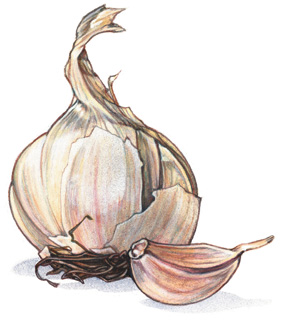
Garlic has been hailed a wonder drug for centuries and has been used to prevent gangrene, treat high blood pressure, ward off common colds and is even believed by some to have cancer-fighting properties.
Now, scientists at The University of Nottingham are leading a new pilot study to see if the pungent bulb could also hold the key to preventing cystic fibrosis patients from falling foul of a potentially-fatal infection.
The research will look at whether taking garlic capsules can disrupt the communication system of the pathogen Pseudomonas to prevent illness from taking hold.

Sometimes it is better to follow the advice of others rather than your own mind even though you seem to have things under control. Not only humans but also fish follow this doctrine as shown by ecologists Jörgen Johnsson and Fredrik Sundström of Göteborg University, Sweden, in the journal Ethology.
They allowed European minnows to learn the correct route through a maze to obtain food in the presence or absence of a predatory brown trout. Then a naïve minnow joined the group on later trials either in the presence or absence of the trout.
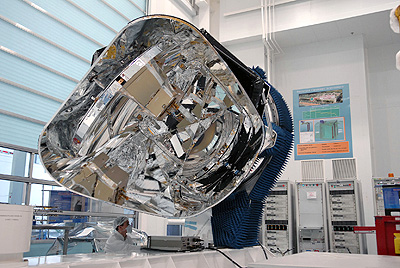
ESA’s Planck satellite, due to study relic radiation from the Big Bang, is on display for the media tomorrow in Cannes.
Credits: ESA-S. Corvaja
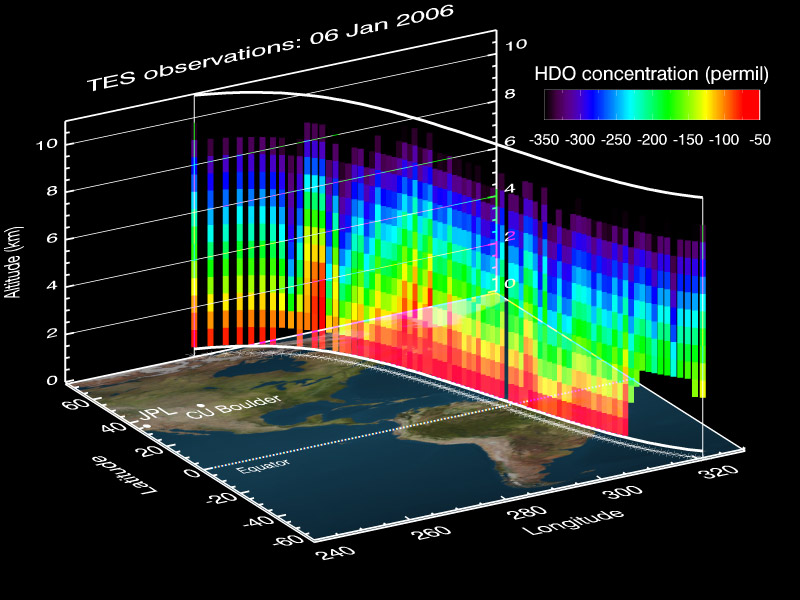
For the first time, NASA scientists have used a shrewd spaceborne detective to track the origin and movement of water vapor throughout Earth's atmosphere. This perspective is vital to improve the understanding of Earth's water cycle and its role in weather and climate.
For the first time, NASA scientists have used a shrewd spaceborne detective to track the origin and movement of water vapor throughout Earth's atmosphere. This perspective is vital to improve the understanding of Earth's water cycle and its role in weather and climate.
This view depicts the distribution of "heavy" and "light" water vapor molecules over Earth's tropics.

Immigrants in the United States require less than half the health-care services than do native-born Americans, according to study findings published in the American Journal of Public Health.
Immigrant children get even lower levels of care, receiving 84 percent less than U.S.-born children, according to researchers at Harvard and Columbia universities and the Keck School of Medicine of the University of Southern California.
During the evaluation of competitive athletes, a history or a documentation of cardiac arrhythmias has become particularly important because arrhythmias may be the initial expression of an underlying cardiac disease or of primary electrical disorders, sometimes early manifestations of potentially life-threatening events. Cardiac arrhythmias are among the most important causes of non-eligibility to sports activities, and some arrhythmogenic diseases are three times more frequent among athletes than among sedentary subjects of the same age.
Arrhythmias, in young competitive athletes and also the elite are usually "benign" or "paraphysiological" (duo to prolonged training).
Mechanical 'artificial hearts' can be used to return severely failing hearts to their normal function, potentially removing the need for heart transplantation, according to new research.
The mechanical devices, known as Left Ventricular Assist Devices (LVADs), are currently used in patients with very severe heart failure whilst they await transplantation. The new study, published in the New England Journal of Medicine, shows that using an LVAD combined with certain drug therapies can shrink the enlarged heart and enable it to function normally once the LVAD is removed.
For the study, researchers from Imperial College London and the Royal Brompton and Harefield NHS Trust gave the full combination therapy to 15 severely ill patients. Of these 15, 11 recovered.
Astronomers using the Subaru telescope in Hawaii have looked 60 million years further back in time than any other astronomers, to find the most distant known galaxy in the universe. In doing so, they are upholding Subaru's record for finding the most distant and earliest galaxies known. Their most recent discovery is of a galaxy called I0K-1 that lies so far away that astronomers are seeing it as it appeared 12.88 billion years ago.

Demand from rich Chinese for Indian tiger pelts and parts used in traditional medicine fuels poaching and may lead to the extinction of the species in the wild, conservationists have warned.
Trade of tiger pelts from India into Chinese-ruled Tibet was flourishing despite laws banning the move, a report released in New Delhi by two conservation groups said Wednesday.
The Wildlife Protection Agency and Environment Investigation Agency estimate only 1,500 to 2,000 wild Royal Bengal Tigers are left in India.
It's a mystery why the speed and complexity of evolution appear to increase with time. For example, the fossil record indicates that single-celled life first appeared about 3.5 billion years ago, and it then took about 2.5 billion more years for multi-cellular life to evolve.
For soldiers injured in combat today, the survival rate is 90 percent or higher--a significant improvement even since the Gulf War in the early 1990s, according to Col. W. Bryan Gamble, M.D., Commander of Landstuhl Regional Medical Center in Germany. Dr.
New research suggests that choosing a mate may be partially determined by your genes. A study published in Psychological Science has found a link between a set of genes involved with immune function and partner selection in humans.
Vertebrate species and humans are inclined to prefer mates who have dissimilar MHC (major histocompatibility complex) genotypes, rather than similar ones. This preference may help avoid inbreeding between partners, as well as strengthen the immune systems of their offspring through exposure to a wider variety of pathogens.
The study investigated whether MHC similarity among romantically involved couples predicted aspects of their sexual relationship.